Clutch Fork: Fault, Replacement and Maintenance Guide
Recognize the heavy commercial vehicle clutch fork (release fork), diagnose its faults, replace it step by step and extend its service life. VADEN technical guide.
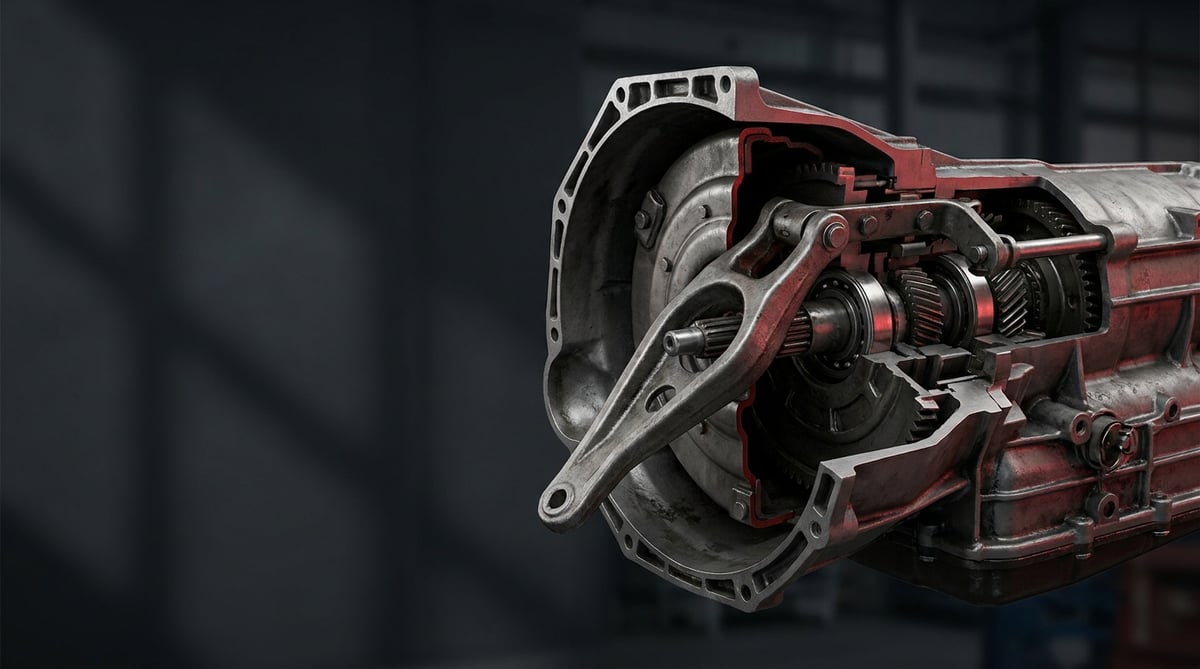
On heavy commercial vehicles, most complaints of a "sinking" pedal, "stiffness" or a metallic "rattle" when the clutch pedal is pressed actually do not start at the pressure plate friction lining, but in the mechanism that pushes it. In the field, the technician often removes the entire clutch set, when in fact the real culprit is the fork itself, the pivot seat or the ball head. This guide was prepared in the language of the workshop to help you recognize the clutch fork (release fork) on tractor units and trucks, correctly diagnose its faults, replace it by the book and extend its service life.
This document was prepared by the VADEN technical team, based on hands-on experience with heavy commercial vehicle clutch systems. The torque, dimension and clearance figures given here are typical references; for exact values always refer to the vehicle's OE service manual. Last updated: July 2026.
Component sizing is based on the relevant international standard family (ISO/EN/DIN/SAE) and the manufacturer OE specification.What Is a Clutch Fork? Its Function and Working Principle
The clutch fork (release fork) is a lever-arm transmission component that carries the motion coming from the clutch pedal, via the release bearing, to the fingers of the pressure plate, thereby disengaging the torque connection between the engine and the gearbox.
Its working principle is based on lever action. When the driver presses the clutch pedal, this movement is transmitted to one end of the fork through a hydraulic (master cylinder + release/slave cylinder) or mechanical (cable) system. The fork pivots around a support point (pivot ball / pivot) on the housing and pushes the release bearing at its other end toward the pressure plate fingers. As the bearing presses the fingers, the pressure plate releases the disc from the flywheel face and torque transmission is interrupted; the driver can then change gear. When the pedal is released, the fork returns, the bearing moves away from the pressure plate and the clutch engages again.
On heavy commercial vehicles, pedal forces are far higher than on passenger cars. For this reason the fork is designed both to withstand high bending loads and to pivot with low friction at the pivot point. Even a small amount of wear increases the dead clearance and spoils pedal feel.
- Fork body: Usually forged steel or reinforced casting; carries the swing and bending loads.
- Pivot seat: The support point around which the fork rotates; can be of the spherical-ball or pin type.
- Bearing contact fingers / fork tips: U-shaped ends that grip the release bearing.
- Retaining springs / clips: Hold the bearing in position on the fork and prevent it from falling off.
- Pivot ball (pivot pin): The wear element that screws into the pivot point and seats the fork on the housing.
The Fork Difference Between Mechanical and Hydraulic Systems
In cable-operated (mechanical) systems, the outer end of the fork is connected directly to the cable shoe and the dead clearance is set with an adjusting nut. In hydraulic systems, the push rod of the release cylinder (an external slave or a CSC/central cylinder) pushes the fork. In the central release cylinder (CSC) applications that are becoming common on some newer heavy commercial vehicles, there is no separate fork; making this distinction correctly during diagnosis prevents unnecessary part removal.
An Overview of Fork Types
Forks vary by connection type (pin, spherical ball, clamp), by material (forged/cast) and by length-to-lever ratio. Since even within the same engine family a different fork may be used depending on the gearbox type, the selection must always be made using the OE number.
| Application / System | Actuation Type | Fork Feature (general reference) |
|---|---|---|
| Heavy tractor unit / long-haul truck | Hydraulic (external slave) | Long-arm, spherical-ball-mounted forged fork |
| Construction / dump truck | Hydraulic, reinforced | Thick-section, high load-bearing body |
| City bus | Hydraulic / pneumatically assisted | Reinforced tip geometry for frequent engagement |
| Medium-duty distribution truck | Mechanical (cable) or hydraulic | Standard-length fork with adjusting nut |
The table is for guidance only. The fork must match the gearbox bell housing, the pivot point and the bearing geometry exactly. Before fitting the part, always verify the OE part number, fork length and pivot type against the vehicle identity (chassis / engine code). An incorrect lever ratio will cause the clutch not to disengage fully, even with the correct bearing.
Fault Symptoms and Diagnosis
Fork faults mostly develop gradually: first a slight noise or a change in pedal feel, then difficulty shifting gears. The table below summarizes the symptoms most frequently encountered in the field, their possible causes and verification methods.
| Symptom | Possible Cause | Check / Verification |
|---|---|---|
| Pedal sinks, clutch does not disengage | Fork cracked or dislodged from the pivot | Open the cover and watch the movement of the fork tip; check whether the bearing advances when the pedal is pressed |
| Gears shift hard, clutch does not fully disengage | Dead clearance has increased, fork tip worn | Measure pedal free travel; check the adjusting nut / push-rod length |
| Metallic squeal / grinding when pressing the clutch | Dry pivot ball, unlubricated pivot | Listen at the pivot point; move the fork by hand to confirm the friction noise |
| Pedal has become heavy, sluggish to return | Corrosion/wear at the pivot, fork bent | Test the fork's swing freedom by hand; look for bending/cracks in the body |
| Clutch partially disengages, vehicle creeps forward | Fork tip rounded, lever ratio distorted | Inspect the contact surface of the fork tips for pitting/polishing |
| Vibration / play sensation at the pedal | Retaining spring/clip broken, bearing moving on the fork | Check the seating of the bearing on the fork and the integrity of the clips |
| Occasionally fails to shift (intermittent fault) | Fork sticks at the pivot and does not return | Press and release the pedal several times to test repeatability; check pivot lubrication |
Diagnosis by Sound: Telling Where It Comes From
A noise that increases when the clutch is pressed generally points to the release bearing or the fork pivot; a noise heard while the pedal is at rest originates from the pilot bearing or the pressure plate. Fork-related noises mostly come from dry friction at the pivot point and change in sync with pedal movement.
Dead Clearance (Free Travel) Check
Pedal free travel exceeding the normal value is the earliest sign that the fork tip or the bearing contact surface has worn. Free travel reflects the clearance the fork covers before it loads the bearing; if it has moved outside the range specified in the manual, adjustment is tried first, and if the adjustment does not hold, wear is present.
Visual and Hand Inspection
When the fork is removed, the contact surfaces at the tips, the pivot seat and the body should be inspected visually. Polished/pitted tips, a rounded pivot seat or a hairline crack in the body require replacement of the part. Suspicious cracks can be confirmed with penetrant (dye penetrant) inspection.
Replacement / Installation Steps
Personal Protective Equipment and Safety: Wear work gloves and safety goggles. Secure the vehicle on level ground with the parking brake applied and the wheels chocked, on an axle stand/lift of adequate capacity. The gearbox is heavy; always work with a transmission jack or suitable support. Wait for the engine and exhaust to cool. Make sure the pressure in the hydraulic system has been released.
- Prepare the vehicle: Disconnect the negative battery terminal; mark and remove the propeller/drive shaft, the gear linkage connection, the sensor connectors and the hydraulic line.
- Support the gearbox: Position and secure the transmission jack, loosen the housing bolts progressively and lower the gearbox by drawing it straight back along its axis.
- Inspect the existing layout: When the bell housing is opened, observe the fork, the bearing and the pivot ball in place; note the direction of wear and the contact marks (as a reference for the correct seating of the new part).
- Remove the bearing and clips: Separate the release bearing from the fork and remove the retaining springs/clips. If the bearing is also to be renewed, replace it at the same time.
- Remove the old fork: Release the fork from the pivot ball; if the spherical ball is worn, renew it too (replacing it together with the fork is recommended).
- Clean the seat and contact surfaces: Clean the pivot seat, the body contact area and the bearing slide surface of old grease and dirt.
- Verify the new fork: Place the new VADEN fork side by side with the old part; make sure the length, tip geometry and pivot type match exactly.
- Apply lubrication: Apply a thin film of the manufacturer's recommended high-temperature grease to the pivot ball and the bearing contact fingers (avoid excess grease).
- Fit the fork and bearing: Seat the fork on the pivot, fit the retaining springs/clips securely, slide the bearing onto the fork and fix it with the clips. Move it by hand to confirm free swing.
- Refit the gearbox: Align the input shaft with the disc hub and slide the gearbox home without forcing; tighten the bolts in a cross pattern, progressively and to the torque value.
- Adjustment and testing: Bleed the hydraulic system, or set the dead clearance with the adjusting nut on a mechanical system. With the engine running, try all the gears and check the engagement-disengagement point.
Points to Watch (Common Mistakes)
Replacing only the fork may not be enough. When the fork wears, the release bearing and pivot ball it contacts have usually worn too. Renewing only the fork and leaving the old bearing leads to a return of the same fault in a short time. While the clutch bell housing is already open, evaluate these parts together.
Grease choice and quantity are critical. The wrong (low-temperature-resistant) grease flows at bell-housing temperature and contaminates the disc and the friction lining; it causes the clutch to slip. Excess grease also flings off and produces the same result. Always apply an OE-approved high-temperature grease as a thin film.
- Fitting a part with a different fork length/lever ratio just because it "looks similar" — causes the clutch not to disengage fully.
- Leaving the retaining clips/springs old and loose — leads to the bearing moving on the fork and to vibration.
- Tightening the gearbox bolts in one go and in a random order — creates axial misalignment and premature wear.
- Skipping the dead clearance adjustment — risks both incomplete disengagement and the bearing constantly touching the pressure plate and burning out early.
- Fitting the pivot ball without lubricating it — means dry friction, squealing and rapid wear.
- Delivering the vehicle without a road test after assembly — the engagement point and gear shifts must be tried.
Technical Values and Check Points
The following values are typical/general references for heavy commercial vehicle clutch systems. Exact values vary with the vehicle, gearbox and system type; the OE service manual is always the authority.
| Parameter | Typical Reference Range | Note |
|---|---|---|
| Pedal free (dead) travel | Approximately 5–30 mm (depending on the system) | Manual value governs; exceeding it is a sign of wear/adjustment |
| Bearing advance (release) stroke | General reference; specified in the manual | Varies with the pressure-plate finger travel |
| Pivot / tip surface wear clearance | Wear limit defined in the manual | If the limit is exceeded, the fork is renewed |
| Operating temperature (peak inside bell housing) | Can generally reach ~200–300 °C | The grease must withstand this temperature |
| Grease type | High-temperature, OE-approved | Thin film; do not overdo it |
Torque values for the gearbox and surrounding connection bolts are also critical check points. The following table is only intended to give an idea of magnitude:
| Connection | Typical Torque Range (general reference) | Note |
|---|---|---|
| Gearbox-to-engine housing bolts | Approximately 40–90 Nm (by diameter/class) | Tighten crosswise and progressively |
| Release cylinder / mount bolts | Approximately 20–45 Nm | Manual value governs |
| Pivot spherical ball | Defined in the manual | To the specified value, without over-tightening |
Torque values vary considerably with bolt diameter, class and manufacturer. Read the tables not as a "target" but as an "expected magnitude", and apply the actual value taken from the OE manual with a calibrated torque wrench.
- Verify that the pedal free travel and the engagement point are within the manual's range.
- Check by hand that the fork swings freely at the pivot, with no sticking/binding.
- Inspect the bearing contact fingers and tips for pitting/polishing.
- Confirm that the retaining clips and springs are seated securely.
- See that the pedal is firm and consistent after bleeding the hydraulic system.
Maintenance and Service Life
When correctly fitted and lubricated, the clutch fork generally works within the same service-life window as the clutch set (disc-pressure plate-bearing). The biggest factor determining its life is the operating conditions and the lubrication state of the pivot point. On vehicles that stop-and-go frequently in the city and run under heavy loads, wear is faster.
- At every clutch service/replacement, inspect the fork's pivot and tips and evaluate them together with the bearing.
- When you notice a change in pedal feel (heaviness, play, sticking), have it checked early.
- Lubricate the pivot ball with OE-approved high-temperature grease; avoid running it dry.
- Make it standard practice to renew the fork and pivot ball as well when the clutch set is replaced.
- Check the dead clearance adjustment periodically; if the adjustment does not hold, investigate wear.
In short, the fork is a cheap part on its own but its job is critical. Replacing it in time protects the clutch set, the bearing and the input shaft bearing, heading off much more expensive faults.
The VADEN ORIGINAL clutch fork product family is manufactured with materials and geometry that withstand the high pedal forces and bell-housing temperatures of heavy commercial vehicles; with correct matching via the OE number, it preserves the smooth engagement and disengagement performance of your clutch system with a long service life.
Related categories: Release Fork · Repair Kit · Complete · Housing · Shaft · Pivot Pin
Related technical guides: Clutch Central Unit (Lower/Upper Servo): Faults & Replacement · Clutch Hose Failure, Replacement and Maintenance Guide · Hydraulic Clutch Pedal Unit: Fault Diagnosis, Replacement, Maintenance · Clutch Release Bearing: Fault, Replacement and Care Guide
Application and compatibility: Vehicle compatibility catalogue · Engine compatibility catalogue
Tags
Frequently Asked Questions
- Will the vehicle move if the clutch fork breaks?
- If the fork breaks completely or comes off the pivot, pressing the pedal cannot disengage the clutch; gear shifting becomes very hard or impossible. In this situation the vehicle should be safely towed and the journey should not be continued.
- Is replacing only the fork enough, or should I renew the clutch set too?
- If the fork has failed early it can be replaced on its own; however, while the bell housing is open, it is recommended to also check the release bearing and the pivot ball and renew them if necessary. If the disc and pressure plate have reached a certain mileage, evaluating them all together saves on labour.
- Is the squeal when pressing the clutch coming from the fork?
- Most of the time, yes — a dry pivot ball produces a squeal in sync with pedal movement. However, a similar noise can also come from the release bearing. For a definite distinction, the bell housing must be opened and the contact points inspected.
- How long does a clutch fork last?
- It has no fixed service life; it depends on operating conditions and lubrication. When correctly fitted and lubricated, it is generally assessed within the same service interval as the clutch set. Heavy city use accelerates wear.
- What happens if the wrong fork is fitted?
- A fork with a different lever ratio or length causes the clutch not to disengage fully, difficulty shifting and premature burning of the bearing, even with the correct bearing. The selection must always be made using the OE part number.
- Which grease should be applied to the fork pivot?
- A high-temperature-resistant, OE-approved special clutch/pivot grease should be used. Ordinary grease can flow at bell-housing temperature, contaminate the friction lining and cause the clutch to slip. A thin film is sufficient.
- If the pedal has become heavy, is the fork to blame?
- It may be. Corrosion/wear at the pivot or a bent fork makes the pedal harder to return. However, the pressure-plate spring, the hydraulic system and the cable also affect pedal weight; diagnosis should be made across the whole system.
- What should I do if the gears still shift hard after replacement?
- First check the dead clearance adjustment and whether any air remains in the hydraulic system. If the adjustment is correct, the problem may originate from the disc, the pressure plate or the input shaft bearing; the system should be reassessed as a whole.
Related Articles
Chassis Mounting Bracket: Failure, Replacement & Care Guide
Chassis mounting bracket guide for trucks and trailers: fatigue cracks, diagnosis, step-by-step replacement, bolt torque values and maintenance tips.

Oil Spray Jet: Faults, Replacement and Maintenance Guide
Engine oil spray jet guide for trucks: how piston cooling nozzles work, clogging and low oil pressure symptoms, diagnosis, replacement steps and torque values.
Turbo Intake & Exhaust Inlet Pipe: Faults and Replacement
Turbo intake and exhaust inlet pipe faults on trucks: leak symptoms, diagnosis, step-by-step replacement, torque values and maintenance tips from VADEN.


