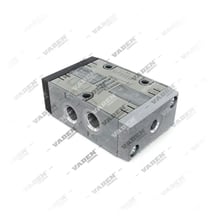
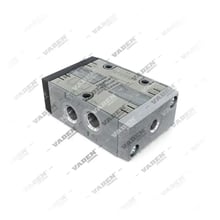
What Is a Connection Components Multi-Way Valve?
The Connection Components Multi-Way Valve is a multi-port valve used in the heavy commercial vehicle air brake system that routes, opens, closes or separates several air lines from a single body. The coupling head is a simple quick-connect fitting and the manifold block is a passive distribution body, while the multi-way valve is the only connection component with a moving internal mechanism that can actively change the direction of airflow.
How Does It Work?
A moving piston, spool or diaphragm inside the valve body routes pressurised air from the inlet port to the relevant outlet according to a command signal or mechanical position, keeping unused lines closed to prevent pressure loss. Some types change position with a manual lever, others automatically through a pilot air signal. A single multi-port body concentrates routing that would otherwise need separate valves, reducing both line count and potential leak points.
What Are the Functions of a Connection Components Multi-Way Valve?
- Line routing: Directs pressurised air between several air lines to the required outlet as needed.
- Circuit isolation: Separates an unused or faulty circuit from the rest of the system, preventing a leak from spreading.
- Pressure distribution: Distributes air from a single supply line evenly across several outlets.
- Priority circuit management: Ensures a priority circuit, such as the service brake, is always supplied, cutting off secondary circuits when needed.
- Simplified installation: Concentrates connection points in one body instead of several separate valves, reducing installation complexity.
What Are the Symptoms of a Connection Components Multi-Way Valve Failure?
- Continuous air leak from the body: A hissing sound at the valve or its connections indicates worn internal seals or seating surfaces.
- Pressure drop: Low or slowly recovering pressure in one or more outlet lines.
- Stiff lever: On manual types, the lever becomes stiff or fails to change position.
- Delayed response: On automatic types, the valve responds late or not at all to the pilot signal.
- Body damage: Cracks, corrosion or loosening at the connection points.
- Cross effect: Pressure fluctuation also affecting an unrelated circuit.
Technical Specifications
Brake System Connection Components Multi-Way Valve specifications| Specification | Description |
|---|
| Operating pressure range | Typically 6-8.5 bar in heavy commercial vehicle air brake systems; the vehicle manufacturer's current service manual is authoritative for exact values |
| Number of ports | 3 to 6 inlet/outlet ports depending on application |
| Body material | Cast/forged steel or aluminium alloy with a corrosion-resistant surface coating |
| Connection type | Threaded fittings or quick-connect (push-in) ends |
| Sealing element | Temperature and pressure resistant synthetic rubber O-ring/gasket |
| Operating temperature | Approximately -40°C to +80°C, depending on application |
Replacement and Maintenance
- Correct OE number: Port count, size and connection standard must match the vehicle's original valve exactly.
- Line marking: Mark each line's inlet/outlet position before removal to avoid confusion during installation.
- Tightening torque: Fitting connections must be tightened to the value specified by the manufacturer; the vehicle's current OE service manual is authoritative for exact values.
- Function test: After installation, pressurise the system and check every outlet for leaks and correct routing.
- Filtration check: Confirm the dryer/filter element on the supply line is working properly; contaminated air wears the valve mechanism quickly.
Choosing the Right Valve
Selection should be based on the OE number rather than the brand, matching the port count, size and connection standard specified by the vehicle manufacturer. The coupling head suits simple line connection and the manifold block suits passive distribution, while the multi-way valve suits circuits needing active routing or isolation. Record the OE code and port dimensions of the removed valve before replacement.
VADEN Connection Components Multi-Way Valve
VADEN offers multi-way valves in the brake system connection components group built to OE size and connection standards, manufactured to original tolerance values for sealing and long service life.
Frequently Asked Questions (FAQ)
What is the difference between a multi-way valve and a manifold block?
A manifold block distributes air to several outlets in a fixed, passive way and has no moving parts. A multi-way valve has a moving internal mechanism that can actively route, open and close airflow.
Can a multi-way valve be confused with a coupling head?
No. A coupling head is a simple connector that provides a quick, manual connection between the tractor and trailer and has no valve function. A multi-way valve is an active component mounted on the vehicle that directs airflow.
Does a valve failure affect the entire brake system?
The priority circuit design generally protects the service brake, but secondary circuits may lose pressure or route incorrectly. Have the vehicle checked at an authorised service in case of doubt.
Is special equipment needed for replacement?
Basic hand tools are usually sufficient, but the vehicle's current OE service procedure should be followed for correct tightening torque and a post-installation leak/routing test.
When should the valve be replaced immediately?
Replace it without delay if there is a continuous air leak, delayed or absent position change, or cracks or corrosion on the body; these symptoms can directly affect brake safety.
Vehicle and engine pages that list parts from this category: Iveco Trakker I
Related technical guide: Foot Brake Valve: Faults, Replacement & Maintenance Guide