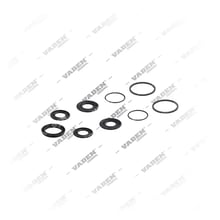
What Is an Air Line Fitting Repair Kit?
An air line fitting repair kit is a service set combining the small parts needed to restore the seal at a connection point in a heavy-duty vehicle's air brake line. Compressed air travels without loss thanks to a sound O-ring, gasket, coupling, and clamp. Heat, vibration, moisture, and the wear of repeated disassembly gradually stop these elements from doing their job. Rather than replacing the whole connection assembly, the kit gets the vehicle back on the road quickly by renewing only the worn parts.
What Does the Repair Kit Contain?
- O-ring and gasket set: Provides the actual seal; a single-use part that must be renewed at every disassembly.
- Coupling and compression nut: Locks the tube end into the body; replaced when the thread is crushed or the tube end goes oval.
- Clamp and mounting elements: Hold the line firmly on the chassis; a loose clamp passes vibration into the connection and causes a leak.
- Connection pin and clip: Stops the tube pulling back out of a push-fit connection; a clip with a fatigued spring can let the line go.
- Blanking plug and bushing: Seals off an unused outlet and supports the tube end against ovaling.
Repair Kit Technical Specifications
| Specification | Description |
|---|
| Product Group | Air Line Fitting Repair Kit (Brake System) |
| Kit Contents | O-ring and gasket set, coupling, clamp, connection pin, clip |
| Sealing Element | Heat-, moisture-, and oil-resistant elastomer gasket and O-ring |
| Connection Types | Push-fit, coupling, and flanged air line connections |
| Application | Truck, tractor unit, bus, and trailer air brake lines |
What Gets Renewed When There Is an Air Leak?
The compressor cutting in more often than usual, a hissing sound heard while stationary, and a pressure drop while parked are the first signs of a connection leak. The fitting body is usually sound; the problem lies in the sealing and retaining elements.
- All hardened, cracked, or crushed O-rings and gaskets are renewed.
- Fatigued clips, cracked clamps, and coupling nuts with stripped threads are replaced.
- A tube end that has gone oval or has a poor cut is trimmed true; otherwise the line is shortened and reconnected.
- A new gasket is never fitted until old residue, rust, and dirt are cleaned off the sealing surface.
Leak Detection Method and the Points That Leak Most Often
Detection is done once the system is at full pressure and the engine is off. Soapy water is applied to the connections; the point where bubbles form is the source. In tight spaces, an electronic listening device helps. Secure the parking brake and wheel chocks, and never loosen a connection while the system is under pressure.
- Compressor outlet and dryer inlet: The zone with the greatest temperature swing, where gaskets harden fastest.
- Four-circuit protection valve outlets: Many connections cluster here and share the vibration load.
- Bellows and valve inlets: Retaining elements fatigue early in this moving-axle area.
- Trailer gladhand coupling heads: The gasket wears fastest here due to frequent connecting and disconnecting.
- Chassis pass-throughs: A line with a loosened clamp rubs thin, and a leak develops at its end.
Correct Tightening and the Damage Caused by Over-Tightening
A proper seal comes from correct seating, not brute force. Over-tightening permanently crushes the O-ring, strips the thread in an aluminum body, cracks the coupling, and pinches the tube end, narrowing the air passage. Under-tightening works loose under vibration and lets the leak return.
- Tighten with a correctly sized wrench, without forcing it; the gasket surface must be clean.
- Torque values vary by vehicle and fitting type; the vehicle's OE service manual is the reference.
- A connection that has already leaked is repaired by renewing its elements, not by tightening it further.
Choosing a Kit by Line Diameter and Connection Type
Air lines combine tubes of different outer diameters with distinct connection standards; visual resemblance alone is not enough.
- Connection type: Gasket and locking elements of push-fit, coupling, and flanged connections are not interchangeable.
- Tube outer diameter: Measure the removed tube and compare it with the O-ring size in the kit.
- Thread size and form: The thread pitch on the body determines how the coupling seats.
- Verification: Exact fitment should be checked against the vehicle model and OE part number.
Pressure Retention Check After Replacement
The repair counts as complete only once the leak is proven to have stopped. The system is charged to the working pressure the manufacturer specifies, the engine is switched off, and the pressure drop is watched on the gauge. The check is repeated with the parking brake released and applied, and with the trailer coupled.
- Fill time is monitored; a longer fill points to a hidden leak.
- The acceptable pressure-drop limit varies by vehicle type; assessment follows the OE service manual.
- After a short road test, the connections are re-checked for vibration-induced loosening.
Conclusion
A large share of the pressure loss in air brake systems comes not from the fitting itself but from worn connection elements. Renewing the O-ring, gasket, coupling, clamp, and clip together with a correctly chosen kit eliminates the leak for good and makes a full parts replacement unnecessary. Controlled tightening, a clean mounting surface, and a post-repair pressure check determine how lasting the repair is. VADEN ORIGINAL offers repair kit solutions built to OEM standards for heavy-duty vehicle brake systems.
Frequently Asked Questions (FAQ)
What is an air line fitting repair kit for?
The repair kit brings together the O-ring, gasket, coupling, clamp, and clip needed to restore the seal at connection points in a heavy-duty vehicle's air brake line. This means only the worn small parts are renewed, instead of replacing the entire leaking connection assembly.
How can I tell there is an air leak?
The compressor cutting in more often than normal, a hissing-like sound heard while the vehicle is stationary, and a pressure drop while parked are the typical signs. To find the leak, soapy water is applied to the connections while the system is at full pressure; the point where bubbles form is the source of the leak.
Which connection points leak most often?
The compressor outlet and dryer inlet, the four-circuit protection valve outlets, the brake chamber and valve inlets, trailer gladhand coupling heads, and chassis pass-throughs with loosened clamps are the areas that leak most often. These points fatigue faster due to high temperature swings, vibration, or frequent connecting and disconnecting.
How tight should a connection be?
A proper seal comes from correct seating, not excessive force. Over-tightening permanently crushes the O-ring, can strip the thread, and narrows the tube end; under-tightening works loose under vibration and lets the leak return. Since the correct torque varies by vehicle and fitting type, the instructions in the vehicle's OE service manual should be followed.
How do I choose the right repair kit?
The choice depends on the connection type (push-fit, coupling, or flanged), the tube's outer diameter, and the thread size on the body. Visual resemblance is not enough; the removed part should be measured, and exact fitment should be verified against the vehicle model and OE part number.