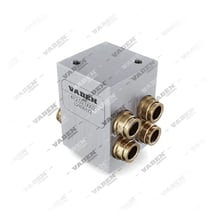
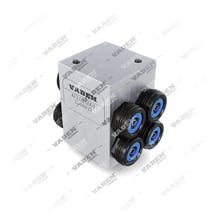
What are the functions of the Connection Components Manifold Block?
The functions of the manifold block within the system can be summarized as follows.
- Distribution: Routes a single compressed air inlet to multiple outlets, reducing the need for separate piping runs.
- Merging: Safely combines air coming from different lines at a common point, for example in a dual-circuit brake system.
- Sealing: Prevents air leakage even under high pressure through gasket seats and O-ring grooves.
- Mechanical robustness: Protects connection points against vibration and road shocks, reducing tension on hoses and pipes.
- Ease of maintenance: Its single-point removable structure shortens service time.
What are the symptoms of a Connection Components Manifold Block failure?
Failures in the manifold block generally appear as pressure loss and air leakage.
- Audible air leak: Hissing air escaping from the block body or connection ports.
- Pressure drop: System pressure on the gauge rising more slowly than normal or staying low.
- Delayed brake response: Softened pedal feel or delayed brake engagement.
- Crack or deformation in the body: Visible cracks in the cast body, excessive corrosion, or worn thread seats.
- Continuous compressor operation: The compressor cycling more often than normal due to the leak.
How is the Connection Components Manifold Block checked?
Before inspection, the system must be fully depressurized or at a safe test pressure.
- Visual inspection: Checking the body for cracks, corrosion, thread damage and deformation at gasket seats.
- Soapy water test: Applying soapy water to connection points while the system is under pressure and watching for bubble formation.
- Pressure hold test: Measuring the pressure drop over a set period after the compressor stops to evaluate the leak level.
- Tightening torque check: Verifying the connection fasteners are torqued to the manufacturer's specified value.
- Bracket and fixing check: Physically checking for loosening caused by vibration.
What should be considered when replacing it?
Correct part selection and assembly sequence are critical when replacing the manifold block.
- Pressure release: All pressure in the system must be safely released before starting replacement.
- Correct port count and thread: The new part's inlet/outlet count and thread type must exactly match the original application.
- Gasket and O-ring renewal: All removed connection gaskets must be replaced with new ones; the old gasket should never be reused.
- Torque compliance: Overtightening can crack the body, undertightening causes leakage; the manufacturer's torque value must be followed.
- Post-assembly test: After replacement, the system must be pressurized again and the leak check repeated.
How is the Connection Components Manifold Block selected?
Selecting the right manifold block requires evaluating vehicle model, port configuration and material quality together.
Manifold block selection criteria| Criterion | Description |
|---|
| Port count and orientation | Inlet/outlet count and angle matching the vehicle chassis layout |
| Material | Cast aluminum or steel, corrosion resistance |
| Working pressure | Compatibility with the vehicle's nominal air brake pressure range |
| Connection thread type | Exact match with the original equipment thread standard |
| Gasket compatibility | Compatibility with standard O-ring/gasket dimensions |
Maintenance and service life
Because the manifold block has no moving parts, its service life is generally long; however, the gaskets and O-rings at connection points can harden over time and lose their sealing ability. Periodic maintenance should include visual inspection of the body and connection points, regular soapy water tests, and torque checks. On vehicles exposed to heavy vibration, bracket fixing should also be checked. Keeping the body surface clean and protected from moisture extends its service life.
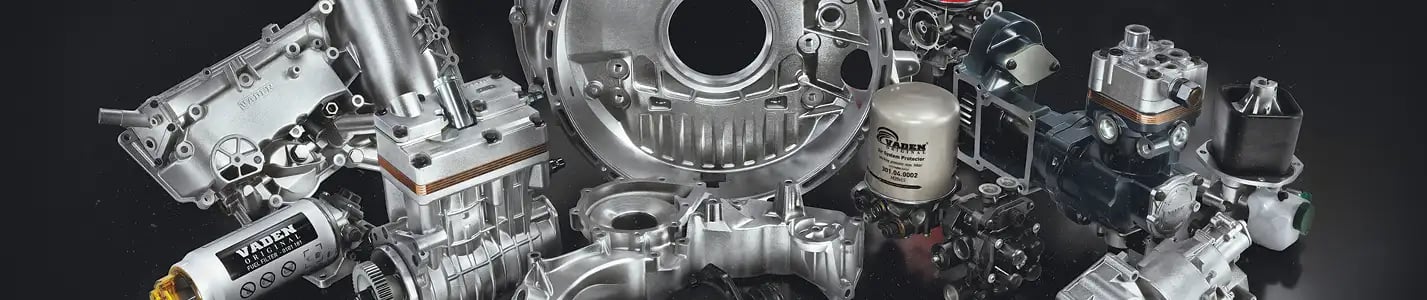
VADEN Connection Components Manifold Block
VADEN offers manifold blocks manufactured for heavy commercial vehicle air brake systems, matching original equipment dimensions and torque tolerances. With correct port configuration and material quality, it provides a solution that supports system reliability.
Frequently Asked Questions (FAQ)
What is the difference between a manifold block and an air tank?
An air tank stores compressed air, while a manifold block is a connection part that distributes or merges that air across different lines; it does not perform a storage function itself.
Can a small leak in the manifold block affect braking performance?
Yes, a continuous leak can delay the system reaching target pressure, cause the compressor to cycle more frequently, and lead to delayed brake response over time.
Does the manifold block need to be replaced at every brake service?
No, since it has no moving parts it does not require routine replacement; replacement is recommended only when visible damage, cracking or a persistent leak is detected.
Can a manifold block with a different port count be installed?
It is not recommended; port count and configuration must match the vehicle's original line layout, otherwise additional adapters may be needed and sealing risk increases.
If no bubbles appear during the soapy water test, is the part sound?
No visible bubbles is a good sign, but final confirmation should be supported with a pressure hold test and periodic torque checks.
Related technical guide: Foot Brake Valve: Faults, Replacement & Maintenance Guide