DPF (Diesel Particulate Filter) Guide: Symptoms & Cleaning
Learn what a DPF is, how passive and active regeneration work, warning signs of clogging, and safe cleaning methods for heavy commercial diesel trucks.
A truck running city distribution routes moves in short stop-start bursts all day; the engine never gets the chance to warm up or run at sustained high revs. After a few weeks, an orange DPF warning light comes on the dashboard, and the vehicle then loses power and drops into a speed-limited protection mode. The driver's first guess is usually a fuel problem, but the real issue is a clogged diesel particulate filter in the exhaust line. This guide covers the DPF system on heavy commercial vehicles from end to end — how it captures soot, how regeneration works, the warning signs of clogging, the effect of short-distance driving, and cleaning methods along with their limits.
What Is a DPF? Function and Working Principle
Diesel particulate filter (DPF) is an emission control component located in the exhaust line of diesel-powered heavy commercial vehicles that physically captures soot and particulate matter from the exhaust gas in a porous ceramic honeycomb structure. As the filter fills, it is cleaned through regeneration, a process that periodically burns off the accumulated soot at high temperature, cutting particulate matter emissions by more than ninety-nine percent by weight.
The DPF is positioned in the exhaust line immediately after the diesel oxidation catalyst (DOC) and contains thousands of honeycomb-shaped channels with alternately plugged ends inside its housing. Exhaust gas enters one channel, passes through the porous wall, and exits through the neighboring channel; this "wall-flow" structure lets soot particles be physically filtered out of the gas stream. The filter body is usually made from cordierite ceramic or silicon carbide; silicon carbide keeps the temperature distribution more even during regeneration thanks to its higher thermal conductivity.
The pressure differential across the filter is the most direct signal of how full the DPF is. A differential pressure sensor placed at the filter's inlet and outlet continuously measures the resistance the exhaust gas encounters as it passes through the filter; this resistance rises as soot accumulates. The engine control unit combines the pressure sensor data with engine speed, exhaust temperature, and distance traveled to estimate the soot load inside the filter through a model — in the field this estimate is called the "soot model."
How does a DPF trap soot?
A DPF works by forcing the gas flow through the channel walls; soot particles are too large to pass through the wall pores, so they build up on the channel's inner surface and inside the pores. Capture efficiency exceeds ninety-nine percent by weight and covers even the finest nanometer-sized particles. As soot builds up, the resistance the filter presents to the exhaust gas rises; once this resistance crosses a threshold, the engine control unit initiates a regeneration request.
What is the difference between a DPF and a DOC (diesel oxidation catalyst)?
The DOC is a catalyst that chemically oxidizes carbon monoxide and unburned hydrocarbons in the exhaust gas and does not trap solid particles; it is usually positioned ahead of the DPF. The DPF, by contrast, is a physical filter that traps solid particles such as soot on its porous wall. In practice the two components work together: the DOC oxidizes NO in the exhaust gas into NO2, feeding passive regeneration, while the DPF uses that NO2 to burn off soot at lower temperature. What a vehicle owner describes as a "catalytic converter fault" is, in the field, most often the DPF itself rather than the DOC.
What Is the Difference Between Passive and Active Regeneration?
Regeneration is the process by which the DPF cleans itself by burning off the soot accumulated inside it, and it happens through two different mechanisms: passive and active. Depending on the vehicle's usage profile, the two mechanisms complement each other; under constant urban driving, passive regeneration cannot reach a sufficient temperature, so active regeneration kicks in more often.
Passive regeneration is a continuous background process the driver does not notice. When exhaust temperature rises naturally at highway speed and under load, the NO2 produced by the DOC can burn off the soot in the DPF even at that temperature, with no need for extra fuel injection or engine control unit intervention. Vehicles that run long highway routes have their DPF request active regeneration almost never.
Active regeneration is a process the engine control unit initiates on its own once it detects that the soot load has crossed a set threshold. The control unit applies an extra post-injection to the cylinders, or delivers fuel through a fuel injector/heater in the exhaust line, to trigger an exothermic reaction on the DOC; this reaction raises exhaust temperature markedly and burns the soot directly with oxygen. Active regeneration usually takes twenty to forty minutes and completes most efficiently while the vehicle travels at a steady speed; frequent stop-and-go driving interrupts regeneration partway through.
| Regeneration type | How it is triggered | Typical exhaust temperature | Does the driver notice? |
|---|---|---|---|
| Passive regeneration | Naturally, at highway speed and under load | Approximately 300-400°C | No, it runs continuously in the background |
| Active regeneration | Engine control unit starts it automatically once the soot threshold is crossed | Approximately 550-650°C | Partly — fan noise, a temporary rise in fuel consumption |
| Forced (service) regeneration | Started manually by a technician using a diagnostic tool | Approximately 600-650°C, with the vehicle stationary | Yes — vehicle parked, loud high-idle sound |
When Is Forced (Service) Regeneration Applied?
If active regeneration is interrupted several times in a row, or the soot load reaches a level that cannot be safely cleared by active regeneration alone, the engine control unit switches to power limitation and raises a warning that driver action cannot resolve. At this point the vehicle is parked in an open area and forced regeneration is started with a diagnostic tool; during the process the engine runs at high idle, exhaust temperature is raised in a controlled way, and the soot is burned off. Forced regeneration does not help if the filter is physically overloaded or blocked with ash; in that case the filter needs to be removed for cleaning or replacement.
How Can You Tell a DPF Is Clogged? Symptoms and Causes
DPF clogging is a gradual process that directly affects the vehicle's performance. The first symptoms usually start with the warning light on the dashboard; if ignored, power loss, increased fuel consumption, and eventually a switch to protection mode follow. The table below summarizes the symptoms commonly seen in the field, their likely causes, and how to check them.
| Symptom | Likely cause | Check / verification |
|---|---|---|
| DPF warning light stays on continuously | Soot load has crossed the threshold and regeneration cannot complete | Read the soot load percentage and regeneration history with a diagnostic tool |
| Engine power limitation (limp mode) engages | Pressure ahead of the filter has exceeded the limit and the ECU has entered protection mode | Check the differential pressure sensor reading and the fault code |
| Active regeneration starts often but does not complete | Constant short-distance/urban driving, exhaust temperature cannot reach target | Review the driving profile, run the vehicle at full-load highway speed |
| Fuel consumption has risen noticeably | Extra fuel injection has increased due to frequent active regeneration | Review regeneration frequency logs, assess the soot accumulation rate |
| Engine oil level rises unexpectedly | Unburned fuel from interrupted active regenerations has collected in the sump (oil dilution) | Check oil level and smell, have an oil analysis done |
| White or bluish smoke from the exhaust | Oil dilution has advanced and oil may be entering the combustion chamber | Check oil level and viscosity, change the oil if needed |
| Differential pressure sensor signal is stuck or implausible | Sensor hose is blocked, clogged with sludge/soot, or the sensor is faulty | Check the sensor hoses by blowing them out, measure the sensor signal |
How Does Short-Distance Driving Affect a DPF?
Short-distance, stop-and-go urban driving is the most demanding operating condition for a DPF. While the engine is cold or running near idle, exhaust temperature does not reach the level passive regeneration needs, so soot keeps building up in the filter unburned. The engine control unit triggers active regeneration more often in this case, but since each trip ends after just a few kilometers, regeneration is mostly left incomplete.
What Is Engine Oil Dilution?
The extra fuel sent to the cylinders during active regeneration, meant to raise exhaust temperature, includes some fuel that does not fully combust; if the drive is cut short, part of that unburned fuel gets scraped off the cylinder walls and mixes into the sump oil. In vehicles that run constant short distances and never complete a regeneration, oil level rises over time, oil viscosity drops, and lubrication performance weakens. If oil dilution progresses, the engine's internal components end up under-lubricated, which is why oil level and smell should be checked regularly.
Standards and further reading
For the regulatory background on this subject, see Regulation (EC) No 595/2009 (Euro VI heavy-duty emissions). Always confirm specific figures and procedures against the current regulation and the vehicle manufacturer service data.
How Is a Clogged DPF Cleaned? Methods, Steps, and Their Limits
When forced regeneration does not help, or the soot load is excessively high, the DPF needs to be removed from the vehicle and cleaned physically. Three methods are commonly used: oven (thermal/pyrolytic) cleaning, ultrasonic bath cleaning, and chemical (solution) cleaning. The choice of method depends on the type of buildup inside the filter — whether it is combustible soot or non-combustible ash.
Oven cleaning heats the filter in a dedicated oven under a controlled temperature program to burn off the organic soot and oil residue inside it. The process can take hours, and temperature is raised and lowered gradually so as not to damage the filter substrate. Ultrasonic bath cleaning exposes the filter to bubble implosions (cavitation) generated by high-frequency sound waves in a special liquid solution; this method is effective at dislodging fine particles deep in the pores and is usually finished off with a pressurized air/water rinse. Chemical cleaning soaks the filter in a special solution that dissolves soot and ash and then rinses it; it gives fast results for light to moderate clogging.
Step-by-Step DPF Cleaning Process
- Connect the vehicle to a diagnostic tool and record the DPF soot load percentage, pressure sensor readings, and regeneration history. Knowing the pre-removal state is needed for comparison later.
- Check whether passive regeneration has been given a chance under suitable driving conditions (a long route at a steady speed); if not, try this option first.
- Start forced (service) regeneration using the diagnostic tool. The vehicle must be parked stationary in a well-ventilated area with the engine running.
- If forced regeneration cannot complete, or repeated attempts produce the same result, decide to send the filter for physical cleaning.
- Let the exhaust line cool, disconnect the battery, and remove the DPF housing from the vehicle by disconnecting the surrounding sensor, pipe, and gasket connections.
- Visually inspect the filter housing; check for cracks, crushing, or signs of glazing caused by overheating. A damaged housing cannot be repaired by cleaning.
- Choose the oven, ultrasonic, or chemical cleaning method based on the type of buildup (combustible soot or non-combustible ash); apply the methods in sequence if needed.
- After cleaning, blow the filter out with pressurized air in the reverse flow direction to clear the loosened soot and ash residue; carry this out under the dust protection measures stated above.
- If a wet method (ultrasonic bath or chemical solution) was used, dry the filter completely with controlled warm air before refitting and testing; no moisture may remain inside the substrate. A pressure-drop measurement on a wet filter reads misleadingly high, and residual moisture creates a thermal stress risk through sudden evaporation during the first regeneration on the vehicle. The cleaning equipment manufacturer's instructions are authoritative for drying temperature and duration.
- Once the filter is fully dry, confirm the channels are clear visually and with a pressure-drop test.
- Refit the filter to the vehicle with a new gasket and new sensor hoses if needed; tighten the connections to the manufacturer's specified torque in a cross pattern.
- Reconnect the battery and switch on the ignition; then reset the differential pressure sensor and, if needed, the soot model using the diagnostic tool. Once the reset is complete, confirm regeneration behavior with a test drive on a safe route.
Points to Watch: Common Mistakes
The most common mistakes seen in the field during DPF maintenance and intervention are:
- Ignoring the warning light and continuing to drive: As the soot load increases, pressure across the filter rises, the engine enters protection mode, and power loss worsens.
- Performing forced regeneration in an enclosed, unventilated area: Exhaust temperature rises significantly; nearby flammable material creates a fire risk.
- Shutting off the engine before regeneration completes: An interrupted regeneration cycle neither fully clears the soot load nor avoids raising the risk of oil dilution.
- Only clearing the light/code without ever checking the filter: If the soot load is still above the limit, the code returns shortly and the filter physically remains full.
- Using the wrong engine oil: Engine oil with a high sulfated ash, phosphorus, and sulfur content (SAPS) accelerates permanent ash buildup in the DPF.
- Not resetting the pressure sensor/soot model after cleaning: The engine control unit keeps treating the filter as still full and continues to request unnecessary regenerations.
- Having the filter cleaned while a faulty injector or turbo problem remains: A filter cleaned without fixing a fault that produces excess oil or fuel leakage fills back up in a short time.
Is Removing or Deleting a DPF Legal?
Completely removing a DPF from a vehicle, gutting its internal structure, or modifying the engine control unit's software so it behaves as if the filter were not there, is an intervention that disables the emission control system and is treated as emission manipulation. This guide does not explain or describe how to carry out such an intervention; only its legal and practical consequences are summarized below.
When a DPF-related problem occurs, the correct and legal path is to diagnose the source of the fault (sensor, software, excessive ash buildup, a related engine fault) and either clean the filter or replace it with an OE-equivalent part. Though it may look costly in the short term, this path keeps the vehicle compliant with regulations and protects expensive components such as the engine and turbo from the secondary failures that emission manipulation causes.
Technical Values and Check Points
The table below summarizes the main points checked in the field on a DPF system and their general reference ranges. Values vary by vehicle manufacturer, engine displacement, and emission level; the exact value should always come from the vehicle's current OE service manual.
| Check point | General reference | What a deviation indicates |
|---|---|---|
| Differential pressure (clean filter, idle) | Low, on the order of a few millibars (OE value is authoritative) | If high, the filter may be partly full or the sensor line may be blocked |
| Soot load warning threshold | A percentage band that varies by manufacturer (OE value is authoritative) | If the threshold is crossed, active or forced regeneration is requested |
| Passive regeneration exhaust temperature | Approximately 300-400°C | If it consistently stays below this, passive regeneration does not occur |
| Active regeneration exhaust temperature | Approximately 550-650°C | If it does not reach target, regeneration is cut short |
| Active regeneration duration | Approximately 20-40 minutes, at a steady speed | If it is repeatedly interrupted, soot buildup accelerates |
| Engine oil level (dilution check) | Within manufacturer range, no fuel smell | If the level rises and smells of fuel, oil dilution is present |
| Filter ash fill capacity | A mileage-based limit that varies by manufacturer (OE value is authoritative) | As the limit is approached, cleaning frequency increases, and eventual replacement is needed |
DPF Maintenance and Driving Habits That Extend Its Life
The strongest factor determining DPF life is using engine oil in the correct specification. Low-SAPS (low sulfated ash, phosphorus, and sulfur) engine oils, formulated specifically for diesel particulate filter vehicles, directly reduce the amount of non-combustible ash that builds up in the filter during combustion. Using oil of the wrong specification fills the ash capacity early, even if the filter stays physically sound, and increases how often cleaning or replacement is needed.
DPF life is also directly affected by driving habits. In vehicles that regularly drive far enough at a steady speed, passive regeneration keeps the soot load consistently low; a usage profile with frequent stops, short distances, and idling time increases the need for active regeneration. Timely repair of engine faults (injector, turbo, EGR) also matters; a fault in these components sends more fuel or oil than normal into the exhaust, accelerating soot production and causing the DPF to fill early.
For fleet operations, it is recommended to add regular readouts of DPF soot load and regeneration history with a diagnostic tool to the periodic maintenance plan. Records showing frequently interrupted regenerations are an early sign of an approaching fault, even before the warning light comes on, and allow it to be caught before the vehicle is stranded on the road.
Where Does the DPF Sit in the Exhaust Emission Chain?
The DPF is not a standalone component in the heavy commercial vehicle exhaust emission control chain; it is one link in a sequence where exhaust gas leaving the engine first passes through the diesel oxidation catalyst (DOC), then has particulate matter captured in the DPF, and in most Euro VI vehicles finally has nitrogen oxides reduced in the SCR unit. A fault in any component of this chain affects the performance and life of the others; for example, a weakened DOC reduces the NO2 production the DPF needs for passive regeneration and increases how often active regeneration is required.
Correct diagnosis, the right maintenance habits, and interventions that comply with regulations extend the vehicle's uptime on the road and ensure that legal obligations regarding emission control are met. Whenever there is any uncertainty, consulting the current OE service documentation specific to the vehicle's engine and chassis code is the most reliable reference point in the field.
Related categories: Exhaust System · Flexible Pipe · Pipe
Main guide: What Is an EGR Valve? Failure Symptoms and Cleaning (Heavy Commercial Vehicles)
Tags
Frequently Asked Questions
- What does DPF stand for?
- DPF stands for Diesel Particulate Filter. It sits in the exhaust line of diesel-powered vehicles and lowers particulate matter emissions by physically trapping soot particles from the exhaust gas in a porous filter body.
- Are a DPF and a catalytic converter (DOC) the same thing?
- No. The DOC is a catalyst that chemically oxidizes carbon monoxide and hydrocarbons in the exhaust gas and does not trap solid particles. The DPF is a filter that physically captures solid particles such as soot in a porous wall structure. The two components are usually positioned one after the other and work together.
- When does passive regeneration happen?
- Passive regeneration is a continuous process that occurs whenever exhaust temperature naturally rises under highway speed and load, without any extra step triggered by the driver or the engine control unit. The NO2 produced by the DOC burns off the soot in the filter at that temperature.
- How does the vehicle behave during active regeneration?
- During active regeneration, the engine control unit raises exhaust temperature through extra fuel injection; the driver may notice an increase in fan noise, a slight change in exhaust smell, and a temporary rise in fuel consumption. The process typically takes twenty to forty minutes and completes most efficiently while driving at a steady speed.
- Can the vehicle still be driven when the DPF light comes on?
- If the light comes on and stays steady, the vehicle can still be driven for a short time, but the driving conditions (a long, steady-speed route) should allow regeneration to complete. If power limitation (limp mode) has engaged, the vehicle should be taken to service as soon as possible, since any delay further increases the soot load.
- Why does short-distance urban driving wear a DPF out faster?
- In short, stop-and-go driving, exhaust temperature does not reach the level passive regeneration needs, and active regeneration is usually cut short. This both speeds up soot buildup and raises the risk of engine oil dilution caused by incomplete regenerations.
- How often does a DPF need cleaning?
- There is no fixed interval; frequency depends on the usage profile, the engine oil specification, and how well regeneration is able to complete. If the soot load cannot be lowered by forced regeneration, or differential pressure stays consistently high, the filter needs to go for physical cleaning.
- When is a DPF beyond cleaning and needs replacement?
- If the filter housing has cracks, breaks, or glazing from overheating, cleaning will not restore performance and the filter needs replacing. Also, once ash buildup approaches the filter's physical capacity, cleaning only offers a partial, temporary fix; a filter that has reached the end of its life should be replaced.
- How does the wrong engine oil affect a DPF?
- Using an oil not specified for DPF-equipped diesel engines, with a high sulfur-ash-phosphorus (SAPS) content, increases the amount of non-combustible ash that builds up in the filter during combustion. Since ash cannot be burned off by regeneration, it permanently reduces the filter's capacity and shortens the interval between cleaning or replacement.
- What happens if a DPF is removed, and is it legal?
- No, it is not legal. Removing or disabling a DPF amounts to manipulating the emission control system; the vehicle falls out of compliance with its type approval. If the intervention is detected during periodic motor vehicle inspection, a serious defect may be recorded and the vehicle may not be considered roadworthy; defect classes and their consequences vary by country, and the current national inspection legislation is authoritative. Insurance companies may also deny a damage claim on a vehicle found to have unauthorized emission system changes.
Related Articles
Turbo Intake & Exhaust Inlet Pipe: Faults and Replacement
Turbo intake and exhaust inlet pipe faults on trucks: leak symptoms, diagnosis, step-by-step replacement, torque values and maintenance tips from VADEN.
Exhaust Flex Pipe: Faults, Replacement and Maintenance Guide
On a truck a collapsed exhaust flex pipe strains the whole line from turbo to DPF: how the bellows absorbs engine movement, fault signs and replacement.
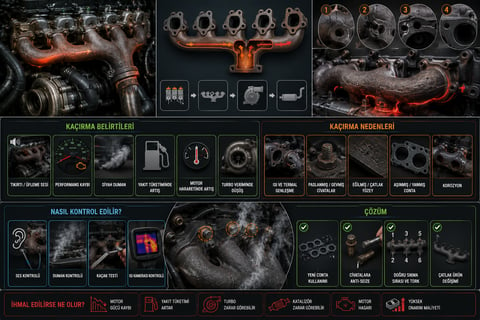
What Is an Exhaust Manifold? Leak Symptoms and Causes
What is an exhaust manifold and how does it work? Leak symptoms, crack causes, turbo impact and diagnosis steps for heavy-duty trucks.


