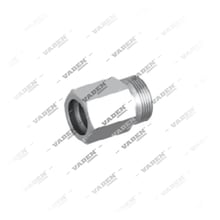
What are the functions of the Brake Connector?
The fitting's functions within the brake circuit can be summarized as follows.
- Line joining: Connects pipe/hose lines of different diameter or direction.
- Sealing: Prevents compressed air from escaping at the connection point.
- Pressure transmission: Ensures system pressure reaches the relevant component without loss.
- Vibration tolerance: Provides a connection that withstands minor movement of the line.
- Maintenance convenience: Allows quick removal and refitting for circuit servicing.
What are the symptoms of a faulty Brake Connector?
The most common symptom of a failed fitting is a whistling-like air leak sound; a hiss that continues even after the engine is switched off indicates a leak in the system. The low air pressure warning lamp on the dash may come on more often, and the compressor may run more than normal. A delayed brake pedal response or slow release of the parking brake may be noticed. Visual inspection may reveal dust buildup around the fitting, a foamy trace formed by an oil-air mixture, or looseness at the connection point. In cold weather, the leak sound may be more noticeable because the change in air density amplifies it. Some drivers may mistake a small leak for normal compressor noise and miss it entirely; over time this can progress to the point where the air tank barely fills or fills very slowly, which is why regular listening checks matter.
How is the Brake Connector checked?
To check, the system should be brought up to full pressure and the engine left idling, and soapy water applied to the fitting connection points to check for bubble formation. The fitting body can be lightly checked for tightness by hand, but should not be forced excessively under pressure. The seating angle of the pipe or hose around the fitting should be inspected, since an angled fit can compromise sealing. Compressor fill time can be measured with a stopwatch and compared against the manufacturer's reference value; an abnormally long fill time indicates a leak in the system. If a suspect fitting cannot be identified, the circuit can be isolated section by section (for example, blocking off a specific line) to narrow down which branch has the leak; this method is especially useful in manifold areas where many fittings are lined up in sequence.
What should be considered during replacement?
Before replacement, the pressure in the system must be fully released, otherwise the removed fitting can become dangerous due to a sudden burst of escaping air. When removing the old fitting, care must be taken not to damage the line it's connected to. When installing the new fitting, suitable thread sealant tape or paste should be applied to the thread surface according to the manufacturer's instructions; too much can narrow the inner bore. The fitting should be hand-started and then tightened with an appropriately sized wrench to the torque specified in the vehicle's current service manual. After installation, the system should be re-pressurized and sealing confirmed with a soapy-water test. While tightening, the line itself must not be twisted; the pipe or hose should be held steady relative to the fitting while only the fitting body is rotated, otherwise hidden stress can build up in the line and lead to a crack elsewhere later on.
How is the Brake Connector selected?
Selection is determined by thread type, diameter and body material. The table below summarizes the selection criteria.
Brake System Fitting selection criteria| Criterion | Description |
|---|
| Thread type | Metric or tapered thread must match the component being connected |
| Diameter | Inner/outer dimension must exactly fit the line diameter |
| Body material | Brass or stainless steel chosen based on the operating environment |
| Pressure rating | Must carry a safety margin above the system's working pressure |
| Connection direction | Selected according to straight, elbow or T-type routing |
Maintenance and service life
Fitting life depends on vibration, temperature cycling and connection frequency; a periodic general check using the soapy-water test is recommended. Repeatedly removing and refitting the same fitting can wear the thread surface, so unnecessary intervention should be avoided. Keeping connection points dry and clean is recommended against corrosion. Logging leak history in fleet maintenance records helps identify areas prone to frequent failure so preventive replacement can be planned for those points.
VADEN Brake Connector
VADEN supplies fittings for heavy commercial vehicle air brake systems built to OE dimensions and pressure-rating standards. Sealing-focused manufacturing gives workshops a reliable connection solution.
Frequently Asked Questions (FAQ)
Can the vehicle be driven if a brake system fitting is leaking?
It is not recommended; air loss can delay brake response, so the vehicle should not be driven until the leak is fixed.
Can a fitting leak be fixed just by tightening?
For minor looseness, tightening may be enough, but if the thread or sealing surface is damaged, the fitting must be replaced.
What tools are used to replace a fitting?
An appropriately sized open-end or socket wrench should be used, following the torque value specified in the vehicle's service manual.
Is a steel fitting more durable than a brass fitting?
Steel fittings generally offer higher pressure and impact resistance, while brass fittings have a corrosion-resistance advantage; selection should be based on the application.
Why is the soapy-water test recommended?
It allows compressed-air leaks to be detected quickly and safely through visible bubble formation.
Related products — Brake System: Connector (view all)
Related technical guide: ABS Brake System: How It Works, Warning Light and Faults