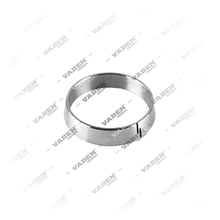
What is a Bracket Clamping Ring?
- Location: The fastening point between the suspension bracket and the chassis/axle tube.
- Material: Forged or cast steel, corrosion-resistant coating.
- Structure: A clamp-type design generally consisting of two half-rings and clamping bolts.
- Application: Trucks, tractors and trailers with air or leaf spring suspension systems.
What are the functions of the Bracket Clamping Ring?
The clamp ring's primary function is to hold the bracket firmly on the relevant tube or shaft, ensuring the suspension load is safely transmitted to the chassis. It also contributes to preserving suspension geometry by preventing the bracket from rotating or sliding.
- Fastening: Clamps the bracket to keep its position on the relevant tube or shaft.
- Load transfer: Supports safe transmission of the suspension load to the chassis via the bracket.
- Geometry preservation: Keeps suspension angles stable by preventing the bracket from rotating or sliding.
- Vibration damping: A tight installation reduces impact and noise caused by looseness.
What are the symptoms of a faulty Bracket Clamping Ring?
A clamp ring fault usually appears as bracket movement due to loosening or cracking, a knocking sound coming from the suspension area, or lateral sway in the vehicle. In advanced wear, the ring can break completely.
- Bracket movement: The suspension bracket rotating or sliding slightly on the relevant tube.
- Knocking sound: A metallic impact sound coming from the suspension area, especially on rough surfaces.
- Lateral sway: The vehicle leaning more than expected in corners or windy conditions.
- Visible looseness: Visible play in the clamping bolts or a crack on the ring surface.
- Uneven tire wear: An irregular tire wear pattern caused by disrupted suspension geometry.
How is the Bracket Clamping Ring checked?
Checking starts with a visual inspection of the ring and its bolts; cracks, corrosion and looseness are examined. Then the bracket is gently forced by hand or with a lever to test whether it moves.
- Visual inspection: Checking the ring surface for cracks, rust and deformation.
- Tightness test: Checking the clamping bolts with a torque wrench.
- Movement test: Checking whether the bracket moves on the tube when forced by hand or with a lever.
- Test drive: Driving at low speed on rough ground to observe abnormal noise or vibration.
What should be considered when replacing it?
When replacing the clamp ring, the bracket and tube surfaces must be cleaned and any corrosion removed. The new ring must be positioned to fully center the bracket, and the bolts tightened gradually in a crossing sequence.
- Surface cleaning: The tube and bracket contact surfaces must be free of rust and dirt.
- Correct positioning: The ring must be positioned to fully center the bracket and preserve suspension geometry.
- Gradual tightening: The bolts must be tightened gradually in a crossing sequence.
- Tightening torque: A general torque range should be applied; the vehicle's current OE service manual should be treated as authoritative.
- Re-check: Re-checking the torque after a short distance of initial use is recommended.
How to choose the right Bracket Clamping Ring?
The decisive criteria when choosing the correct ring are tube/shaft diameter, bracket model and suspension type (air/leaf spring). A ring of a different diameter can prevent the bracket from being fully secured, so a product matching OEM dimensions should be preferred.
Selection criteria for the Suspension Bracket Clamp Ring| Parameter | Typical value / range |
|---|
| Tube/shaft diameter | Varies by bracket and axle model; OEM dimension is authoritative |
| Material | Forged or cast steel |
| Coating | Zinc or similar corrosion-preventive coating |
| Bolt class | High-strength, matching manufacturer torque specification |
| Compatibility | Exact match with bracket model and OEM part number |
Maintenance and service life
The clamp ring's service life depends on adherence to the tightening torque and the ground conditions the vehicle operates in. On vehicles that continuously operate on rough roads or under heavy load, the bolts can loosen over time. Periodic torque checks and a visual movement test during maintenance are recommended. On vehicles operating in heavy terrain such as construction sites or mining areas, vibration levels are high, so shortening the torque check interval prevents unexpected bracket movement.
On vehicles operating in corrosion-prone coastal regions or on salted roads, rust formation on the ring and bolts can accelerate; in these conditions, using an original-dimension zinc-coated part and regular underbody washing are complementary measures that extend service life.
VADEN Bracket Clamping Ring
VADEN bases its bracket clamp rings for heavy commercial vehicle suspension systems on OEM dimensions and material standards. For the correct application, the VADEN product catalog and technical support line are available for reference.
Frequently Asked Questions (FAQ)
Can the vehicle be driven if the clamp ring loosens?
It can be driven a short distance, but since suspension geometry can be disrupted, the risk of damage to tires and other components increases; checking the torque as soon as possible is recommended.
Is only the ring replaced, or should the bracket also be checked?
When replacing the ring, it is recommended to also check the bracket and its contact surface for cracks or excessive wear.
Why is tightening torque so important?
Under-tightening can cause the ring to loosen and the bracket to move, while over-tightening can cause deformation on the ring or tube surface; the manufacturer's torque value should be followed.
Is this part the same for air spring and leaf spring systems?
While the basic function is the same, dimensions and design vary by bracket type; a product suitable for the vehicle model should be selected.
When should the ring be re-checked after installation?
Re-checking the torque value after a short distance of initial use, for example after a few hundred kilometers, is recommended.
Related technical guide: Heavy-Duty Air Suspension Failures: Air Springs, Leveling Valves and ECAS