Single vs Twin-Cylinder Air Compressor: Choice & Fitment
Learn how to match single or twin-cylinder air brake compressors to your truck: flow demand, drive and cooling interfaces, fault diagnosis, replacement steps.
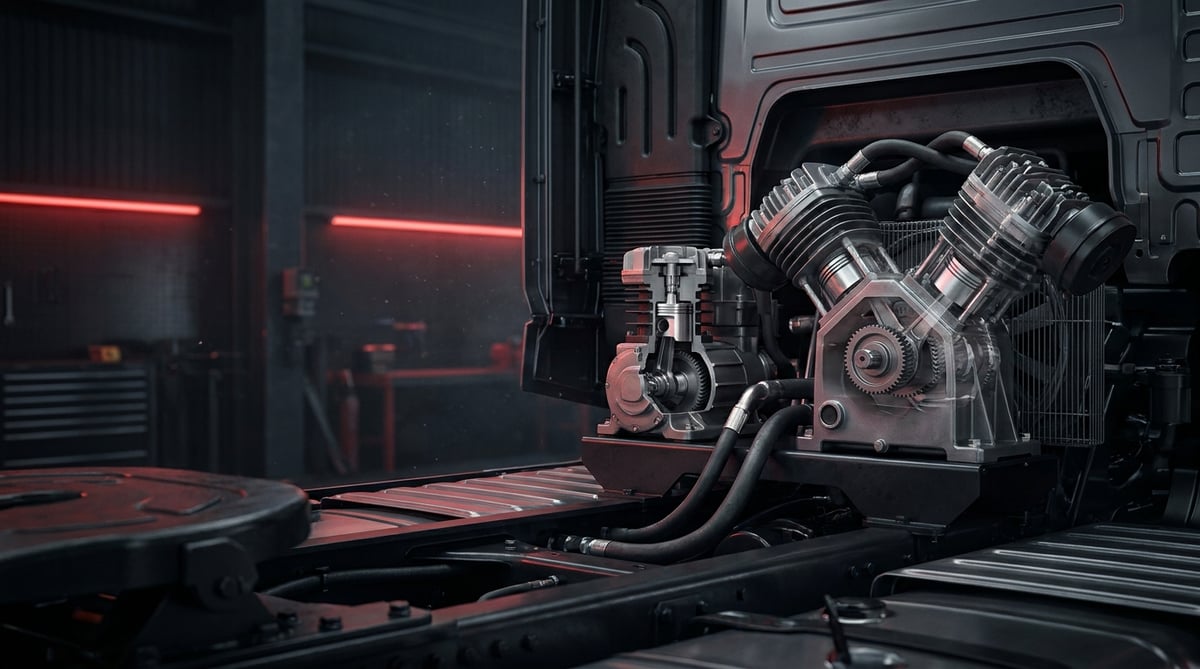
It is one of the most debated topics in the workshop: "The vehicle builds air slowly, should we switch to a twin-cylinder unit?" Sometimes that is the right call, and sometimes the real problem is not the compressor at all. On a heavy commercial vehicle the compressor type is not chosen arbitrarily; the drive interface, the cooling architecture and the total demand of the air consumers decide the matter together. This guide explains the difference between single and twin-cylinder air brake compressors, the fitment checklist, fault diagnosis and replacement discipline from a service technician's point of view.
What Is Single vs Twin-Cylinder Compressor Selection and Fitment? Function and Operating Principle
Single versus twin-cylinder compressor selection and fitment is the task of matching the delivery rate demanded by a heavy commercial vehicle's air brake system to the correct compressor architecture: single-cylinder units typically provide 150-350 cm³ swept volume and roughly 200-450 L/min of air delivery, while twin-cylinder units reach the 350-800 cm³ and 500-1,000 L/min range. The choice depends not only on delivery rate but also on the compatibility of the drive interface, cooling type and mounting geometry.
The air brake compressor is a piston machine that takes its motion from the engine, compresses air and delivers it to the air dryer and from there to the tanks. In the single-cylinder type a single piston and connecting rod assembly works; in the twin-cylinder type two pistons move on the same crankshaft, usually with a 180 degree phase difference. Two pistons sweep twice the air at the same speed and distribute the crank load more evenly; that is why twin-cylinder units are preferred in heavy duty applications where high delivery and low vibration are expected.
The operating principle is simple: on the intake stroke air fills the cylinder, on the delivery stroke it is compressed and sent into the discharge line. Because compressed air heats up, the cylinder head is cooled either by air through fins or by engine coolant; the air cools along the line, condenses its moisture and reaches the dryer. When pressure reaches the governor's cut-out value the unit switches to unloaded operation, and when pressure drops it goes back under load.
The critical concept in this cycle is the duty cycle: how much of the compressor's running time is spent under load. A unit that stays under load runs hotter, carries more oil and has a shorter service life. This is the heart of the single-to-twin-cylinder conversion debate: what is missing is usually not instantaneous pressure but the volume of air produced per unit of time.
When is a single-cylinder compressor sufficient?
A single-cylinder compressor is the correct and economical choice in applications with moderate air consumption: urban distribution trucks, medium duty vehicles that do not tow a trailer, chassis types with a limited number of air consumers. Its advantages are low parasitic power draw, simple connection and low cost.
When is a twin-cylinder compressor necessary?
A twin-cylinder compressor is necessary in applications where air demand is high and continuous: long haul tractor units, trailer combinations, buses with full air suspension, tipper and crane bodywork, air driven PTO applications. In heavy class engine families (application examples such as Mercedes OM 470/471, Volvo D13, MAN D26, DAF MX-13, Scania DC13, Iveco Cursor 13) twin-cylinder, water cooled and gear driven units are common. On buses, doors that open at every stop and the kneeling function noticeably increase air consumption.
The eight interfaces that determine fitment
- Drive type: on gear drive the tooth count and module must match, on belt drive the pulley diameter and number of grooves.
- Mounting flange: number of holes, bolt circle diameter, spigot diameter and flange thickness.
- Cooling architecture: air cooled head or water cooled head/body; port positions and diameters.
- Lubrication: pressure fed oil from the engine or its own sump; oil inlet port and return path.
- Intake source: turbo fed from the engine air filter or atmospheric through its own filter.
- Discharge line: outlet port thread, its position and the cooling distance up to the dryer.
- Control interface: unloader line, energy saving system (ESS) port, clutched version.
- Speed ratio and direction of rotation: compressor speed relative to crankshaft speed and the maximum permitted speed.
| Feature | Single-cylinder | Twin-cylinder |
|---|---|---|
| Typical swept volume | 150-350 cm³ | 350-800 cm³ |
| Typical air delivery (at approximately 2,000 rpm) | 200-450 L/min | 500-1,000 L/min |
| Common cooling type | Mostly air cooled head | Mostly water cooled head/body |
| Vibration and crank load | Less balanced due to the single piston | More balanced with two phase shifted pistons |
| Parasitic power draw | Lower | Higher (can be reduced with ESS/clutch) |
| Typical application | Distribution truck, medium duty chassis | Tractor unit, bus, tipper, crane bodywork |
| Weight and installation space | More compact | Larger; chassis/engine packaging must be checked |
Delivery rate is not selected on a "more is better" basis. The air supply performance of brake systems is defined by the air supply and build-up time requirements within the scope of ECE R13; the tanks are expected to reach the specified pressure within a defined time. The right question is not "how many cylinders" but "which unit meets the total air demand of this combination within the permitted build-up time and a reasonable duty cycle". The limit values vary by vehicle and must be verified from OE documentation.
Beyond cylinder count, whether the drive is permanent or runs through a clutch also matters; that variant is covered in the clutched air brake compressor guide.
How do you recognise a single vs twin-cylinder compressor selection and fitment problem?
Single versus twin-cylinder compressor selection errors and the compressor's own faults show up in the field with similar symptoms: air builds up slowly, the dryer purges frequently, oil appears in the system. The distinction is made by looking at the conditions under which the symptom appears; the wrong type selection usually shows itself during high consumption, while a mechanical fault shows itself under all conditions.
| Symptom | Probable cause | Check / verification |
|---|---|---|
| Air tanks fill very slowly, the wait before moving off gets longer | Insufficient delivery, intake restriction, valve plate wear or a leak in the system | First a system leak test, then measuring tank build-up time with a pressure gauge |
| The compressor almost never unloads, it stays under load continuously | High duty cycle; consumption exceeding unit capacity, or a leak | Measuring the pressure drop rate at idle; checking the governor cut-out/cut-in range |
| The air dryer purges very frequently, the cartridge saturates quickly | Moisture carried to the dryer with hot air, high duty cycle, short discharge line | Inspecting discharge line length and routing; checking dryer inlet temperature |
| Oil in the tanks and valves, hardened carbon deposits in the discharge line | Piston ring wear, overheating, insufficient cooling, high crankcase pressure | Removing the line and inspecting its inner cross section; inspecting the cooling circuit and crankcase breathing |
| Metallic knocking and irregular noise from the compressor area | Connecting rod or main bearing wear, drive gear backlash, loose bolts | Checking play in the drive with the engine stopped; torque checking the bolts |
| Coolant leak from the compressor body or head | Head gasket fatigue, cracking, head tightened to the wrong torque | Pressurised system leak test; monitoring the expansion tank level |
| Pressure drops only under loaded operation (tipper, doors, kneeling) | Insufficient delivery; the unit cannot meet the bodywork demand | Recording pressure while the consumer runs; comparing build-up time unloaded and under load |
Leak test first, compressor second
The most frequent mistake in the field is to blame the compressor directly on a system that builds up slowly. The correct order is the reverse: after the engine is stopped, the amount of pressure drop over a defined period is measured. If the drop exceeds the acceptance limit, the problem is a leak and replacing the compressor solves nothing.
Measuring build-up time
The tanks are drained, the engine is run at constant speed and the time for pressure to reach the cut-out value is measured with a stopwatch. Keeping the speed constant and the consumers closed is essential. The measured time is compared with the reference value in the vehicle's OE documentation.
Oil carry-over or dryer fatigue?
Oil in the tanks alone does not mean the compressor is finished; a saturated dryer cartridge produces a similar symptom. To distinguish them, the discharge line is removed and the inner surface inspected: if there is oily, carbonised deposit, the source is the compressor. If the line is clean and the cartridge saturated, the cartridge is renewed first.
Standards and further reading
This subject is governed by the equipment rules for air-braked commercial vehicles. In the United States the federal air brake standard, FMVSS 121 (49 CFR 571.121) defines the reservoirs, protection and timing a compliant system must provide, and Europe applies the equivalent limits of UNECE Regulation No. 13. For further detail, see the illustrated reference guide at airbrakecompressor.com. Always confirm specific figures against the current regulation and the vehicle manufacturer service data.
Readers outside the United States should work from their own national framework: in the United Kingdom the braking system must be maintained under regulation 18 of the Road Vehicles (Construction and Use) Regulations 1986, and in India the governing rules are published by the Ministry of Road Transport and Highways.
How is a single vs twin-cylinder compressor replaced? Step by step
- Make the vehicle safe: Stop the engine, apply the parking brake, chock the wheels, disconnect the battery isolator. On tilt cab vehicles, lock the cab safety catch.
- Depressurise the system: Drain all air tanks through the drain valves and verify zero pressure on the gauge. Do not forget that the spring energised (parking brake) section is also released; the vehicle must not be moved in this condition.
- Drain the coolant and the oil path: On water cooled units, drain the relevant section of the circuit into a suitable container; dispose of the fluids in accordance with environmental regulations.
- Clean and mark the area: Clean around the fittings and hoses to be removed with compressed air and a clean cloth, and label the lines. A single particle entering the air system ruins the valves and the dryer.
- Disconnect the lines and connections: Disconnect the discharge, intake, unloader/ESS control, oil feed and return lines and the coolant hoses in sequence; immediately cap every opening with a clean plug.
- Release the drive: On belt drive, slacken the tensioner and remove the belt; on gear drive, note the drive gear and timing marks before removal.
- Remove and inspect the compressor: Loosen the bolts in stages and lower the unit while supporting it; on twin-cylinder units use suitable lifting equipment because of the weight. Inspect the intake port, the discharge port and the drive backlash; the findings point to the root cause.
- Verify the new unit: Place the new compressor side by side with the old one and compare the flange bolt circle, spigot diameter, drive gear or pulley, port positions, oil port and direction of rotation, and check the OE reference number. If even one interface does not match, do not start the installation.
- Renew the discharge line and the dryer cartridge: Do not try to clean and reuse a carbon fouled line; a narrowed cross section strains the new unit from day one. Renew the line, replace the dryer cartridge and preserve the cooling distance of the line.
- Install and torque: Seat the unit with new gaskets and O-rings, and tighten the bolts to the manufacturer's value, crosswise and in stages. Tighten the fittings with a torque wrench; "feel" both leaks and damages the sealing face. On belt drive, set the tensioner to the specified value.
- Commission and verify: On pressure fed units carry out the pre-lubrication step, fill the coolant and bleed the air. Start the engine and, without applying high load in the first few minutes, check for leaks, noise and temperature. Then measure the build-up time, read the cut-out and cut-in pressures, and after a test drive check the fault codes and that the connections are dry.
What are the most common mistakes when replacing a single vs twin-cylinder compressor?
- Replacing the compressor without a leak test: Slow build-up is usually caused by a leak; the symptom continues even after the unit is changed.
- Not accounting for bodywork consumption: A tipper, crane or additional air suspension can exceed the vehicle's original air budget.
- Dirty installation: Removal carried out without cleaning around the fittings carries abrasive particles into the air system.
- Skipping the pre-lubrication step: Running dry in the first seconds permanently damages the bearings.
- Not bleeding the coolant: Air trapped inside the head creates local overheating and gasket fatigue.
- Tightening the bolts in a random order: This distorts the flange and causes gasket leaks; crosswise and staged tightening is essential.
- Reusing single use gaskets and washers: A sealing element that has already been crushed will leak on a second installation.
- Changing the intake source: Converting a turbo fed intake to an atmospheric filter upsets both the delivery rate and the lubrication balance.
Single vs twin-cylinder compressor technical values and check points
The following values used in single versus twin-cylinder compressor selection are general reference ranges frequently encountered on heavy commercial vehicle air brake systems. Engine family, bodywork and year of manufacture shift these ranges; for exact data the vehicle's current OE service manual is authoritative.
| Parameter | Typical range (general reference) | Note |
|---|---|---|
| Swept volume (single-cylinder) | 150-350 cm³ | Varies by application |
| Swept volume (twin-cylinder) | 350-800 cm³ | Approaches the upper band on buses and heavy bodywork |
| Air delivery (at approximately 2,000 rpm compressor speed) | 200-1,000 L/min | Lower band single, upper band twin-cylinder |
| System cut-out pressure | Generally 8-12.5 bar (116-181 psi) | Determined by the governor setting; vehicle specific |
| Cut-in pressure | Typically 1-2 bar below the cut-out value | If the range narrows, the unit goes under load frequently |
| Recommended duty cycle | A band of approximately 15-25 percent is targeted | A continuously high ratio shortens service life noticeably |
| Discharge line outlet temperature | Typically in the order of 150-200 °C under load | Continuous high temperature causes carbonisation |
| Oil feed pressure (pressure lubricated units) | Same as engine oil pressure; typically 1-4 bar | The lower limit at idle is verified from the manual |
| Pressure drop (engine off, leak test) | Must be limited; the acceptance limit is vehicle specific | Measured before the compressor is blamed |
| Connection point | Typical torque band (general reference) | Application note |
|---|---|---|
| Compressor flange bolt M10 | 40-60 Nm | Tightened crosswise and in stages |
| Compressor flange bolt M12 | 70-110 Nm | The bolt class changes the value |
| Cylinder head bolts | 20-40 Nm | Tightened in a defined sequence and in stages |
| Discharge line fitting | 25-45 Nm | With a new sealing element |
| Oil feed banjo bolt | 15-30 Nm | A new washer is fitted at every removal |
| Coolant connection element | 10-25 Nm | Overtightening crushes the gasket face |
- Is the tank build-up time close to the reference value, and was it measured with the consumers closed?
- Is the pressure drop with the engine off within the acceptance limit, and was a leak test carried out?
- Are the governor cut-out and cut-in pressures correct, or has the range narrowed?
- Is there carbon deposit inside the discharge line, and are its routing and length original?
- Is the dryer cartridge within its service interval, and is the purge frequency normal?
- Are the drive gear backlash or the belt tension at the manufacturer's value?
- Are the intake line and filter clean, and have the mounting bolts been torque checked?
How is single vs twin-cylinder compressor maintenance carried out and service life extended?
Single versus twin-cylinder compressor selection, once the correct type is determined, leaves three things that decide service life: clean intake air, a low duty cycle and effective cooling. When these three are provided, the compressor is one of the long lived parts of the vehicle. Conversely, a unit that runs continuously under load because of small leaks, draws dirty air and has a narrowed discharge line will fall short of the expected life regardless of its type. The most common cause of early failure in the field is not the compressor itself but the neglect around it.
- Fighting leaks: System pressure drop should be measured periodically, and small leaks at hoses and fittings should be corrected without delay.
- Dryer cartridge discipline: The cartridge should be replaced according to the manufacturer's interval, and operation should not continue with a saturated cartridge.
- Tank draining habit: Tanks should be drained regularly and the accumulated water and oil monitored; an increase in oil is the compressor's early warning.
- Intake line cleanliness: The air filter interval should not be exceeded, and the intake hose should be checked for crushing and cracking.
- Preserving the cooling: On a water cooled unit the circuit should be clean and free of air, and on an air cooled unit the fins should be free of oil and dust layers.
- Discharge line inspection: The line should be removed periodically and its inner cross section inspected, and renewed if carbon deposit has started.
- Engine oil and its interval: In most applications the compressor is lubricated with engine oil; an extended interval and an unsuitable oil class reflect directly on the piston rings.
- Monitoring air quality: The moisture, oil and particle load in the system can be assessed with the logic of the ISO 8573 family that defines compressed air quality classes; in practice this means dry, oil free and clean air.
In fleet operations the most effective approach is to treat the compressor not as a single part but as a subsystem: the compressor, the discharge line, the dryer and the governor form the same chain; renewing one and leaving the others shortens the life of the new part.
Application and compatibility: Vehicle compatibility catalogue · Engine compatibility catalogue
Related categories: Twin Cylinder · Single Cylinder
Main guide: Air Brake Compressor: Faults, Replacement & Maintenance Guide
Tags
Frequently Asked Questions
- Can a twin-cylinder compressor be fitted in place of a single-cylinder one?
- It can be fitted only if the vehicle manufacturer has approved a variant for that chassis and engine. A matching flange is not enough; the drive gear tooth count and speed ratio, the oil feed port, the cooling type and the installation space must also match. If there is no suitable variant, the correct approach is to eliminate leaks and review air consumption rather than convert.
- Is a twin-cylinder compressor always better?
- No. A twin-cylinder unit provides a higher delivery rate but draws more parasitic power from the engine, is heavier and costs more. On a distribution vehicle with moderate air consumption a single-cylinder unit is both sufficient and more economical; the right choice is made according to the vehicle's real air demand and duty cycle.
- How many litres per minute of compressor delivery does my vehicle need?
- The required delivery rate is determined by the brake system volume together with the total demand of the auxiliary consumers. In practice the criterion is the time for the tanks to reach operating pressure from empty. As a general reference, single-cylinder units work in the 200-450 L/min band and twin-cylinder units in the 500-1,000 L/min band; the exact requirement must be verified from the vehicle manufacturer's data.
- If air builds up slowly, does the compressor have to be replaced?
- Not directly. The most common cause of slow build-up is leaks in the system; a saturated dryer cartridge and a restricted intake come second. The correct order is a leak test first, then a dryer and intake check, and only last a compressor delivery measurement. When this order is not followed, replacing the compressor does not solve the problem.
- What is the difference between a water cooled and an air cooled compressor?
- The difference lies in how the heat generated during compression is rejected. On air cooled units the head is finned and the heat is given up to the ambient air; they are generally used in lower delivery applications. On water cooled units the engine coolant is passed through the head or the body; because the heat is rejected more effectively, they are preferred in high delivery and high duty cycle applications. The two types cannot be used interchangeably.
- Should the air dryer cartridge also be replaced when the compressor is changed?
- Yes, that is the recommended practice. The oil and moisture carried over from a faulty compressor will have saturated the cartridge; continuing with the old cartridge means the new unit is strained from day one. The carbon fouled discharge line must also be renewed at the same service.
- What should the duty cycle of a compressor be?
- The duty cycle is the portion of the compressor's total running time spent under load, and on heavy commercial vehicles it is targeted to stay in a band of approximately 15-25 percent as a general reference. Continuously exceeding this ratio raises the discharge temperature and leads to oil carry-over and early wear. The most common cause of a high ratio is not an undersized unit but leaks in the system.
- Why are twin-cylinder compressors usually used on buses?
- Air consumption on a city bus is noticeably higher than on a truck: doors opening and closing at every stop, the kneeling function, level control of the air suspension and frequent brake applications create continuous air demand. This demand makes a high delivery, effectively cooled unit essential.
- How do I select the right compressor?
- The vehicle model alone is not enough for the selection. The engine code, chassis number, year of manufacture, bodywork type and, if possible, the OE reference number on the old compressor should be used together. Searching the VADEN catalogue can be done on the basis of this data: you can reach an application based list by engine code, or search the OE number to see the matching VADEN part number. Before ordering, also compare the flange bolt circle, the drive gear or pulley, the cooling type and the port positions.
- What should I check when starting the engine for the first time after fitting a new compressor?
- On pressure fed units carry out the pre-lubrication step before starting; running dry in the first seconds permanently damages the bearings. Fill the coolant and bleed the air, because air trapped inside the head creates local overheating. Then, without applying high load in the first few minutes, check for leaks, noise and temperature, measure the build-up time, read the cut-out and cut-in pressures and, after a test drive, check the fault codes and that the connections are dry.
Related Articles
Clutched Air Brake Compressor: Faults, Replacement, Care
Clutched air brake compressors on trucks: how the clutch works, telling a slipping clutch from a worn compressor, replacement steps and torque values.
Air Brake Compressor: Faults, Replacement & Maintenance Guide
On a truck, a slow-filling reservoir or oil in the dryer often starts at the compressor's cut-in/cut-out cycle, not the compressor body: diagnosis and care.
Truck Air Compressor by Engine & Make: DD15, Cummins, PACCAR, Mack & More
When a tractor unit comes into the shop with a note that simply says "compressor job", the thing that decides how long the work will actually take is usually