What is a brake pad (disc brake pad)?
A brake pad is a wearing brake component that is pressed against the brake disc (rotor) by the piston or mechanism inside a disc brake caliper, converting the vehicle's kinetic energy into heat through friction to bring it to a stop. On heavy commercial vehicles this part typically consists of friction material riveted or bonded to a steel backing plate and is used as an inner/outer pad set, two per caliper. This pad belongs to the disc brake caliper (Brake Caliper) system and is a different product from a drum brake shoe lining or a parking brake lining.
What does a disc brake pad do?
- Generate braking force: Contacts the disc to create friction and slows or stops the vehicle in a controlled way.
- Convert energy into heat: Turns motion energy into frictional heat and is engineered to withstand that heat.
- Maintain brake balance: Provides even friction across the wheels on an axle so the vehicle does not pull under braking.
- Protect the disc and caliper: The correct friction material limits disc wear and thermal damage.
- Support driving safety: Delivers a repeatable, predictable braking response compatible with ABS/EBS systems.
Brake pad technical summary table
| Property | Description |
|---|
| Material | Steel backing plate + low-metallic / non-asbestos organic friction material (asbestos-free) |
| Vehicle type | Heavy commercial vehicles: trucks, tractor units, buses, trailers and semi-trailers |
| Compatibility | Matched to disc brake caliper type and disc diameter (axle-based set) |
| System | Disc brake caliper (Brake Caliper) / air disc brake system |
| OE-equivalent approach | Targets form-fit-function equivalence with leading OE manufacturers |
| Fitment | As a kit of inner and outer pads per caliper, on both sides of the axle |
| Maintenance | Check thickness and uneven wear; replace as a set at the wear limit |
What is in a brake pad set and its related parts?
- Pad set (inner/outer): The pair of friction elements used per caliper; always replaced as an axle-based set.
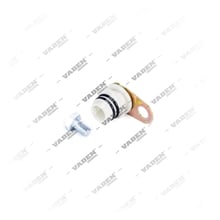
- Repair kit: Contains the small parts such as retainers, clips and seals that should be renewed during a pad change; supports correct operation of the caliper mechanism.
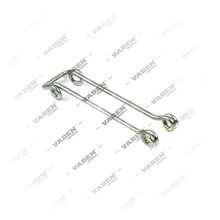
- Spring: The pad retaining/hold-down spring keeps the pad seated in its housing and reduces vibration and noise.
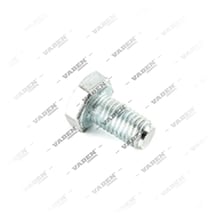
- Bolt: The fastener that secures the pad retainer and cover components; must be fitted to the correct torque.
What to watch for when maintaining brake pads?
- Thickness check: Measure the friction material thickness regularly; pads that reach the wear limit must be replaced without delay.
- Replace as a set: Always replace the pads on the same axle together; replacing one side only causes braking imbalance.
- Disc condition: Do not fit new pads to a disc that is heavily scored, heat-cracked or at its minimum thickness; renew the disc as well if needed.
- Bedding-in period: On new pads, avoid harsh braking for the first miles to let the surfaces seat in (bed in).
- Genuine parts preference: For safe, consistent braking, choose OE-standard pads such as VADEN ORIGINAL.
Common brake pad problems and solutions
- Longer stopping distance: Cause: worn or glazed pads. Fix: renew the pad set and check the disc surface.
- Squeal/screech when braking: Cause: missing/worn retaining spring or clip and pad vibration. Fix: replace the pad together with the repair kit and spring.
- Uneven (tapered) wear: Cause: sticking or guide problem in the caliper mechanism. Fix: check the caliper and repair kit, and replace the pad.
- Judder/vibration when braking: Cause: disc run-out or the pad not contacting the disc evenly. Fix: check disc flatness and replace the pads as a set.
- Vehicle pulls under braking: Cause: differently worn or different type pads on the same axle. Fix: fit identical, same brand/type pads on both sides.
- Brake smell and overheating: Cause: continuous friction or a seized caliper. Fix: check caliper free movement and use heat-resistant genuine pads.
Why choose VADEN ORIGINAL brake pads?
- OE-standard friction: A high, consistent coefficient of friction gives predictable, safe braking.
- High thermal resistance: Resists brake fade under heavy loads and long downhill descents.
- Durable backing plate: A strong steel plate and solid bond target long service life and low wear.
- Wide application range: Equivalent solutions for Mercedes-Benz, MAN, Scania, Volvo, DAF, Iveco, Renault, BMC and Ford, plus Wabco/Knorr-Bremse caliper systems.
- Set compatibility and technical support: A complete solution with pad, spring, bolt and repair kit, plus expert support in choosing the right part.
Frequently Asked Questions (FAQ)
When should brake pads be replaced?
Replace the pads as a set when the friction material reaches the wear limit, when you hear a squeal/wear warning, or when stopping distance increases. A thickness check is recommended at every service.
Are disc brake pads the same as drum brake linings?
No. This product is a disc brake pad used inside a disc brake caliper; it differs in design and fitment from the shoe lining in a drum brake.
Is it enough to replace the pad on just one wheel?
No. For brake balance, the pads on the same axle must always be replaced together as a set; replacing one side only makes the vehicle pull under braking.
Should the disc also be replaced with the pads?
The disc should be replaced if it has reached its wear limit, is cracked or is heavily scored. Otherwise new pads will not seat properly and both performance and life will drop.
Why do new pads brake weakly at first?
New pads need a bedding-in period until they fully seat against the disc surface. Avoiding harsh braking for the first miles stabilizes performance.
Are the repair kit and spring essential during a pad change?
They are recommended. Renewing the retaining spring, clips and repair kit parts prevents noise, ensures correct clamping and supports even pad wear.
Conclusion
The brake pad is a critical wear part that directly determines the safety of a heavy commercial vehicle's disc brake system, and it must be replaced as a set with the correct friction material. Regular inspection, axle-based replacement and the use of the right related parts improve both safety and the life of the braking components. For consistent brake performance in your trucks, buses and trailers, choose VADEN ORIGINAL disc brake pads.
Related articles: When Should Brake Pads Be Replaced? Symptoms and Service Life