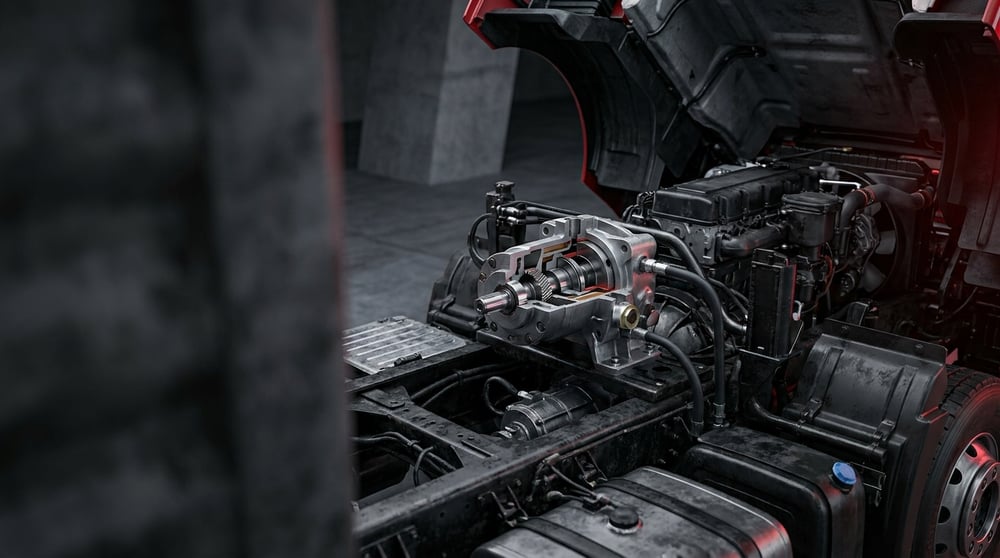
Cab Tilt Pump (Cab-Lift Hydraulic)

Cab Tilt Pump: Faults, Replacement & Maintenance Guide
Temmuz 22, 2026
The only way to reach the engine, transmission, clutch and over-engine lines of a tractor unit or truck is to tilt the entire cab forward; and the invisible hand that lifts this cab, weighing several tonnes, is often a small hand pump tucked away in the lower-rear corner of the chassis. When the driver pumps the lever up and down a few times, hydraulic pressure slowly raises the cab; once the work is done, the valve is turned and the pump is worked again to lower the cab. This seemingly simple system is in fact a safety component: if the cab hangs halfway, lowers by itself, or fails to hold where it was raised, both the vehicle and the service personnel are put at risk. This guide covers the operation of the cab tilt pump (cab-lift hydraulic pump) on heavy commercial vehicles, the correct diagnosis of fault symptoms, field-applicable replacement practice, and the hydraulic discipline that determines the system's service life — in the light of the OE brand context (Weber, Hydac, Kirchhoff-type tilt systems; engine/chassis manufacturer service specifications).
E-E-A-T note: This document was prepared by the VADEN technical team, based on field experience with heavy commercial vehicle cab tilt systems. The procedures are industry-wide good practices; for exact torque, pressure and oil figures the vehicle OE service manual is always definitive. Last updated: July 2026.
What Is a Cab Tilt Pump (Cab-Lift Hydraulic)? Its Function and Working Principle
The cab tilt pump is a hand (piston) pump with an integrated directional control valve that converts the motion produced by the driver's hand power into hydraulic pressure and delivers this pressure to the cab tilt cylinder, allowing the cab of a heavy commercial vehicle to be tilted forward and then lowered again.
The system operates as a closed hydraulic circuit. The pump body contains an oil reservoir, a set of check valves, a directional (raise/lower) selector valve, and usually a pressure relief/safety valve. When the driver presses the lever down, the piston draws oil from the reservoir; when the lever is pulled up, it pushes this oil into the lift line at high pressure; because the check valves prevent the oil from flowing back, pressure builds with each stroke and the cab rises step by step. In the lowering position the valve changes direction; as the cab's own weight pushes the oil from the cylinder back to the reservoir, the pump manages the descent rate in a controlled manner. In double-acting systems the cylinder works under pressure in both the raising and lowering directions, and the cab lowers under the pump rather than under gravity; this provides more controlled behaviour on a steep gradient or in wind.
The fundamental building blocks of a heavy commercial cab tilt pump are as follows:
- Pump body and oil reservoir (housing & reservoir): The cast/machined body that houses the piston cylinder, the valve block and the hydraulic oil volume.
- Piston and pumping lever (piston & lever): The moving assembly that converts hand power into hydraulic pressure; the lever bearing and piston seal are the areas most prone to wear.
- Check valves: Ball/cone valves that allow oil to flow only in the intended direction; when contaminated they leak and the cab lowers.
- Directional/selector valve: The rotary valve that switches between raising and lowering; usually operated by a latch or lever.
- Pressure relief/safety valve: Engages when the cab is fully open or under excessive pressure, protecting the system and the cylinder.
- Shaft seals and O-rings (seals): Provide sealing at the piston shaft and valve ports; these are the elements that leak most frequently.
- Hydraulic lines and cylinder connection (lines & cylinder): The pressure lines connecting the pump to the cab tilt cylinder(s).
Its Place in the System: The Pump – Line – Cylinder Chain
The cab tilt pump does not work on its own; it is the inlet of a hydraulic chain. On most vehicles the pump is positioned in the right or left lower-rear corner of the chassis, with the lever accessible from the outside. The pressure it produces travels through a steel pipe or high-pressure hose to the tilt cylinder located at the level of the cab front hinge. As the cylinder opens and extends, the cab tilts forward about the hinge axis. Every element in this chain affects the pump's performance: a leaking cylinder seal, a cracked line or a jammed safety latch can cause the cab to fail to rise or to fail to hold, even if the pump itself is sound.
Single-Acting or Double-Acting?
Cab tilt systems come in two basic architectures. In a single-acting system the pump only raises the cab; lowering occurs when the directional valve is opened and the cab's own weight pushes the oil back. In a double-acting system the pump applies pressure in both the raising and lowering directions; the cab is not left to gravity but lowers under control. This distinction matters in diagnosis: in a single-acting system a "the cab lowers too fast/uncontrollably" complaint is most often related to the descent throttle element; in a double-acting system a "the cab won't lower/lowers with difficulty" complaint relates to the lowering line or the valve.
Type Comparison
| Feature | Single-Acting Hand Pump | Double-Acting Hand Pump |
|---|---|---|
| Raising | By pump pressure | By pump pressure |
| Lowering | By the cab's own weight (valve open) | Lowers under pump pressure in reverse |
| Control feel | Gravity-dependent on descent | Controlled in both directions |
| Common usage | Many medium/heavy trucks | Heavy tractor units, fully-tilting cabs |
| Typical failure point | Check valve leak, shaft seal | Directional valve, lowering line, seals |
| Number of lines | Usually a single pressure line | Two lines (raise/lower) |
Part number verification is essential. Within the same vehicle family there are multiple pump variants with different stroke, port direction, valve type (single/double-acting) and connection thread size. "It looks similar" is not enough: fitting a double-acting pump or a unit with the wrong port direction to a single-acting system can cause the cab to fail to rise or to lower unsafely. Before replacement, match the OE number on the old pump, its acting type and its port positions exactly against the VADEN equivalent reference.
Fault Symptoms and Diagnosis
Cab tilt pump faults mostly present as "the cab rises slowly", "won't rise" or "won't hold". The table below is a quick reference for field diagnosis; the distinguishing symptoms are detailed afterwards. Since most of the symptoms can be mimicked by a low oil level, air trapped in the system or a cylinder-side leak, the oil level and cylinder/line sealing should always be checked before blaming the pump.
| Symptom | Possible Cause | Check / Verification |
|---|---|---|
| The lever pumps but the cab never rises | Low/empty oil, air trapped in the system, check valve leak | Reservoir level; pressure build-up after a few strokes; valve check |
| The cab rises but slowly, requiring far too many strokes | Internal leak (piston/valve), slight air, worn seal | Observe rise per stroke; test seal and valve for leaks |
| The cab rises but won't hold, slowly settling back down | Check valve or cylinder seal leak | Hold the pump with the cab raised and watch the descent rate; line/cylinder leak |
| Oil leaking from the pump body/lever area | Piston shaft seal or port O-ring wear | Clean and pump to trace the leak source |
| The cab sticks at a certain point, won't open fully | Relief valve opening early, air in the cylinder, mechanical binding | Safety latch/lock; bleed the cylinder; check hinge and obstructions |
| On lowering, the cab drops harshly/uncontrollably or won't lower | Descent throttle element, directional valve or lowering line issue | Directional valve operation; check lowering line and throttle/orifice |
| The lever moves freely with no resistance | Empty reservoir, air on the suction side, piston seal worn out | Add oil and bleed; if resistance does not return, check the internal assembly |
Distinguishing "Won't Rise" from "Won't Hold"
These two symptoms point to different fault groups. If the cab does not rise at all, look first at the simplest causes: the reservoir oil level may be low, air may have entered the system, or the suction check valve may be contaminated and not closing. If no sense of pressure builds in the lever after a few strokes, the suction side (oil/air/valve) is to blame. If the cab rises but does not stay where it holds and slowly settles back down, this is almost always an internal leak: either the pump's load-holding check valve or the cylinder seal is bleeding off pressure. To make the distinction, after the cab is raised the pump line and cylinder line are observed separately; this is how you determine whether the leak is in the pump or the cylinder.
Internal Leak Test
The most reliable diagnosis is made by observing whether the pump holds pressure under load. The cab is raised to a safe height (with the mechanical safety support engaged without fail), pumping is stopped, and the cab is watched to see whether it settles centimetre by centimetre. If it stays steady, the pump and cylinder are holding the load; if it settles slowly, which element in the line is leaking is found by isolating the lines. Two rules are critical in this test: the cab is never left open in a way that relies on hydraulic pressure alone for anyone to go underneath it — the mechanical safety lever/support must always be engaged; and no one is beneath the cab during the test.
Oil Level and Air Check
The simplest but most skipped step in diagnosis is the reservoir. On a tilt pump the oil level must be checked with the cab in the lowered position; because when the cab is raised most of the oil is in the cylinder and the level appears misleadingly low. If the level is low or there is air in the system, the lever feels spongy and the cab rises hesitantly rather than step by step. Because air can compress within the oil, it absorbs part of the energy on each stroke; that is why diagnosis carried out without bleeding is misleading. If these findings are not resolved before fitting a new pump, the new pump will repeat the same symptom.
Replacement / Installation Steps
Personal protective equipment (PPE) and safety: The cab tilt system carries high pressure and a heavy load. Before starting work, bring the cab to the fully closed position with the safety lock engaged; never work under the cab relying on hydraulic pressure alone. Do not disconnect a pressurised hydraulic line while there is pressure in the system; hydraulic oil is irritating to skin and eyes. Wear gloves and goggles, secure the vehicle and chock the wheels. If the cab is to be raised, the mechanical safety support (safety strut/lever) must be engaged without fail.
The following steps are a general good-practice flow on a heavy commercial vehicle. For engine/chassis-specific torque, line fitting type, port direction and disassembly sequence, the manufacturer's service manual must always be followed.
- Lower the cab and depressurise the system: Bring the cab to the fully closed position and engage the safety lock. Move the directional valve to the lowering position to release residual pressure in the line; confirm that there is no resistance left in the lever.
- Collect the oil in a suitable container: Drain the oil from the reservoir and, if possible, from the line. Hydraulic oil is collected in accordance with waste regulations; it is not released to the ground/drains.
- Mark the pump's position and the lines: Before disassembly, photograph and label which port the pressure/lowering lines are connected to. In a double-acting system, if the lines are mixed up, the cab behaves in the reverse direction.
- Disconnect the lines and cap the openings: Disconnect the hydraulic lines; to prevent dirt/dust from getting in, immediately cap all open ports and line openings with clean plugs/bags. The greatest enemy in a hydraulic system is dirt.
- Remove the old pump: Loosen the bracket/body mounting bolts gradually. If there are bolts of different lengths, mark their positions; keep a cloth ready for the oil remaining beneath the pump.
- Verify the new pump and variant: Compare the new unit's acting type (single/double), port direction, thread size and lever side exactly against the old one. If they do not match, do not fit it.
- Prime the new pump before installation: Before fitting the new pump, fill the reservoir with clean oil of the correct type and pump the lever a few times unloaded to feed the internal volume with oil. Dry pumping wears the piston and valves unnecessarily and prolongs the bleeding time.
- Fit the pump and torque it: Tighten the bracket bolts to the manufacturer's torque, gradually and in the proper sequence. Excessive torque means cracking/stressing of the body; insufficient torque means vibration and leakage.
- Connect the lines with new sealing elements: Use new O-rings or gaskets on the fitting/banjo connections; do not reuse old, crushed seals. Confirm with your markings that you have connected the pressure and lowering lines to the correct port; tighten the fittings to the manufacturer's torque.
- Fill and bleed: Fill the reservoir with the correct oil. Raise and lower the cab slowly to the halfway point a few times to expel the air in the system; after each cycle, top up the level with the cab in the lowered position. Repeat until the lever feels fully charged with solid resistance and the cab rises smoothly and without hesitation.
- Perform load-holding and leak checks: With the safety support engaged, raise the cab, stop pumping and confirm that the cab holds the load (does not settle). Watch all connections, the shaft seal and the reservoir level; after a few raise-lower cycles, check for leaks and check the level again.
Points to Watch (Common Mistakes)
In the cab tilt system, success lies less in the installation itself than in safety discipline, the correct oil and cleanliness. The most common mistakes:
Leaving the cab open relying on hydraulic pressure alone and going underneath it is the most lethal mistake in this system. A pump or cylinder with an internal leak can lower the cab without any warning. Whenever the cab is raised, the mechanical safety support (safety strut) must be engaged; no one should be under the cab without support.
Checking the oil level with the cab raised and using the wrong hydraulic oil are two common mistakes. With the cab raised, most of the oil is in the cylinder; the level appears misleadingly low, and if too much oil is added the reservoir overflows when the cab lowers. The level is always checked with the cab lowered. The oil type must be the hydraulic oil specified by the vehicle manufacturer; the wrong viscosity or a mixture degrades the seals and makes pumping harder at low temperature.
- Bleeding incompletely: Air left in the system creates misleading symptoms such as a spongy lever feel, hesitant raising and, over time, the cab settling step by step; bleeding requires patience and may take several cycles.
- Connecting the pressure and lowering lines the wrong way round: In a double-acting system, if the lines are mixed up the cab works in reverse or does not move at all; always label them before disassembly.
- Failing to cap open lines/ports: Dust and dirt getting in during disassembly make the sensitive check valves leak, and the cab stops holding.
- Skipping the cylinder side and blaming only the pump: The "the cab won't hold" symptom is often a cylinder seal leak; before replacing the pump, whether the leak is in the pump or the cylinder must be isolated.
- Neglecting the safety lock/latch: Setting off without the cab lock fully closed is extremely dangerous; after each lowering, the lock's engagement must be verified by eye and by hand.
Technical Values and Check Points
The following values are typical/general references for heavy commercial vehicles in general; exact torque, pressure and oil figures vary by vehicle and pump variant. For model-specific values the manufacturer's service data is definitive.
- System operating pressure: Cab tilt systems can operate, as a general reference, in the ~150–250 bar (approximately 2,200–3,600 psi) band during raising depending on load; peak pressure at full opening or at the safety setting may go higher. The exact relief pressure is stated in the pump/cylinder specification.
- Safety/relief valve setting: The safety valve, which engages at full opening and under overload, protects the system and the cylinder; the setting value is model-specific and must not be tampered with.
- Oil type: Usually the hydraulic oil specified by the manufacturer (mineral hydraulic oil of low-to-medium viscosity in most applications; ATF-type fluid in some systems). The type and viscosity are stated on the reservoir cap/service manual; they are not mixed.
- Operating temperature: The system generally works at ambient temperature; in cold climates, as the oil viscosity increases, pumping may become harder. In very cold conditions the correct low-temperature oil is important for the cab to rise smoothly.
- Oil level rule: The level must always be with the cab in the lowered position and between MIN and MAX; checking the level with the cab raised is misleading.
Typical Torque References (General)
The torque values below are only general references giving an idea of magnitude; for the actual value always use the vehicle service manual.
| Connection | Typical Range (general reference) | Note |
|---|---|---|
| Pump bracket/body bolts | ~20–45 Nm | Gradual, proper sequence; do not stress the body |
| Pressure/lowering line fitting bolt | ~30–60 Nm | With a new O-ring/gasket; watch for thread damage |
| Cylinder connection pin/bolt | Manufacturer value governs | Mostly model-specific; refer to the manual |
| Reservoir filler/plug | Low torque | Do not overtighten; check the gasket/O-ring |
On first operation after replacement, perform the load-holding test with the safety support engaged: raise the cab halfway, stop pumping and watch for a few minutes to see whether the cab settles. If it stays steady, the system is holding the load; if it settles slowly, an internal leak (the pump check valve or the cylinder) must be investigated.
Field check points:
- Is the oil level between MIN and MAX with the cab lowered, and is the oil clear/foam-free?
- Does the lever feel charged with solid resistance rather than spongy (air check)?
- Does the cab rise smoothly and without hesitation, and hold the load where it was raised?
- Is there any leakage at the pump shaft seal, the port connections and the lines?
- Do the directional valve raise/lower positions work properly, and does the safety lock seat fully?
Maintenance and Service Life
The service life of a cab tilt pump depends largely on the cleanliness of the hydraulic oil, air discipline in the system and correct use; the pump often fails to hold the load not because of itself but because of contaminated oil, trapped air or a neglected cylinder seal. For proactive maintenance:
- Monitor the oil level regularly and in the correct position: Check the level with the cab lowered; a drop is an early herald of a leak.
- Use the correct oil type and viscosity: Use the hydraulic oil specified by the manufacturer; avoid mixing types and using an unsuitable viscosity in cold climates.
- Find the source of air early: A spongy lever or hesitant raising is a sign of a loose connection on the suction side or low oil; bleed and eliminate the source.
- Do not neglect a leak: Leakage from the pump shaft, a port or the cylinder seal is both oil loss and a safety risk; intervene early.
- Check the safety support and the lock: The mechanical safety lever/support and the cab lock are safety elements independent of the pump; verify their function regularly.
- Do not keep the cab under pressure unnecessarily: Lower the cab once the work is done; keeping the system continuously under load tires the seals.
With this discipline, a heavy commercial cab tilt pump gives a long and predictable service life; because a fault usually arrives not as a sudden failure but with traceable symptoms such as "spongy lever", "cab rises slowly" or "won't hold", planned maintenance and replacement are possible. Because of the safety dimension of this system, symptoms must not be neglected and the cab must always be supported by the mechanical safety.
Frequently Asked Questions
I'm pumping the cab tilt pump but the cab won't rise, what is the reason?
The most common causes are a low or empty oil level, air trapped in the system, and a suction check valve that is contaminated and not closing. First check the reservoir level with the cab lowered, and if necessary add the correct oil and bleed the air. If no sense of pressure builds in the lever after a few strokes, the suction side (oil/air/valve) is to blame; if resistance comes but the cab rises very slowly, an internal leak or seal wear should be investigated.
The cab rises but won't hold, slowly settling back down. Why?
This symptom is almost always an internal leak: either the pump's load-holding check valve or the seal of the cab tilt cylinder is bleeding off pressure. To make the distinction, the cab is raised (with the mechanical safety support engaged) and the pump and cylinder lines are observed separately. If the leak is in the pump, the pump is renewed; if in the cylinder, the cylinder. This fault is critical from a safety standpoint; the cab must not be left open without support.
What oil goes into the cab tilt pump?
Use only the hydraulic oil specified by the vehicle manufacturer: mineral hydraulic oil of low-to-medium viscosity in most applications, and an ATF-type fluid in some systems. The type and viscosity are stated on the reservoir cap or in the service manual. The wrong viscosity makes pumping harder in the cold; mixing different types can degrade the seals. If you are unsure of the type, drain the system and refill with the correct oil.
When should I check the oil level — with the cab raised or lowered?
The level must always be checked with the cab in the lowered (closed) position. With the cab raised, most of the oil is in the cylinder, so the reservoir level appears misleadingly low; in this case, if too much oil is added the reservoir overflows when the cab lowers. The correct level is between MIN and MAX with the cab closed.
Is a cab tilt pump repaired or replaced complete?
At an early stage, if only an O-ring or shaft seal is leaking and the internal surfaces are sound, seal/valve renewal may be possible. However, if the check valve is not holding the load, the piston seal is worn out or dirt has spread through the system, the internal assembly is worn; in this case, a complete pump replacement with the tolerance and durability of an OE equivalent gives a safer and more economical result. The decision is made based on the load-holding test and the identification of the leak source.
Is it safe to work under the cab while it is raised?
No; working under the cab relying on hydraulic pressure alone is extremely dangerous. A pump or cylinder with an internal leak can lower the cab without warning. Whenever the cab is raised, the mechanical safety support (safety strut/lever) must be engaged without fail, and no one should be under the cab without support.
How is the air bled when the pump is replaced?
First prime the new pump before installation by filling it with the correct oil and pumping the lever unloaded a few times. After filling the reservoir, raise and lower the cab slowly to the halfway point a few times; after each cycle, top up the level with the cab lowered. Repeat until the lever feels charged with solid resistance and the cab rises smoothly and without hesitation. If a spongy lever feel is still present, air remains in the system.
The lever is spongy/moves freely, what should I do?
A spongy or freely-moving lever usually indicates one of two things: there is air in the system or the reservoir oil is low. First check the level with the cab lowered, add the correct oil and bleed the air. If the lever still fails to build resistance despite full oil and bleeding, the piston seal or the suction valve may be worn out; the internal assembly should be checked.
The cab tilt pump (cab-lift hydraulic) is a critical hydraulic component that directly determines a heavy commercial vehicle's maintenance access and service safety. Correct piston and valve quality, reliable check valve load-holding and an OE-equivalent production standard are decisive for both service safety and the leak-free long life of the system. The VADEN Cab Tilt Pump (Cab-Lift Hydraulic) product family is manufactured with the goal of OE-equivalent tolerance and durability, taking into account the high-pressure and safety-critical conditions of tractor-truck applications; used together with the diagnostic, safety and installation practices in this guide, it provides reliable and predictable cab tilt performance.