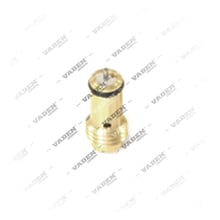
What are the functions of the Stiff Check Valve?
The rigid-body check valve performs the classic check valve functions along with added benefits from its rigid-mount design:
- One-way flow: Allows air to flow only toward the bellows or reservoir, completely blocking reverse flow.
- Fixed connection protection: The rigid body prevents mounting threads on the manifold or block from loosening over time.
- Vibration resistance: Not requiring a flexible hose makes it resistant to material fatigue at points exposed to constant vibration.
- Pressure retention: Preserves pressure in the connected line even when the compressor is off.
- Compact mounting: Allows a direct connection in tight spaces without needing hose routing.
What are the symptoms of a failed Stiff Check Valve?
Failure of this type usually shows up at the manifold or block area it is connected to:
- Air leak at the connection point: A continuous hissing sound is heard if the seal or thread between body and block degrades.
- System pressure loss: Failure of the valve to seal fully causes pressure in the connected line to drop over time.
- Vehicle sagging slowly: The connected bellows or reservoir cannot hold pressure, so chassis height drops over time.
- Cracking or breakage in the body: Excessive torque or impact can crack the cast body due to its rigid mounting design.
- Frequent compressor cycling: Constant pressure loss causes the compressor to engage more often than normal.
How is the Stiff Check Valve inspected?
Because of its rigid mounting, inspection should focus especially on the connection area:
- Visual inspection: Check the body for cracks, casting defects, or thread damage.
- Soapy water test: With the system under pressure, apply soapy water around the valve body and mounting thread to check for leaks.
- Reverse flow test: Apply air from the outlet side to check for reverse permeability.
- Connection tightness check: Verify the mounting thread has not loosened using a torque wrench.
What should be considered when replacing it?
The rigid mounting design requires extra care during replacement:
- Thread compatibility: The new valve must exactly match the thread type and pitch on the block or manifold.
- Correct tightening torque: The cast body is sensitive to excessive torque; the manufacturer's specified value must not be exceeded.
- Sealant/tape: Use appropriate thread sealant or tape where required.
- Flow direction check: Install in the correct direction as indicated by the arrow on the valve.
- System test: Test sealing and flow direction under pressure after installation.
How to choose the right Stiff Check Valve?
Correct selection starts with the mounting point's thread size and a material suited to the system pressure.
Rigid-Body Check Valve selection criteria| Criterion | Description |
|---|
| Mounting thread | Must exactly match the thread type and pitch on the block or manifold |
| Working pressure | Must match the vehicle's air suspension system nominal pressure |
| Body material | Must be corrosion-resistant cast or machined metal |
| Flow capacity | Must be sufficient for the connected line's volume and fill rate |
| Application | Verify OEM reference against chassis and suspension type |
Maintenance and service life
The rigid-body check valve generally has a longer service life than hose-connected types because it lacks a weak point like hose fatigue or cracking. However, the rigid body is sensitive to excessive torque or physical impact. Checking connection thread tightness and inspecting the body for cracks at scheduled service is recommended. The vehicle's current service manual is the authority for exact pressure and torque values.
VADEN Suspension Stiff Check Valve
VADEN supplies OE-quality rigid-body check valves matched to the correct thread size and pressure rating for heavy commercial vehicle air suspension systems. These parts provide durable, reliable pressure retention at fixed mounting points.
Frequently Asked Questions (FAQ)
How does a rigid-body check valve differ from a standard check valve?
It mounts directly to a block or manifold with a rigid body instead of a flexible hose, giving it greater vibration resistance.
When is a rigid-body check valve preferred?
It is preferred at mounting points with minimal movement and vibration that require a direct metal-to-metal connection.
What happens if the body cracks?
A continuous air leak forms at the connection point and system pressure drops over time.
Why is excessive torque risky during installation?
The cast body is sensitive to excessive torque; exceeding the manufacturer's value can cause cracking.
Why does a rigid-body check valve typically last longer?
Because it lacks a weak point like hose fatigue or cracking, the rigid design is generally more durable.
Related technical guide: Heavy-Duty Air Suspension Failures: Air Springs, Leveling Valves and ECAS