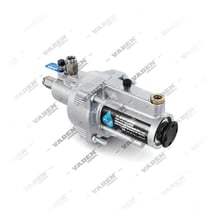
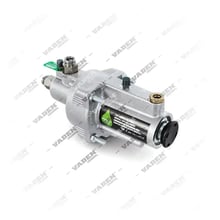
What are the functions of the Pressure Booster?
The main functions of the pressure booster within the clutch system are as follows.
- Force assistance: Increases the force applied by the driver on the pedal with the help of air pressure, easing clutch disengagement.
- Hydraulic pressure amplification: Boosts the hydraulic pressure coming from the master cylinder with air support and transmits it to the slave cylinder.
- Smooth gear shifting: Ensures the clutch engagement-disengagement motion happens in a more controlled and balanced way.
- Driver comfort: Reduces pedal fatigue during heavy traffic and long-distance use.
- System safety: Provides a redundant working principle that allows hydraulic pressure to still be transmitted, albeit limited, even if air assistance is disabled.
What are the symptoms of a Pressure Booster failure?
Pressure booster failures generally appear as pedal stiffness and deterioration in clutch response.
- Stiff pedal: The clutch pedal being noticeably harder to press than normal.
- Air leak sound: Hissing air escaping from the booster body or air connection.
- Oil/hydraulic leakage: Oil traces leaking from the hydraulic side, staining around the booster.
- Difficulty shifting gears: Stiffness or noise when shifting because the clutch does not fully disengage.
- Delayed response: Delayed engagement or slipping of the clutch when the pedal is released.
How is the Pressure Booster checked?
Before inspection, the engine should be started and the system pressure allowed to reach nominal level.
- Visual inspection: The body is examined for hydraulic or oil leakage traces.
- Air leak test: With the system under pressure, soapy water is applied to connection points to check for leaks.
- Pedal force comparison: Abnormal stiffness is evaluated by comparing against normal pedal force.
- Piston movement check: It is observed whether the booster piston moves smoothly and fully when the pedal is pressed.
- Connection and bracket check: The mounting bracket is physically checked for looseness.
What should be considered when replacing it?
Both the air and hydraulic lines must be handled correctly when replacing the pressure booster.
- Pressure release: Pressure in both the air and hydraulic lines must be safely released before starting replacement.
- Hydraulic bleeding: Bleeding must always be performed after installation so no air remains in the hydraulic line.
- Gasket and seal renewal: All removed gaskets and seals must be replaced with new ones.
- Correct hydraulic fluid use: No fluid other than the type specified by the manufacturer should be used.
- Test drive: Pedal force and clutch response should be verified with a short test drive after installation.
How is the Pressure Booster selected?
Selecting the right pressure booster requires evaluating vehicle model, system pressure and connection dimensions together.
Clutch pressure booster selection criteria| Criterion | Description |
|---|
| Vehicle/engine application | Compatibility with the vehicle model-specific clutch system design |
| Air connection size | Compatibility with system air line port diameter and thread type |
| Hydraulic connection size | Master/slave cylinder hydraulic line connection standard |
| Working pressure range | Compatibility with the vehicle's nominal air brake system pressure |
| Gasket/seal material | Original-size sealing elements resistant to hydraulic fluid |
Maintenance and service life
The service life of the pressure booster largely depends on the condition of its internal gaskets and seals; under heavy use these elements can wear over time and lead to leakage. Periodic maintenance should regularly check for leakage traces around the body, leaks at air connections, and changes in pedal force. Monitoring the hydraulic fluid level and repeating the bleeding procedure when necessary supports healthy system operation.
VADEN Pressure Booster
VADEN offers pressure boosters manufactured for the clutch systems of heavy commercial vehicles, matching original dimensions and pressure tolerances. With correct gasket material and precise piston manufacturing, it provides a solution that supports driver comfort and clutch reliability.
Frequently Asked Questions (FAQ)
Can the vehicle still be driven if the clutch pressure booster fails?
It can be driven to a limited extent, but since the pedal becomes very stiff and the clutch may not fully disengage, gear shifting becomes difficult; prompt attention is recommended.
Are the pressure booster and the clutch master/slave cylinder the same part?
No, the master and slave cylinders are separate components that generate and transmit hydraulic pressure; the pressure booster is an additional element that amplifies that hydraulic pressure with air assistance.
Can a booster with an air leak be repaired?
In some applications repair is possible with an internal seal kit, but if the body shows wear or cracking, complete replacement is a more reliable solution.
Why is bleeding the hydraulic line important when replacing the pressure booster?
Air remaining in the hydraulic line creates a spongy feel at the pedal and can prevent the clutch from fully disengaging, so the bleeding procedure must not be skipped after installation.
Why does the clutch pedal become stiffer over time?
Wear of the internal gaskets and seals in the pressure booster can reduce air assistance and increase pedal force; in this case the part should be checked.
Related technical guide: Clutch Central Unit (Lower/Upper Servo): Faults & Replacement