What are the functions of the exhaust manifold EGR pipe?
As a critical connecting element of the emission control system, the exhaust manifold EGR pipe performs several functions together.
- Gas routing: Ensures hot gas taken from the exhaust manifold reaches the EGR valve or cooler in a controlled manner.
- Sealing: Works together with the gaskets at the flange connections to prevent gas leakage and support accurate emission readings.
- Temperature resistance: Maintains its structural integrity despite continuous exposure to high exhaust gas temperature.
- Vibration tolerance: Connection points that provide flexibility against engine vibration prevent the pipeline from cracking.
- Emission compliance: A correctly functioning EGR circuit contributes to the engine operating in compliance with emission standards (Euro norms).
What are the symptoms of a faulty exhaust manifold EGR pipe?
A fault in the exhaust manifold EGR pipe negatively affects both engine performance and emission values.
- Exhaust leak sound: A crack in the pipe or a flange leak produces a hissing or knocking sound while the engine runs.
- Fault code and warning light: Pressure or flow deviation in the EGR circuit is logged as a fault code by the engine control unit.
- Loss of engine power: Disrupted EGR flow affects combustion efficiency and can cause a loss of power.
- Soot buildup: Soot accumulation around the pipe and at the connection points can be visually noticeable.
- Change in exhaust smoke: Disrupted EGR flow can cause a visible change in the color or density of exhaust smoke.
How is the exhaust manifold EGR pipe inspected?
Inspection starts with a visual check while the engine is cold and is completed with a pressure or smoke test if needed.
- Visual inspection: Check the pipe for cracks, deformation, excessive soot buildup, or discoloration.
- Flange tightness: Verify that the flange bolts connecting to the exhaust manifold and EGR valve are torqued to the correct value.
- Smoke test: Use an exhaust smoke generator to introduce pressurized smoke into the system and locate the leak point.
- Fault code reading: Scan the engine control unit's fault codes to check for any records related to the EGR circuit.
- Connection point inspection: Check vibration-absorbing connection elements for wear or cracking.
What should be considered during replacement?
Replacing the exhaust manifold EGR pipe is a precision job that directly affects sealing and must be done carefully.
- Gasket replacement: Replace all gaskets at the flange connections together with the new pipe; do not reuse the old gasket.
- Correct torque sequence: Tighten flange bolts in the sequence and to the value specified by the manufacturer, in stages.
- Heat shield check: Reinstall heat shields or insulation parts around the pipe undamaged.
- Alignment: Fit the pipe in correct alignment between the manifold and the EGR valve so no stress is created.
- Leak test: After installation, run the engine and check the connection points for leaks.
How to choose the right exhaust manifold EGR pipe?
Correct selection depends on the engine type and EGR system version; choosing by OE part number rather than brand reduces the risk of mismatch.
Exhaust manifold EGR pipe selection criteria| Criterion | Description |
|---|
| OE reference number | Use the number matching exactly the engine type and EGR system version |
| Material | High-temperature-resistant stainless steel or alloy |
| Flange type | Bolt hole pattern of the manifold and EGR valve connecting flanges |
| Length and angle | Geometry matching the layout in the engine bay |
| Emission norm | Design matching the vehicle's Euro emission standard |
Maintenance and service life
Because the exhaust manifold EGR pipe is continuously exposed to high temperature, material fatigue and soot buildup can appear over time; it does not require periodic replacement but regular visual inspection is recommended. Keeping the EGR valve and cooler clean reduces soot buildup inside the pipe and helps the system run efficiently. Always follow the EGR system maintenance intervals in the vehicle's current OE service manual.
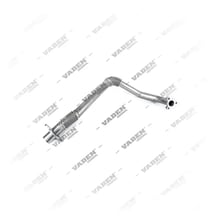
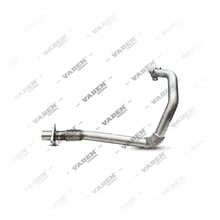
VADEN exhaust manifold EGR pipe
VADEN offers OE-referenced exhaust manifold EGR pipes for the heavy commercial vehicle engine group as stocked spare parts. Products are matched by OEM number to engine type and EGR system version, allowing technical workshops to identify the correct part quickly.
Frequently Asked Questions (FAQ)
Is soot buildup in the EGR pipe normal?
A certain level of soot buildup is expected due to the nature of the EGR system; however, excessive buildup can restrict flow and trigger a fault code, so regular inspection is recommended.
Does the fault code clear automatically after replacing the EGR pipe?
No, after replacing the pipe the fault code in the engine control unit must be cleared with a diagnostic tool and the system retested.
How does a leak in the EGR pipe affect engine power?
A leak disrupts the pressure balance in the EGR circuit and can reduce combustion efficiency, which is felt as power loss and increased fuel consumption.
Should the heat shield also be checked during pipe replacement?
Yes, if the heat shield is damaged, nearby wiring and hoses face a risk of overheating, so the shield's condition should also be verified.
Is the VADEN exhaust manifold EGR pipe a direct fit for the original part?
VADEN products are matched by OE reference number; when the correct OEM number is selected, flange, length, and angle match the original.
Related technical guide: Exhaust Manifold: Cracks, Leaks, Replacement & Torque Guide