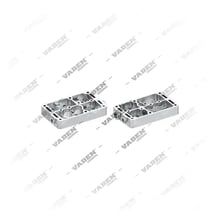
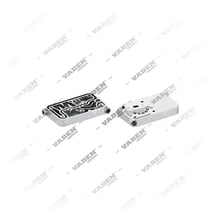
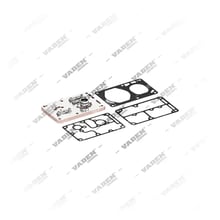
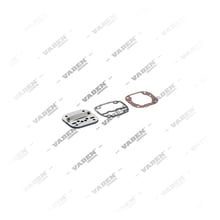
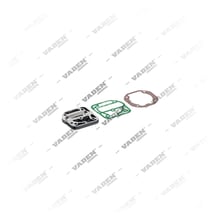
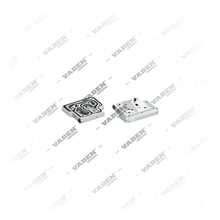
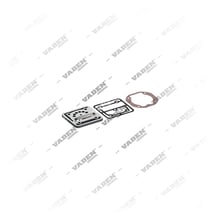
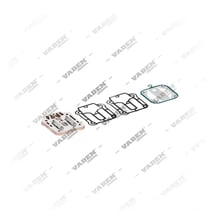
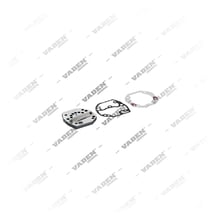
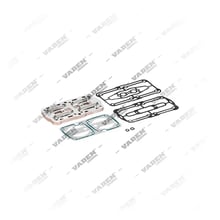
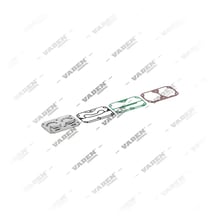
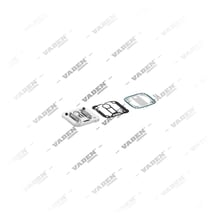
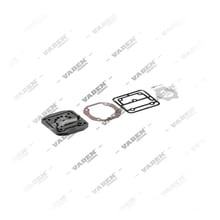
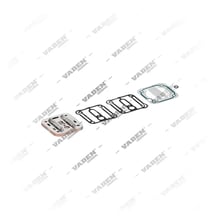
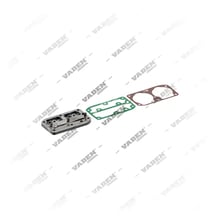
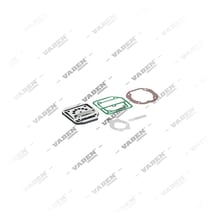
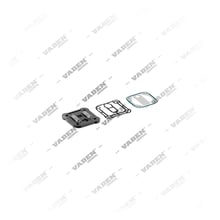
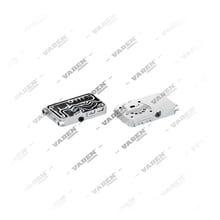
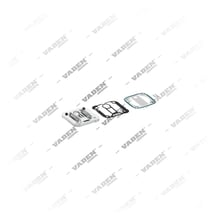
What is a compressor valve plate?
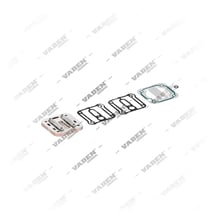
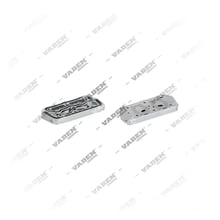
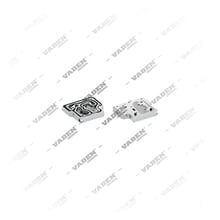
Structurally, the plate is a single-piece body containing intake ports, discharge ports, reed seats, reed stoppers, and mounting holes. Its top and bottom surfaces are ground to provide sealing with the gasket; the flatness of these surfaces directly determines compressor efficiency. Single-stage compressors have a single row of ports, while twin-cylinder and two-stage applications have multiple port groups and intermediate transfer channels on the plate. Because the compressor in truck, tractor, bus, and trailer applications runs continuously under load, the valve plate is one of the parts most subject to thermal stress and impact fatigue.
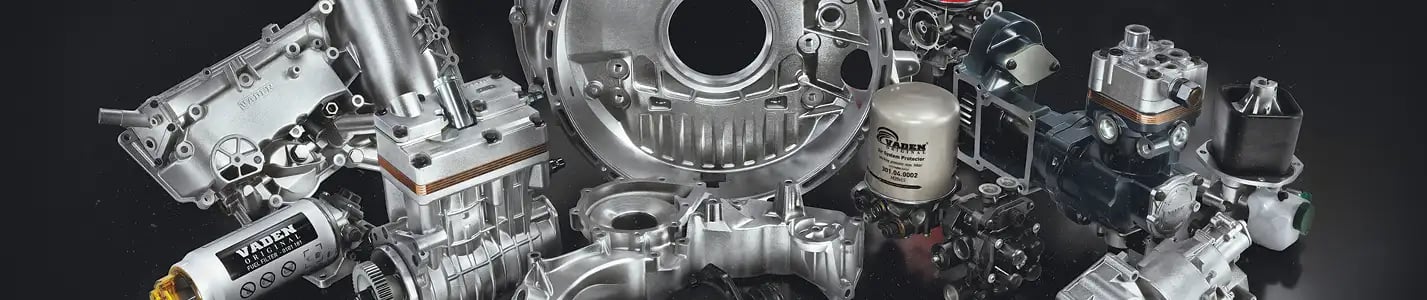
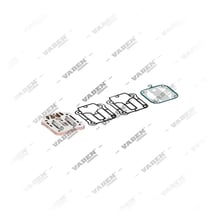
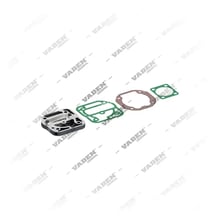
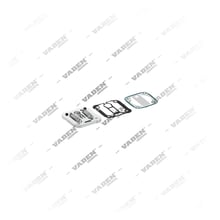
The valve plate is not a standalone wear part by itself; together with the reeds, reed springs, mounting rivets or screws, and top-bottom gaskets it forms a sealing system. For this reason, in the field the plate is usually handled together with the gasket kit and reed set, as part of a compressor overhaul.
What are the functions of the compressor valve plate?
The valve plate is one of the most critical components determining the efficiency of the compressor that produces compressed air in the air brake system. Its main functions are:
- One-way flow control: The intake reed opens as the piston descends, drawing fresh air into the cylinder; it closes as the piston rises. The discharge reed opens only when in-cylinder pressure exceeds line pressure, sending air to the dryer or air tank.
- Sealing: The seating surface between the plate surface and the reed prevents leakage during the compression stroke. If this seating fails, the produced air leaks back to the intake side and fill time increases.
- Separation between block and head: The plate separates the hot discharge region from the relatively cool intake region; in water-cooled compressors this separation also prevents cooling water from mixing with the air channels.
- Limiting reed movement: The stoppers on the plate limit the opening height of the reed, preventing it from bending excessively and fatiguing before breaking.
- Heat transfer: Part of the heat released during compression is transferred through the plate to the head and cooling circuit.
What are the symptoms of compressor valve plate failure?
Valve plate failures most often arrive at the service with the complaint "compressor isn't building air," but symptoms can be read earlier:
- Longer air fill time: If the vehicle's tanks fill noticeably later than normal, the reed seating surface is one of the first places to suspect.
- Compressor staying constantly in load mode: Due to pressure leakage the regulator cannot unload the compressor; the compressor runs continuously, and fuel consumption and temperature rise.
- Excessive oil carryover: Leakage on the discharge side and high temperature cause oil to vaporize and be carried into the line. Early saturation of the air dryer cartridge and oil accumulation in tanks and valves are typical indicators.
- Overheating of the compressor head: As hot air leaks back into the cylinder, the head and discharge line heat above normal; discoloration (darkening) may be seen on the discharge pipe.
- Metallic ticking and knocking: If a broken reed fragment circulates at the port mouth, a rhythmic metallic sound comes from the compressor; this requires urgent attention.
- Blowback from the intake side: Air blowing back from the intake filter or line shows the intake reed is not closing.
- Air or oil leakage between head and block: Caused by warping of the plate surface or gasket crushing.
How is the compressor valve plate checked?
The check has two stages: a performance test on the vehicle, followed by inspection of the removed part.
- Fill time measurement: With the system drained, the time for the tanks to reach a certain pressure at a specified engine speed is measured and compared with the value given by the vehicle manufacturer.
- Temperature comparison: The intake and discharge regions are compared with an infrared thermometer; abnormal elevation on the discharge side indicates a leak.
- Visual inspection: After the plate is removed, port openings are checked for notches, pits, carbon buildup, and scratches. The reed seating mark is expected to form an unbroken, even ring.
- Flatness measurement: The plate surface is checked in cross directions with a straightedge and feeler gauge. Visible warping is a definitive sign of a heat-deformed plate.
- Reed inspection: The reed is laid on a flat surface; if there is lift, cracking, tip curling, or breakage, the reed set must be renewed.
- Sealing test: With the plate installed, low-pressure air is applied to the discharge port and reverse leakage is observed.
The reference for measurements is always the vehicle's and compressor's current OE service manual; a plate that falls outside the tolerance in the manual should be renewed, not ground.
What should be watched for during replacement?
Valve plate replacement concerns the entire upper group of the compressor. The most common field errors occur during installation:
- Always renew the gasket kit: A used gasket leaks even if the plate surface is flawless. Both top and bottom gaskets must be replaced together.
- Clean the surfaces: Carbon and old gasket residue on the block and head surfaces are cleaned without scratching the surface. Scrapers and grinding stones that damage the surface must not be used.
- Direction and position: The plate's installation direction and pin/locating holes must be checked; a reversely installed plate swaps the intake and discharge ports and damages the compressor on first start.
- Staged and cross-pattern tightening: Head bolts are tightened in cross order in several stages. Going to full torque in one pass warps the plate. The manufacturer's manual is authoritative for the torque value.
- Foreign object check: Fragments from a previously broken reed may remain in the cylinder or discharge channel; channels must be cleaned before installation.
- Discharge line and dryer: After an overheated compressor, the carbon plug in the discharge pipe and a saturated dryer cartridge should also be checked and renewed if necessary.
- First start: After installation, the compressor is run unloaded for a while; the head area is monitored for leaks and temperature rise.
How is the compressor valve plate selected?
The only reliable way to select correctly is OE number matching. The manufacturer's number on the compressor housing (Wabco, Knorr-Bremse, Bendix, or Mercedes-Benz, MAN, Volvo, DAF, Scania, Iveco vehicle number) should be read and the plate searched by this number. Since different compressor types can be used even on the same vehicle model, model information alone is not sufficient; the OE number is decisive, not the brand name. Cylinder count, single/twin stage, air-cooled or water-cooled housing, and port layout form the basis of the selection criteria. Our product group offers numerous valve plate options suitable for different compressor types; by providing the compressor code, correct matching can be done quickly.
Compressor valve plate selection and inspection points| Inspection point | What is checked | Decision |
|---|
| OE number | Manufacturer code on the compressor housing | Exact match required |
| Port layout | Number and location of intake/discharge ports | Compare side by side with the old part |
| Plate thickness | Comparison with the removed part | A different thickness is not acceptable |
| Surface flatness | Straightedge + feeler gauge | Renew if out of tolerance |
| Reed seating mark | Unbroken ring mark | Renew if notches/pits present |
| Reed and spring | Cracks, curling, breakage | Replace as a set |
| Gasket kit | Top and bottom gasket | New at every disassembly |
| Tightening torque | OE service manual value | Cross and staged tightening |
Maintenance and service life
The life of the valve plate depends directly on the quality of the air and oil entering the compressor. Dirty intake air has an abrasive effect on port openings, while degraded or late-changed engine oil leads to carbon buildup on the plate. Carbon prevents the reed from seating fully, creating a leak, and the leak raises temperature, triggering further carbon formation. This cycle is the most common reason an otherwise long-lived plate wears out prematurely.
In practice, the following maintenance habits noticeably extend life: periodic checking of the intake filter or the line supplying air to the compressor, changing engine oil and oil filter at the interval given by the vehicle manufacturer, timely renewal of the air dryer cartridge, regular water drainage of the tanks, and keeping the cooling circuit (in water-cooled compressors) unobstructed. Because an excessively long or too narrow discharge line also raises temperature, OE dimensions should be adhered to when making line modifications.
If a compressor overhaul is being performed, the valve plate, reed set, gasket kit, and piston rings should be handled together. Replacing only the reed and continuing to use a worn plate leads to the new reed deteriorating again quickly.
VADEN compressor valve plate
VADEN is a manufacturer specialized in the production of air brake compressors and compressor parts. In the compressor valve plate group, a wide application range is offered suitable for the single- and twin-cylinder compressor types commonly used in heavy commercial vehicles. Products are manufactured taking into account the compressor's operating temperature and duty cycle, with size and surface quality controlled. The fastest way to the correct part is to provide the OE number on the compressor housing; you can match the valve plate suited to your application among the options in this category.
Frequently Asked Questions (FAQ)
If the compressor valve plate fails, does the vehicle stop building air completely?
Generally not completely; a gradual performance loss is seen first. Fill time lengthens, the compressor stays in continuous load mode, and the discharge side overheats. However, if a reed breaks and blocks the port opening, or a fragment gets into the cylinder, air production can stop suddenly and more severe compressor damage may occur. Therefore lengthening fill time should be treated as an early warning.
Can a worn valve plate be salvaged by grinding?
Not recommended. Plate thickness and reed seating height are precision dimensions; when the surface is ground, dead volume and reed opening height change, efficiency drops, and the reed fatigues prematurely. If there are pits, notches, or measurable warping on the surface, the part should be renewed. For dimensional tolerances, the vehicle's current OE service manual is authoritative.
Should the gasket kit and reeds also be changed when replacing the valve plate?
Yes. Gaskets are single-use; a reused gasket leaks between the head and block. Reeds wear as a pair with the plate. Installing an old reed on a new plate, or a new reed on a worn plate, causes leakage to recur quickly due to seating mismatch. During an overhaul, the plate, reed set, and gasket kit should be handled together.
How do I choose the correct valve plate — is the vehicle model enough?
Vehicle model alone is not sufficient. Different compressor types can be used within the same model. Read the OE number on the compressor housing (Wabco, Knorr-Bremse, Bendix, or Mercedes-Benz, MAN, Volvo, DAF, Scania, Iveco vehicle number) and select based on this number. Also compare port count, port layout, and plate thickness with the removed part. The OE number, not the brand name, is decisive.
Can oil reaching the air dryer be caused by the valve plate?
Yes, it is a common cause. A leak on the discharge side raises in-cylinder temperature, and the high temperature causes oil to vaporize and be carried with the air. The dryer cartridge saturates early, and oil accumulates in tanks and valves. In this case, replacing only the cartridge is not a solution; the compressor's upper group and valve plate should be checked, and carbon buildup in the discharge line should also be cleaned.
Related technical guide: Truck Air Compressor Overhaul Kit: Head, Valve Plate, Gasket