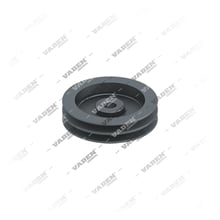
The pulley's correct diameter and gear/belt profile determine the speed at which the compressor operates relative to engine speed; if this ratio changes, both the compressor's air output capacity and its mechanical service life are directly affected. In heavy commercial vehicles, the compressor is an auxiliary unit that runs continuously as long as the engine runs; the pulley must provide uninterrupted power transfer throughout this continuous operation, which is why it is manufactured to resist material fatigue and vibration.
What are the functions of Compressor Pulley?
The pulley's functions within the system are aimed at keeping the compressor running in sync and efficiently with the engine.
- Motion transfer: Transmits rotational motion taken from the engine to the compressor's crankshaft.
- Speed ratio setting: Its diameter and tooth count determine the compressor's operating speed (reduction ratio) relative to engine speed.
- Load bearing: Withstands radial and axial loads arising from belt tension or gear/chain force.
- Alignment: Keeps the drive element (belt/chain) running in the correct plane, preventing premature wear.
- Vibration balance: Limits vibration generated during rotation through balanced mass distribution.
- Cooling contribution: In some designs, fins on the pulley provide a small contribution to airflow around the compressor.
What are the symptoms of Compressor Pulley failure?
A pulley failure usually shows up as noise, vibration, and changes in compressor performance.
- Abnormal noise: Knocking, ticking, or belt-slip noise coming from the pulley area.
- Excessive vibration: Increased vibration felt while the engine runs due to pulley imbalance or loose mounting.
- Drop in compressor air pressure: Wear on the pulley teeth or belt seating surface can cause drive loss and, as a result, insufficient air output.
- Visible damage: Cracking on the pulley surface, broken teeth, or heavily worn belt marks.
- Loose connection: Signs the pulley is moving on the shaft or that the retaining nut has loosened.
How is Compressor Pulley checked?
Inspection should be performed with the engine stopped and the compressor accessible.
- Visual inspection: Check the pulley surface, tooth profile, or belt seating surface for cracks, wear, and deformation.
- Fastening check: Verify the nut or bolt securing the pulley to the shaft is tight to the correct torque.
- Alignment check: Verify the pulley is in the same plane as the other pulleys/gears in the drive system.
- Vibration/noise test: Run the engine at idle and listen for abnormal noise or vibration from the pulley area.
- Balance check: In suspect cases, check the pulley's dynamic balance.
- Surface temperature: On pulleys experiencing belt slip, the contact surface can be checked by hand (with the engine cold) for abnormal heating.
What should be considered during replacement?
Correct installation directly affects the service life of the compressor and the drive system.
- Correct removal: Remove the pulley from the shaft with a suitable puller without forcing it; impact-based removal can damage the shaft.
- Cleanliness: Clean the shaft and pulley bore of dirt and rust residue before installation.
- Correct torque: Tighten the retaining nut/bolt to the manufacturer's specified torque.
- Belt/gear tension: After pulley replacement, adjust belt tension or gear/chain clearance to the manufacturer's specified value.
- Alignment verification: Recheck after installation that the pulley is in the same plane as the other drive elements.
How should Compressor Pulley be selected?
Selection requires an exact match to the compressor model and drive type.
Compressor pulley selection criteria| Criterion | Description |
|---|
| Compressor model match | Pulley diameter and shaft connection geometry vary by compressor model |
| Tooth count/reduction ratio | Must have the ratio needed for the compressor to run at the correct speed |
| Drive type | Must have a profile suited to belt-driven, gear-driven, or chain-driven systems |
| Material and balance | Must be made of wear-resistant material that runs balanced at high speed |
| Bolt hole | Must match the shaft and fastener size exactly |
Maintenance and service life
A compressor pulley secured to the correct torque and subject to regular alignment checks is a long-lasting component. Periodically checking belt tension prevents premature wear on the pulley's tooth surfaces. On vehicles operating in dusty, dirty environments, regular cleaning of the pulley area slows down wear. For fleet vehicles, evaluating the compressor drive system as a whole (pulley, belt/chain, and tensioner) during periodic maintenance prevents early wear in one component from spreading to the others. For exact torque and tension values, the vehicle's current OE service manual is authoritative.
VADEN Compressor Pulley
VADEN offers OE-compatible compressor pulleys for heavy commercial vehicle air brake compressors. Manufactured with correct reduction ratio and balance characteristics, the part supports efficient, quiet operation of the compressor.
Frequently Asked Questions (FAQ)
What does a compressor pulley do?
It transfers the engine's rotational motion to the compressor's crankshaft, allowing the compressor to produce compressed air for the air brake system.
What happens if the pulley teeth wear out?
Slip and efficiency loss occur in belt or chain drive, the compressor's air output capacity can drop, and the drive element's service life shortens.
What does noise from the pulley indicate?
It usually indicates a loose fastener, misalignment, or a worn tooth/belt surface; if ignored it can cause more serious damage to the compressor or drive system.
Is balance important when replacing the pulley?
Yes, an unbalanced pulley generates vibration at high speed and can shorten the service life of both the compressor shaft and its bearings.
What happens if a pulley with the wrong reduction ratio is used?
The compressor runs at higher or lower speed than intended; too high a speed causes overheating and premature wear, while too low a speed can cause insufficient air pressure.
Related technical guide: Clutched Air Brake Compressor: Faults, Replacement, Care