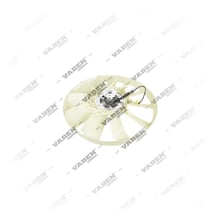
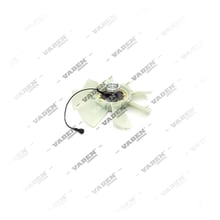
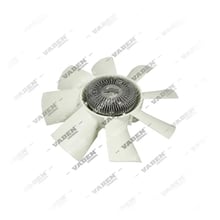
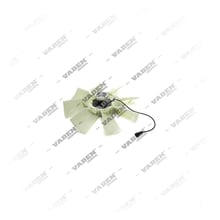
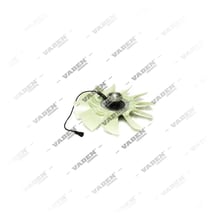
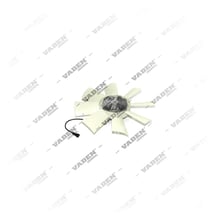
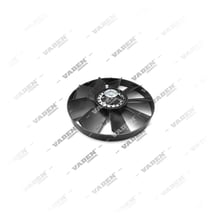
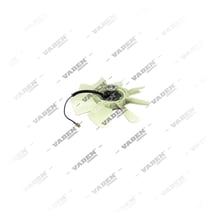
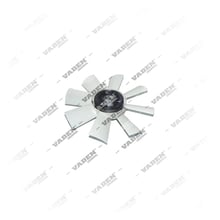
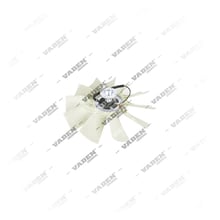
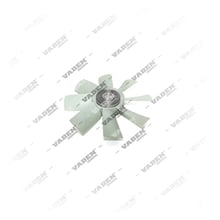
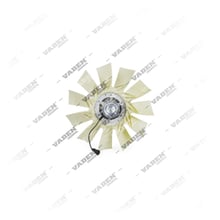
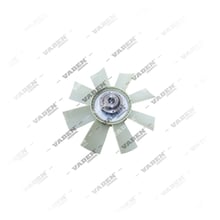
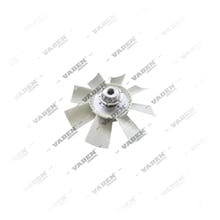
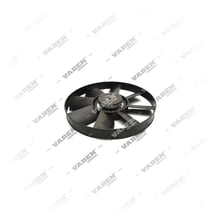
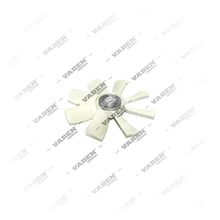
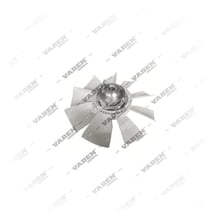
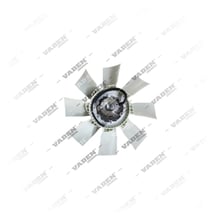
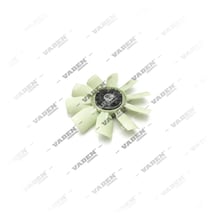
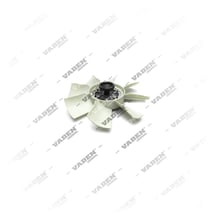
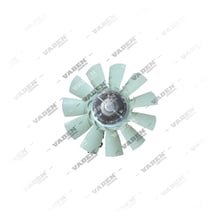
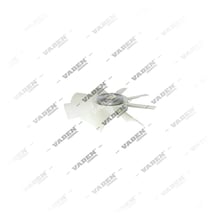
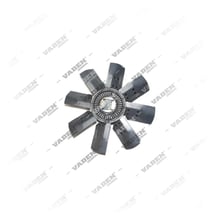
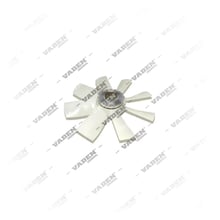
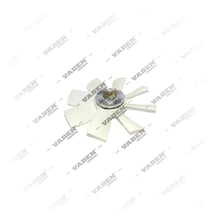
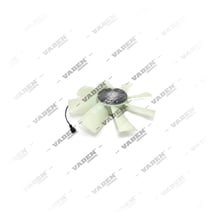
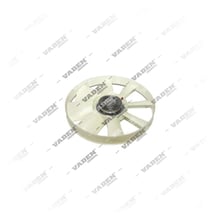
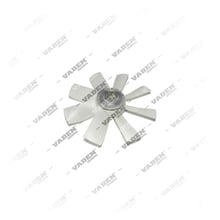
What Is a Visco Fan?
The viscous fan clutch is the temperature-controlled clutch that engages a heavy commercial vehicle's radiator fan according to engine temperature, part of the Cooling System > Fan chain. In the field it also goes by thermatic fan clutch or fan drive clutch, and some mechanics still call it a "mercury fan" out of habit, even though the housing never contained mercury — the sealed chamber holds silicone fluid whose viscosity changes with temperature. This subgroup covers clutch housings, fan blades, mounting flanges, and fasteners.
A fixed-drive fan spins continuously at engine speed and draws power even when the engine is cold. A viscous fan clutch instead drives the blade through a controlled coupling that free-wheels until extra airflow is actually needed, giving a faster climb to operating temperature, less parasitic power loss, and lower fan noise.
How Does a Visco Fan Work?
Operation starts with a bimetallic spring that senses the temperature of the air coming off the radiator core. As temperature rises, the spring flexes and opens a valve plate, letting silicone fluid flow into the working chamber. Sheared between the drive disc and housing, the fluid transmits engine rotation to the blade. Once temperature drops, the valve closes, fluid returns to the reservoir, and the fan goes back to free-wheeling.
- Temperature Sensing: A bimetallic spring measures air temperature off the radiator core and mechanically triggers the valve.
- Progressive Engagement: Fan speed rises in stages as more fluid fills the chamber.
- Free-Wheel Mode: While the engine is cold the blade turns slowly, keeping power draw to a minimum.
- Electronic Control: On electro-viscous versions, a control-unit solenoid replaces the spring, reacting to coolant and A/C pressure together.
Visco Fan Technical Specifications
Performance is defined by housing material, mounting type, engagement temperature, and coupling capacity. Housings are cast from heat-conductive aluminum alloy, the disc set is hardened steel or aluminum, the bearing is lubricated for life, and the silicone fluid is factory-filled — neither is topped up in the field. Mounting is a bolt-on flange, a threaded hub, or a shaft-fit design.
Compatibility depends on bolt hole count and diameter, hub thread direction, installed height, blade count, outer diameter, and rotation direction; wrong rotation reverses the airflow. These figures are general guidance — for exact engagement temperature and torque, the vehicle manufacturer's current service manual is the authority.
Visco Fan Types and Subcomponents
- Bimetallic Thermostatic Clutch: The most common type; fully mechanical, no extra wiring.
- Electro-Viscous Clutch: Managed by a control-unit signal, weighing coolant temperature and A/C pressure together.
- Heavy-Duty Full-Lock Type: For tractor units, dump trucks, and off-road machinery needing a higher engagement ratio.
- Fan Blade Assembly: Reinforced polymer or metal blades; replace together with the clutch.
- Mounting Flange, Hub & Pulley: Connects the clutch to the engine; a worn flange unbalances a new unit.
- Fasteners: Bolt sets, washers, and gasket kits.
How to Choose the Right Visco Fan
Correct selection starts with the vehicle model and engine code — even the same tractor unit can carry different hub connections and engagement temperatures across its engine options. Before ordering, check the removed part's OE number, bolt pattern, and hub thread direction.
Selection criteria for a Viscous Fan Clutch| Criterion | What to Check | Result of the Wrong Choice |
|---|
| Engine code and model year | Vehicle type plate, engine number | Mounting won't line up, height mismatch |
| Connection type | Bolted flange, threaded hub, or shaft fit | Cannot be installed, thread strips |
| Hub thread direction | Right- or left-hand thread marking | Clutch works itself loose in operation |
| Fan diameter and blade count | Clearance to the shroud | Contact with the shroud, blade breakage |
| Rotation direction | Direction arrow marked on the fan | Airflow runs backward, cooling falls short |
| OE cross-reference | OE number of the removed part | An incompatible unit gets shipped |
Visco Fan Maintenance and What to Watch For
A viscous fan clutch is sealed and needs no fluid top-up or internal servicing over its working life; maintenance comes down to periodic inspection and disciplined installation. With the engine cold, turning the blade by hand should meet light, even resistance — neither spinning freely nor feeling locked.
- Keep the Fins Clean: Dust-clogged fins push internal temperature up, and the fluid breaks down prematurely.
- Inspect the Fan Alongside the Clutch: A cracked blade wears out a new clutch's bearing quickly.
- Respect the Torque Values: Tighten bolts crosswise to spec; a loose mount throws off the balance.
- Check the Belt and Pulley: A slipping belt leaves cooling inadequate even when the clutch engages correctly.
- Don't Forget the Radiator and Thermostat: A clogged radiator gives the same overheating symptom as a failed clutch.
Common Failures and How to Fix Them
- Engine Overheats but the Fan Won't Engage: Fatigued bimetallic spring or stuck valve; test on a hot engine, and replace the unit if speed doesn't rise.
- Fan Stays at High Speed Constantly: Fluid trapped in the chamber or valve stuck open; constant roar and rising fuel use, unit needs replacing.
- Humming and Vibration at Idle: Bearing wear or blade imbalance; inspect the clutch and fan together.
- Cracked Fan Blade: Shroud contact or debris impact; a broken blade unbalances the assembly and should be replaced right away.
- Fault Code on Electronic Types: Solenoid wiring fault or lost sensor signal; check the harness before swapping the unit.
Why VADEN ORIGINAL?
VADEN builds air brake and engine auxiliary systems for heavy commercial vehicles. Viscous Fan Clutch products are made to OE dimensions — mounting pattern, hub thread direction, and fan diameter matched to the original — with broad OEM cross-reference for fast, correct fitment across Mercedes-Benz, MAN, Scania, Volvo, DAF, Iveco, Renault Trucks, BMC, and Ford applications.
- Built to OE Dimensions: Mounting measurements and rotating-mass balance verified against the original unit.
- Broad OEM Matching: Cross-referenced by OE number against the removed part.
- Exported to 100+ Countries: A wide network keeps supply flowing for fleets and workshops.
- Kit Completeness: Clutch, fan, and mounting hardware under one roof.
Conclusion
The viscous fan clutch is a decisive component in the Cooling System > Fan chain, keeping engine temperature in balance and heading off unnecessary power loss. Choosing the right unit goes smoothly once engine code, connection type, hub thread direction, fan diameter, and rotation direction are confirmed. For an overheating complaint, checking the radiator, thermostat, and belt alongside the clutch avoids unnecessary parts swaps. For installation values, the vehicle manufacturer's current service manual is the final word.
Frequently Asked Questions (FAQ)
Does a "mercury fan" actually contain mercury?
No. It's a naming habit that stuck in the field, but the unit never contained mercury at any point. Inside the clutch is a high-viscosity silicone fluid whose flow behavior changes with temperature. That fluid is filled at the factory and is not topped up in the field.
How can you tell a viscous fan clutch has failed?
With the engine cold, turning the blade by hand should meet light resistance — it shouldn't spin completely free, and it shouldn't feel locked either. If fan speed doesn't rise noticeably once the engine warms up, or if the fan instead roars at high speed all the time, that points to a fault. A ring of oily residue on the front face of the clutch also signals silicone loss.
Can a viscous fan clutch be repaired?
It's a sealed, factory-filled unit — the internal valve assembly and the silicone fluid can't be renewed under field conditions. Once you're dealing with silicone loss, a stuck valve, or bearing wear, replacing the unit complete is the correct call.
Does the fan blade need to be replaced along with the clutch?
Yes, if the blade shows cracks, a broken tip, or a missing balance weight, it should always be replaced at the same time. An unbalanced blade will chew through a new clutch's bearing in short order, and the vibration complaint will simply come right back.
What information should I have ready to choose the right viscous fan clutch?
Vehicle model and model year, engine code, the OE number of the removed part, connection type, hub thread direction, and the fan's outer diameter are usually enough. If the vehicle has air conditioning, a retarder, or extra cooling equipment, mention that too — those setups can call for a higher engagement capacity.
Related technical guide: Viscous Fan Clutch: Fault, Replacement & Maintenance Guide