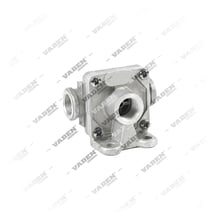
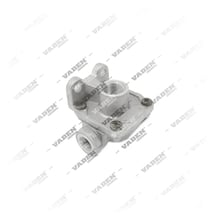
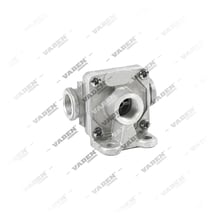
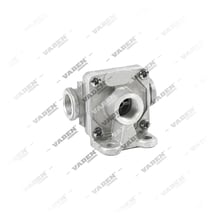
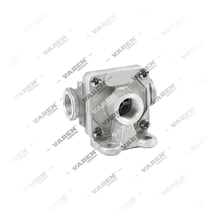
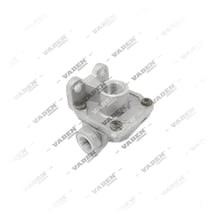
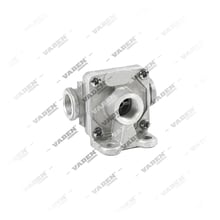
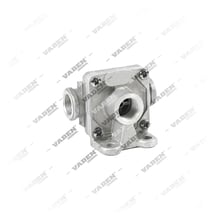
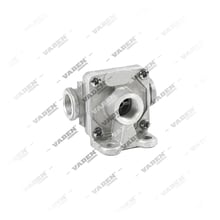
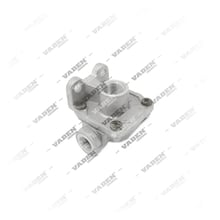
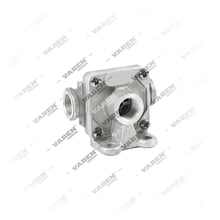
What Is a Quick Release Valve?
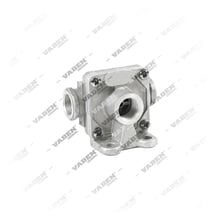
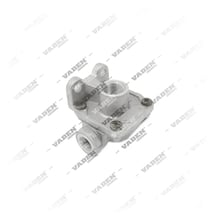
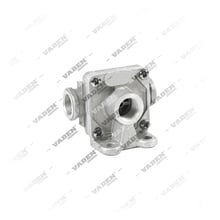
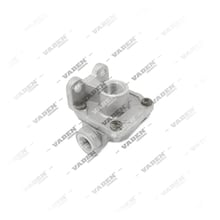
The Quick Release Valve is a complete valve unit in the pneumatic brake system of heavy commercial vehicles that rapidly vents compressed air from the brake chambers the instant the brake pedal is released. It is typically mounted close to the rear axle brake chambers and eliminates the release lag caused by long air lines. In the field it is also referred to as a quick exhaust valve. This category covers the complete body-diaphragm-cover assembly; individual repair parts such as seals and the diaphragm are listed separately under a repair kit group. The decision point here is whether to replace a worn unit complete or overhaul it with a repair kit. VADEN ORIGINAL Quick Release Valve is manufactured to OE dimensions referenced to Wabco and Knorr-Bremse, offering direct bolt-on compatibility.
How Does a Quick Release Valve Work?
When the brake pedal is pressed, the rubber diaphragm inside the valve body directs the incoming compressed air to the brake chamber and closes the exhaust port. When the pedal is released, pressure in the supply line drops, the diaphragm shifts position, and the air in the brake chamber vents directly to atmosphere through the wide exhaust port on the valve instead of having to travel back to the main valve block. As a result, the brake chamber empties much faster and the linings release from the drum or disc almost instantly. Especially on multi-axle trucks and trailers, this speed advantage prevents brake drag and preserves lining and drum or disc life.
Quick Release Valve Technical Specifications
The valve body is typically made from cast aluminum or a high-strength polymer, while the internal diaphragm is manufactured from synthetic rubber resistant to temperature and pressure fluctuations. Connections may be standard metric thread sizes such as M16 or M22, or a vehicle-specific flange type, with one inlet and two outlet ports. The working pressure range varies by vehicle manufacturer, and the vehicle's current service manual should always be consulted for exact torque, pressure, and tolerance values. When determining compatibility, body shape, port diameter, thread standard, and mounting hole spacing must all be verified together.
- Body Material: Cast aluminum or high-strength polymer provides resistance to corrosion and vibration.
- Diaphragm Material: A synthetic rubber compound with high temperature and ozone resistance is used.
- Connection Standard: Available with M16 or M22 thread sizes as well as flanged mounting options.
- Port Configuration: Features one inlet, one or two outlet ports, and a wide-diameter exhaust port.
Quick Release Valve Types and Subgroups
- Single-Outlet Quick Release Valve: The basic body type serving a single brake chamber or circuit.
- Dual-Outlet Quick Release Valve: Simultaneously supplies and vents two brake chambers on the same axle.
- Flange-Mounted Type: Designed for direct bolted attachment to the axle or chassis.
- Threaded-Connection Type: A compact-body variant that screws directly into the air line.
- Quick Release Valve for Trailers: Used to increase release speed in trailer brake circuits due to long air lines.
How to Choose the Right Quick Release Valve
Choosing correctly requires verifying vehicle make, axle type, number of ports, and connection standard together. The table below summarizes the key criteria to consider during selection.
Quick Release Valve Selection Criteria| Criterion | Check Point |
|---|
| Number of Ports | Whether a single or dual outlet is required is determined by the axle layout |
| Connection Type | Whether flanged or threaded must be matched to the existing line configuration |
| Thread Standard | Sizes such as M16 or M22 must match the original part exactly |
| Body Material | Cast aluminum or polymer body should suit the operating environment |
| OE Reference Number | Should be cross-checked against Wabco or Knorr-Bremse references |
| Complete Unit or Repair Kit | If the body shows cracks or deformation, complete replacement should be preferred |
Quick Release Valve Maintenance and Points to Watch
- Port Cleaning Before Installation: Dirt and moisture in the inlet and outlet ports should be cleaned before installation, as they can prevent the diaphragm from seating properly.
- Correct Tightening Torque: Overtightening can crack the body, while insufficient tightening causes air leaks; the torque value specified by the vehicle manufacturer should be applied.
- Keeping the Exhaust Port Clear: Dust and mud buildup reduces release speed; the exhaust port should be checked periodically.
- Diaphragm Inspection: A hardened or cracked diaphragm causes release delay and should be replaced promptly.
- Verifying Mounting Direction: The valve must be installed according to the airflow direction marked on it; reversed installation negatively affects brake response.
Common Faults and Solutions
- Slow Brake Release: Caused by a hardened diaphragm or a clogged exhaust port; the valve should be cleaned or replaced complete.
- Continuous Air Leak Noise: Caused by a torn diaphragm or a worn sealing surface; complete valve replacement is recommended.
- Brakes Not Fully Releasing (Drag): Caused by the diaphragm failing to shift position or dirt buildup inside the body; the valve should be disassembled and inspected, and replaced if necessary.
- Asymmetric Braking Effect: Caused by one port becoming blocked on a dual-outlet valve; both outlets should be tested separately and the valve replaced.
- Delayed Response in Cold Weather: Hardened rubber diaphragms lose flexibility at low temperatures; a temperature-resistant OE-quality part should be used.
Why Choose a VADEN ORIGINAL Quick Release Valve?
- Manufactured to OE Dimensions: Body, port, and thread dimensions are produced to match the original part exactly, requiring no additional machining.
- Broad OEM Coverage: Compatible with multiple vehicle makes and models corresponding to Wabco and Knorr-Bremse references.
- Durable Diaphragm Material: A rubber compound resistant to temperature and pressure fluctuations maintains release speed over the long term.
- Leak-Tight Body Tolerances: Precision manufacturing tolerances reduce the risk of air leaks after installation.
- Exported to More Than 100 Countries: Delivered with the quality and supply capacity trusted by fleet operators worldwide.
Conclusion
The Quick Release Valve is a critical safety component that rapidly vents air from the brake chambers, ensuring the linings release instantly and preventing brake drag. A valve selected with the correct number of ports, connection type, and OE reference directly affects both brake response time and lining and drum life. VADEN ORIGINAL Quick Release Valve, built to OE dimensions with broad vehicle compatibility, offers a reliable choice for fleet maintenance.
Frequently Asked Questions (FAQ)
What does a quick release valve do?
A quick release valve vents the compressed air in the brake chamber directly to atmosphere through its wide port when the brake pedal is released, instead of sending it back to the main valve block. This allows the brake chamber to empty much faster, so the linings release from the drum or disc almost instantly.
What happens when a quick release valve fails?
A faulty valve causes brakes not to release fully (drag), slow brake response, or a continuous air leak sound. Since these symptoms can lead to premature lining wear and increased fuel consumption, the valve should be inspected without delay.
Should I replace the quick release valve complete or repair it?
If the body shows no cracks, deformation, or excessive corrosion, replacing only the diaphragm and seals may be sufficient. However, if the body is damaged or release performance has dropped significantly, complete valve replacement is both safer and more economical in the long run.
Which vehicles is the VADEN ORIGINAL quick release valve compatible with?
VADEN ORIGINAL quick release valves are compatible with the Wabco and Knorr-Bremse referenced pneumatic brake systems found on heavy commercial vehicles from makes such as Mercedes-Benz, MAN, Scania, Volvo, DAF, Iveco, Renault, and BMC. Before ordering, the number of ports and connection type should be verified against the vehicle.
What should be considered when installing a quick release valve?
The valve must be installed in the airflow direction indicated on it, the ports should be free of dirt and moisture, and the tightening torque specified by the vehicle manufacturer should be applied. Incorrect mounting direction or improper torque can cause air leaks or body damage.
Related technical guide: Air Dryer Purge Valve: Faults, Replacement and Maintenance