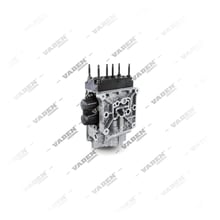
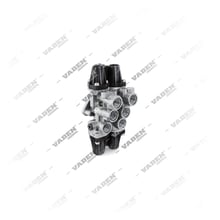
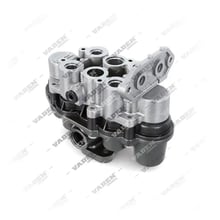
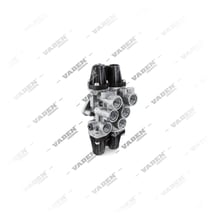
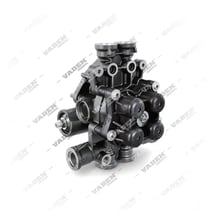
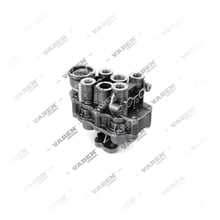
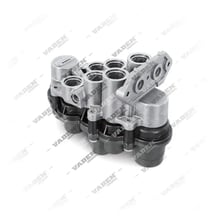
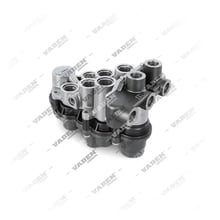
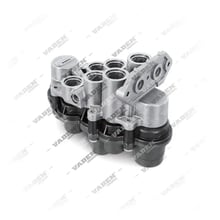
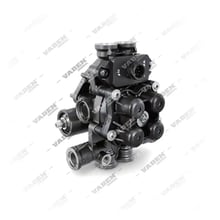
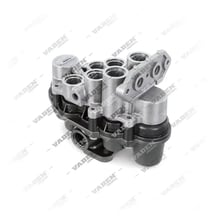
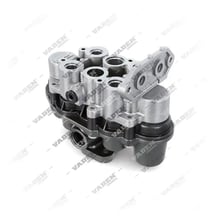
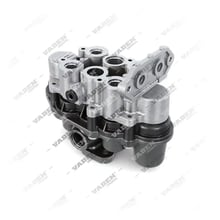
What are the functions of a multi-circuit protection valve?
The functions of the multi-circuit protection valve center on securing the brake system on a per-circuit basis.
- Circuit separation: Splits the single air supply from the compressor into independent brake circuits.
- Fault isolation: If a leak or rupture occurs in one circuit, isolates that circuit so the others do not lose pressure.
- Priority sequencing: Adjustable springs set a fill priority between circuits so critical circuits (e.g. the service brake) pressurize first.
- Minimum pressure protection: Each outlet withholds air from its circuit until a set minimum pressure is reached, ensuring the system fills in a balanced way.
- Backflow prevention: Internal check valves prevent air in a full circuit from bleeding back into a faulty one.
- System consolidation: Distributes multiple circuits from a single point, reducing the number of lines and potential leak points.
What are the symptoms of a failed multi-circuit protection valve?
Faults in this valve typically show up as a pressure problem in one or more brake circuits.
- Slow pressure build-up: Brake circuits pressurize more slowly than normal after start-up.
- Continuous air leak sound: An audible air leak from the valve body or its connections.
- A circuit failing to pressurize: A specific circuit (for example the parking brake or trailer circuit) does not build pressure while others do.
- Warning lamp: The low air pressure warning on the dashboard stays lit longer than expected.
- Uneven braking: Pressure imbalance between circuits causes brake response to differ from axle to axle.
- Longer compressor run time: Due to the leak, the compressor runs more often and longer than normal to reach target pressure.
How is a multi-circuit protection valve checked?
Checking is performed as part of the overall air brake system pressure test.
- Pressure measurement: Pressure at each outlet is measured separately with a gauge and compared to the manufacturer's specified opening pressures.
- Leak test: Body joints and connections are checked with soap solution or an electronic leak detector.
- Circuit isolation test: One circuit is deliberately depressurized to observe whether the other circuits hold pressure.
- Check valve test: Each outlet is tested to confirm it operates one-way and does not allow backflow.
- Visual inspection: The body is checked for cracks, corrosion, or loose fittings.
- Spring tension check: If an adjustable spring is suspected of drifting from its factory setting, it is removed and its tension is measured.
What should be considered when replacing it?
Replacing the multi-circuit protection valve affects every circuit in the brake system, so the job requires careful attention.
- Circuit matching: Before removal, mark which line connects to which outlet; a wrong connection disrupts circuit priority.
- Line cleanliness: Dirt and moisture in the connecting lines must be removed and not carried over to the new valve.
- Gaskets and O-rings: Seals at the connection points must be renewed; old seals should never be reused.
- Tightening torque: Connection nuts must be tightened to the manufacturer's specified torque; a loose connection causes an air leak.
- System test: After installation, verify that all circuits fill in the correct order and to the correct pressure.
How to choose the right multi-circuit protection valve?
Correct valve selection depends on matching the vehicle's number of circuits and pressure architecture; selection should be based on OE number, not brand.
Multi-Circuit Protection Valve selection criteria| Criterion | Description |
|---|
| OE number | A reference that fully matches the vehicle's brake system architecture should be sought. |
| Number of outlets | A 3- or 4-outlet body should be selected to match the number of circuits on the vehicle. |
| Opening pressures | Factory-set spring pressures reflecting circuit priority must be preserved. |
| Connection type | Line thread and size must match the existing lines. |
| Material quality | Body and check valve material must resist corrosion and pressure fatigue. |
| Mounting position | Connection angles and mounting holes must match the existing chassis layout on the vehicle. |
Maintenance and service life
The service life of the multi-circuit protection valve depends on moisture and contamination levels in the air brake system and on how regularly the air dryer is serviced. Periodic replacement of the air dryer cartridge helps protect the check valves and springs inside the valve from corrosion. Running pressure tests at regular intervals allows circuit-level faults to be caught early. In systems where the dryer is neglected, accumulated moisture can freeze in winter and cause check valves to stick, delaying circuit fill; for this reason, scheduling dryer replacement and valve inspection on the same maintenance calendar is recommended. For exact maintenance intervals and pressure values, the vehicle's current OE service manual is authoritative.
VADEN Multi-Circuit Protection Valve
VADEN supplies multi-circuit protection valves to OE tolerances for vehicles with different circuit counts and pressure architectures. Cross-checking against OEM reference numbers lets you match the correct valve to the vehicle's brake system.
Frequently Asked Questions (FAQ)
If the multi-circuit protection valve fails, do all brakes go out at once?
The valve is designed for the opposite outcome; even if one circuit fails, it isolates that circuit to prevent all brakes from failing simultaneously, though the affected circuit itself may not function.
Does the multi-circuit protection valve do the same job as the air dryer?
No, the air dryer removes moisture from the air, while the multi-circuit protection valve distributes and isolates the dried air across circuits; they are separate components with different roles in the air brake system.
If one circuit shows no pressure at all, is the valve necessarily the cause?
No, a leak in the line itself or in another component on that circuit (such as a brake chamber or another valve downstream) can produce the same symptom, so a line-level leak test should be done first.
Does replacing the valve require disconnecting all the lines at once?
Yes, replacing the body generally requires disconnecting all attached lines, which is why marking the line-to-outlet mapping beforehand is critical.
Why do different circuits have different opening pressures on this valve?
The factory setting is deliberately staggered so that critical circuits, such as the service brake, pressurize before others; this priority order matters for brake safety.
Related technical guide: Four-Circuit Protection Valve: Faults, Diagnosis & Replacement