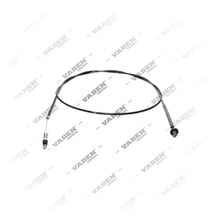
What is a Engine Hood Wire?
- Location: The line running from the control lever inside the cabin, through the chassis/cabin junction, to the hood latch.
- Material: Galvanized or stainless steel wire, plastic/metal outer sheath.
- End fittings: Nipples, adjustable threaded end caps and connection pins.
- Application: Trucks and tractors with a manual or semi-automatic hood locking mechanism.
What are the functions of the Engine Hood Wire?
The cable's primary function is to mechanically transmit the control movement inside the cabin to the hood latch and to enable the hood to open and close safely. It also guarantees the proper operation of the locking function that prevents the hood from opening unintentionally while driving.
- Mechanical transmission: Transfers the control lever's movement to the hood latch.
- Safe opening: Enables the hood to be released in a controlled manner with a single motion.
- Locking support: Contributes to keeping the hood closed and stable while driving.
- Ergonomics: Provides control from inside the cabin without requiring direct access to the hood mechanism.
What are the symptoms of a faulty Engine Hood Wire?
A cable fault usually appears as stiffness, free play, or a complete lack of response in the control lever. If the cable breaks, the hood cannot be opened at all via the control lever and manual intervention may be required.
- Stiff control: Abnormal resistance or stiffness when pulling the lever.
- Free play: The hood latch not responding despite the lever being pulled.
- Complete breakage: The control lever going completely slack and the hood failing to open.
- Visible wear: Rust on the cable surface, fraying of the wire strands.
- Loose hood: The hood vibrating while driving due to a weakened locking function.
How is the Engine Hood Wire checked?
Checking starts with a visual inspection along the cable's route; sheath damage, wire fraying and looseness at the end fittings are examined. Then the control lever is pulled several times to observe the hood latch's response.
- Visual inspection: Checking for sheath damage, rust and wire fraying.
- Functional test: Response time and travel distance of the hood latch when the control lever is pulled.
- Connection check: Looseness or wear at the end nipples and pins.
- Sheath routing check: Identifying sharp edges or pinch points where the cable could rub.
What should be considered when replacing it?
When replacing the cable, the route and connection points of the old cable must first be noted, and the new cable routed the same way. The end fittings must be secured with the correct pin and nipple, and sheath retaining clips reinstalled at the required points.
- Correct routing: The cable should follow its original route, avoiding contact with sharp edges.
- Connection integrity: The end pins and nipples must be installed so they seat fully.
- Adjustment check: Cable tension should be adjusted so the hood latch locks fully.
- Function test: After installation, the hood should be opened and closed several times to verify the control works smoothly.
- Clip and sheath fixing: All retaining clips must be placed in their original positions.
How to choose the right Engine Hood Wire?
The decisive criteria when choosing the correct cable are the cabin/hood model, cable length and end fitting type. A cable of a different length can cause excessive free play or insufficient travel at the control lever, so a product matching the OEM length and connection type should be preferred.
Selection criteria for the Cabin Engine Hood Release Cable| Parameter | Typical value / range |
|---|
| Cable length | Varies by cabin/hood model; OEM dimension is authoritative |
| Wire material | Galvanized or stainless steel |
| Sheath material | UV- and wear-resistant plastic/metal composite |
| End fitting type | Nipple, threaded end pin or clip (model dependent) |
| Compatibility | Exact match with cabin/hood model and OEM part number |
Maintenance and service life
The cable's service life depends on the vehicle's operating environment and how often the hood is opened and closed. On vehicles operating in humid and salty environments, the steel wires inside the cable can rust earlier. Periodically cleaning the cable route and lightly lubricating moving points reduces friction and extends service life. When a crack or puncture is noticed on the sheath, early intervention is recommended, since moisture will seep in and directly affect the inner wire.
On fleet vehicles where the hood is opened frequently, such as operations with daily fuel or oil checks, the cable's mechanical fatigue allowance is used up faster; adding a cable check to the periodic maintenance list for this usage profile prevents unexpected failures. Proper operation of the hood hinges and the latch bearing also reduces the load on the cable, indirectly extending its service life.
VADEN Engine Hood Wire
VADEN bases its engine hood release cables for heavy commercial vehicle cabin equipment on OEM length and connection standards. For the correct model selection, the VADEN product catalog and technical support line are available for reference.
Frequently Asked Questions (FAQ)
How is the hood opened if the release cable breaks?
When the cable is fully broken, the hood latch generally must be accessed manually with direct mechanical intervention; this procedure varies by vehicle model and authorized service support is recommended.
Is replacing the cable a task I can do myself?
It can be done with simple hand tools, but correct routing and tension adjustment are important; authorized service support is recommended for inexperienced users.
Why does the cable stiffen over time?
Moisture, dust and dirt seep into the sheath and increase friction between the inner wire and the sheath, causing the control lever to become stiff.
How often should the cable be checked?
There is no fixed interval; a visual check during periodic maintenance and testing whether the control lever operates smoothly is recommended.
What happens if a cable of the wrong length is installed?
A cable that is too short can prevent the latch from locking fully; a cable that is too long can cause excessive free play and delayed response at the control lever. A product matching the OEM length should be used.
Related technical guide: Cab Tilt Pump: Faults, Replacement & Maintenance Guide