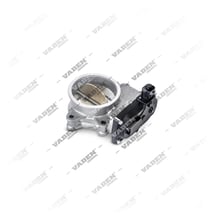
What are the functions of an EGR Throttle?
This flap balances emission control against engine performance.
- Flow direction: Regulates the mixing ratio and distribution of exhaust gas and fresh air within the intake manifold.
- NOx reduction: Lowers combustion temperature, contributing to reduced nitrogen oxide emissions.
- Electronic synchronization: Changes position based on engine speed and load according to ECU commands.
- Intake pressure regulation: On some systems it helps balance intake manifold pressure.
- Sealing: Maintains intake system sealing in the closed position, preventing unwanted air leakage.
What are the symptoms of a failing EGR Throttle?
Failure is usually noticed through engine performance and fault codes.
- Warning light on: The ECU illuminates the engine fault light when it receives an unexpected signal from the flap position sensor.
- Power loss and rough running: A flap that fails to fully open or close disrupts the air-fuel mixture, causing power loss.
- Unstable idle: A flap stuck in the wrong position causes idle speed fluctuation.
- Increased smoke: Faulty EGR flow reduces combustion efficiency, which can cause black smoke from the exhaust.
- Increased fuel consumption: An unbalanced mixture ratio negatively affects fuel economy.
How is an EGR Throttle checked?
Inspection uses both electronic diagnostics and mechanical examination.
- Fault code reading: Read EGR-related fault codes from ECU memory with a diagnostic tool.
- Actuator test: Test whether the flap actuator completes a full stroke when commanded.
- Visual inspection: Remove the flap housing and check for soot buildup and mechanical sticking.
- Position sensor measurement: Verify sensor output signal with a multimeter or diagnostic tool.
- Freedom of movement: Check whether the flap blade moves freely by hand or via the actuator.
What should be considered during replacement?
Electronic compatibility and installation precision matter during replacement.
- Software matching: On some systems, an ECU adaptation/learning procedure may be required after installing a new flap or actuator.
- Soot cleaning: Clean soot buildup from the intake manifold and surrounding area before fitting the new flap.
- Correct gasket use: The flap housing gasket must always be renewed; never reuse the old gasket.
- Wiring connection check: The actuator connector must seat fully, free of corrosion or looseness.
- Function test: After installation, test flap movement with a diagnostic tool to confirm correct operation.
How to choose the right EGR Throttle?
Selection is determined by engine code, emission standard and ECU software version compatibility. The wrong actuator type or sensor characteristic can trigger incorrect fault codes.
EGR Valve Flap selection criteria| Criterion | Description |
|---|
| Engine code match | Must fully match the vehicle's engine code and emission class |
| Actuator type | Stepper motor or vacuum actuator must match the original |
| Connector type | Must be directly compatible with the vehicle wiring harness |
| Sensor calibration | Position sensor must match ECU expectations |
| Reference verification | Confirm with OEM number and chassis data |
Maintenance and service life
Because it is continuously exposed to soot and oil vapor in the exhaust gas, the EGR flap carries an increasing risk of mechanical sticking over time. Low-quality fuel or extended idling can accelerate soot buildup. Periodic intake system cleaning and a healthy EGR cooler extend the flap's service life. Average service life depends on engine operating conditions and maintenance discipline; the vehicle's current OE service manual is authoritative for the exact interval.
VADEN EGR Throttle
VADEN offers EGR valve flaps manufactured to OE tolerances for heavy commercial vehicle engines. Electronic compatibility and mechanical precision support reliable operation of the emission system.
Frequently Asked Questions (FAQ)
Can a vehicle be driven with a faulty EGR flap?
It can be driven briefly but is not recommended; power loss, rough running and elevated emissions can occur, and in advanced cases the ECU may enter a protection mode that limits performance.
Are the EGR flap and the EGR valve the same part?
No, they are complementary components in the system; the EGR valve regulates how much exhaust gas is recirculated, while the flap regulates flow distribution on the intake side. Depending on the vehicle, they may be combined in a single housing.
Why does the warning light stay on after replacing the flap?
The ECU adaptation procedure may not have completed, or the connector may not be fully seated; the fault memory should be cleared with a diagnostic tool and retested.
How does soot buildup affect the flap?
Soot restricts free movement of the flap blade, causing mechanical sticking that prevents full opening and closing and triggers a fault code.
Can the EGR flap be cleaned and reused?
Light soot buildup may be temporarily resolved by cleaning, but if the actuator or sensor is worn, cleaning is not sufficient and the part must be replaced.
Related technical guide: EGR Valve & EGR Flap: Faults, Replacement and Maintenance