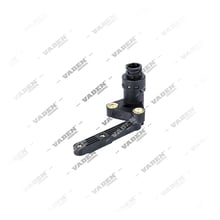
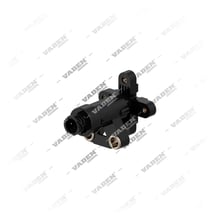
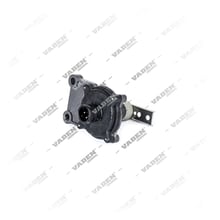
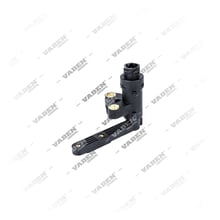
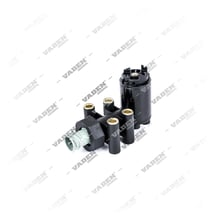
What Is an ECAS Height Sensor?
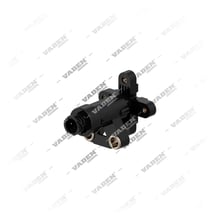
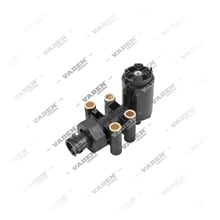
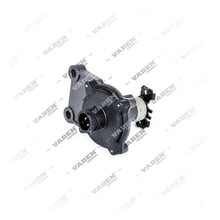
The ECAS Height Sensor is the component that allows a heavy commercial vehicle's Electronically Controlled Air Suspension (ECAS) system to measure the distance between the chassis and the axle. In the field it also goes by "level sensor," "ride height sensor," or "ECAS potentiometer." It converts the angular movement between its chassis-mounted housing and the control arm linked to the axle into an electrical signal, which is fed to the ECAS control unit as the basis for real-time adjustment of air pressure in the bellows. On trucks, tractor units, buses, and trailers it is typically fitted at multiple axle positions, usually one sensor per axle. Without it the system cannot detect vehicle height, so ECAS cannot perform automatic leveling and the suspension can remain locked in a fixed position.
How Does an ECAS Height Sensor Work?
The sensor housing is bolted to the chassis while its moving arm connects to the axle or suspension trailing arm through a linkage rod. As the vehicle is loaded or unloaded, the distance between chassis and axle changes; this rotates the arm, and the potentiometer or Hall-effect element inside converts that rotation into a proportional voltage or digital signal. The ECAS control unit continuously reads this signal, compares actual ride height with the reference value, and triggers the relevant valves to fill or exhaust air in that axle's bellows whenever a deviation is detected. Chassis height is thus held at the predefined level regardless of load, which directly affects ride comfort, road holding, and dock alignment.
ECAS Height Sensor Technical Specifications
The sensor housing is typically made from impact- and moisture-resistant reinforced plastic or an aluminum alloy, offering IP67-level protection against dust and water. The measuring element is either a rotary potentiometer or a contactless Hall-effect sensor; the operating angle varies by vehicle model but generally falls in the 60 to 100 degree range. Electrical connection is made through 3- or 4-pin connectors depending on the manufacturer, with supply voltage typically at 5 or 12 volts. Arm length, connector type, and mounting flange dimensions decide compatibility. For exact resistance values and calibration figures, always consult the vehicle's current service manual.
- Housing Material: Impact- and moisture-resistant reinforced plastic or aluminum alloy.
- Protection Class: Typically IP67-level dust and water protection.
- Measuring Element: Rotary potentiometer or contactless Hall-effect sensor.
- Supply Voltage: Typically 5 or 12 volts, depending on model.
ECAS Height Sensor Types and Subcategories
- Potentiometric Sensor: Works through a change in resistance and is standard on most conventional ECAS applications.
- Hall-Effect (Contactless) Sensor: Generates a signal from a change in magnetic field without mechanical wear, for a longer service life.
- Linkage Arm and Ball Joint Set: The mechanical parts connecting the sensor to the axle or trailing arm, sold separately.
- Mounting Bracket: The carrier part that secures the sensor to the chassis, varying by vehicle model.
- Connector and Wiring Set: The electrical hardware linking the sensor to the ECAS control unit.
- Single- and Dual-Axle Applications: Some vehicles use one sensor, while multi-axle trailers and buses have a separate sensor per axle.
How to Choose the Right ECAS Height Sensor
When selecting the correct sensor, verify the OEM reference number against the vehicle's make, model, and chassis number; sensors that look similar can have different arm lengths or angles. The connector pin count and output orientation must also match the wiring harness, otherwise a fault code will be triggered. The table below summarizes the key selection criteria.
ECAS Height Sensor Selection Criteria| Criterion | What to Check |
|---|
| Sensor Type | Potentiometric or Hall-effect element must match the vehicle's original system |
| Arm Length and Angle | Linkage arm length and maximum rotation angle must suit the vehicle model |
| Connector Type | Pin count and socket orientation must fully match the existing wiring harness |
| Mounting Flange | Bracket hole pattern and fixing dimensions must align with the chassis mounting point |
| Axle Position | Sensor calibration can differ by front, rear, or trailer axle location |
| Protection Class | IP67 or higher dust/water protection matters for resistance to salt and moisture |
ECAS Height Sensor Maintenance and Key Considerations
- Inspect the Linkage Arm Regularly: Play or deformation at the ball joint causes signal errors and should be checked visually on a periodic basis.
- Watch the Connector for Corrosion: Moisture and salt can oxidize the pins; keep the connection clean and properly seated.
- Verify Calibration: After replacing the sensor, vehicle height must be recalibrated in the ECAS unit, otherwise the system operates against the wrong reference.
- Watch the Mounting Angle: Make sure the arm's range of motion does not bind against mechanical stops, since excess strain wears the sensor out quickly.
- Use Correctly Dimensioned Parts: A mismatched sensor with a different arm length or angle can cause faulty leveling and uneven loading.
Common Faults and Solutions
- Vehicle Keeps Rising or Lowering: The sensor signal may be unstable; check the linkage arm and connector, replacing the sensor if needed.
- ECAS Warning Light Comes On: There may be an open or short circuit in the sensor wiring; test the harness and connector pins.
- Vehicle Height Does Not Reach Reference Level: Calibration may have been lost; recalibrate with a diagnostic tool after replacement.
- Mechanical Noise Near the Sensor: The linkage arm or ball joint may be worn; inspect the mechanical linkage and renew as necessary.
- Unstable Suspension Under Load: One axle sensor may be reading incorrectly; test each axle's sensor individually.
Why Choose VADEN ORIGINAL?
VADEN ORIGINAL ECAS Height Sensor products are manufactured to OE dimensions and replicate the original arm length, connector layout, and operating angle. Key advantages include:
- OE-Dimension Manufacturing: Arm length, operating angle, and connector layout match the original part exactly.
- Broad OEM Cross-Reference: Compatible with Wabco and Knorr-Bremse ECAS systems on Mercedes-Benz, MAN, Scania, Volvo, DAF, and Iveco vehicles.
- Durable Housing Construction: Corrosion- and moisture-resistant material provides IP67-level protection.
- Strict Quality Control: Every sensor undergoes functional testing after production, before shipment.
- Extensive Export Network: A manufacturing base exporting to over 100 countries gives fleets and workshops reliable access.
Conclusion
The ECAS Height Sensor is a critical measuring component for the correct operation of an electronically controlled air suspension system, keeping the vehicle stable, safe, and comfortable under load. A sensor with the correct type, arm length, and connector match preserves system calibration and reduces failure risk. The VADEN ORIGINAL range delivers a reliable solution for this component, built to OE quality standards.
Frequently Asked Questions (FAQ)
How does the vehicle behave when the ECAS Height Sensor fails?
When the sensor fails, the ECAS system cannot correctly detect actual vehicle height, so the vehicle typically keeps rising and lowering repeatedly or becomes locked in a fixed position. An ECAS or suspension warning light may illuminate on the dashboard, and ride comfort along with alignment to loading docks can be affected.
Is calibration required after replacing the sensor?
Yes, after replacing the sensor the reference vehicle height must be recalibrated in the ECAS control unit using a diagnostic tool. If calibration is skipped, the system continues operating against the wrong reference and leveling becomes inaccurate.
Does each axle need its own height sensor?
Multi-axle trucks, buses, and trailers generally have a separate sensor on each axle because ECAS levels every axle independently. On simpler single-axle applications one sensor may be sufficient; the correct number depends on the vehicle configuration.
What is the difference between a potentiometric and a Hall-effect sensor?
A potentiometric sensor produces a change in resistance through mechanical contact, while a Hall-effect sensor generates a signal from a contactless change in magnetic field. Hall-effect sensors are generally considered longer-lasting since there is no mechanical wear, but the type specified by the vehicle manufacturer should always be used.
Which vehicles is the VADEN ORIGINAL ECAS Height Sensor compatible with?
VADEN ORIGINAL sensors are manufactured to be compatible with the Wabco and Knorr-Bremse ECAS systems used on heavy commercial vehicles such as Mercedes-Benz, MAN, Scania, Volvo, DAF, and Iveco. Before ordering, it is recommended to verify compatibility using the vehicle's chassis number and original part reference.
Related technical guide: ECAS Solenoid Valve: Faults, Replacement & Maintenance Guide