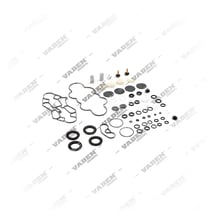
What are the functions of a distributor valve repair kit?
- Renewing the seal: Refreshes the gaskets and O-rings that separate the air passages inside the valve body, eliminating internal and external leaks.
- Diaphragm function: Renews the diaphragm that converts pedal force into proportional air pressure, restoring the valve's precise response.
- Support for moving parts: Renews elements such as the piston, springs, and seals inside the valve so the mechanism operates smoothly and consistently.
- Restoring original performance: Allows a worn valve to regain the response precision and sealing level it had when new.
What are the symptoms of a failed distributor valve?
- Delay in the brake pedal: Pressure reaching the brake chambers late when the pedal is pressed, or a lengthened response time.
- Disproportionate brake pressure: Output pressure at the brake chambers no longer proportional to pedal force, producing harsh braking even at light pedal input or weak braking at full pedal input.
- Air leak sound: A continuous hissing sound from the valve body, especially noticeable when the pedal is released.
- Brake imbalance: The vehicle pulling to one side while braking, resulting from a disturbed brake pressure distribution between axles.
- Frequent compressor cycling: Continuous air loss from the valve causing the compressor to engage more often than expected.
How is a distributor valve checked?
Inspection first uses a soapy water test around the valve body with the system pressurised; foaming indicates an external leak. Pedal force is applied at varying levels while output pressure at the brake chambers is measured with a gauge, checking whether it rises proportionally with pedal force. When the valve is removed and the internal structure examined, look for cracking, hardening, or perforation on the diaphragm, crushing or wear on O-rings, and scoring or corrosion on the piston surface. When working on air brake systems, no component should be removed before the system has been fully vented, and necessary safety precautions must be taken against contact with pressurised elements.
What should be considered during replacement?
- Correct repair kit: A kit matching the valve's model and version exactly should be used, confirming the parts list against the manufacturer's code on the valve.
- Sequential assembly: Gaskets, diaphragms, and springs must be installed in the sequence and orientation specified by the manufacturer, following an assembly diagram if available.
- Cleanliness: Air passages inside the valve body should be cleaned with compressed air, leaving no dirt or metal shavings.
- Lubrication: Moving parts should be lubricated with the type and amount of grease recommended by the manufacturer; excess grease can block air passages.
- Function test: After assembly, the pressure-to-force proportion must be verified on a test bench or on the vehicle.
How should a distributor valve repair kit be selected?
Selection should be based on the manufacturer's part number and version code marked on the valve; even valves that look similar can have different internal gasket dimensions. Confirming against the OEM part number guarantees the kit contents are complete and correctly sized.
Distributor valve repair kit selection criteria| Criterion | Description |
|---|
| Valve model/version | Must match the manufacturer's code on the valve exactly |
| Kit contents | Gaskets, diaphragm, O-rings, seals, and springs must all be included |
| Material | Elastomer resistant to air brake system pressure and temperature |
| Dimensional tolerance | Matches the valve body's passages and bores exactly |
| Pressure rating | Suitable for the system pressure specified in the vehicle's current OE service manual |
Maintenance and service life
A valve overhauled with a distributor valve repair kit lasts a long time in systems that run dry, clean compressed air. Moisture or oil residue entering the system causes the diaphragm and gaskets to harden prematurely. During routine brake maintenance, the air dryer's condition should be checked, and the area around the valve should be regularly scanned for leaks with a soapy water test.
VADEN distributor valve repair kit
VADEN manufactures OEM-matching distributor valve repair kits for heavy-duty commercial vehicle air brake systems, built to the correct material and dimensional tolerance, with the goal of preserving the vehicle's original brake precision and safety performance.
Frequently Asked Questions (FAQ)
What is the difference between a distributor valve repair kit and a complete valve
A repair kit contains only the wearing internal parts such as gaskets, diaphragm, and springs; if the valve body is sound, using a repair kit instead of a complete valve is both more economical and sufficient.
How does a distributor valve fault affect brake balance
If internal wear disturbs the brake pressure distribution between axles, the vehicle can pull to one side while braking, and this requires immediate attention.
What is the most critical step when installing the repair kit
Installing the diaphragm and gaskets in the sequence and orientation specified by the manufacturer is critical; incorrect sequencing can prevent the valve from functioning at all.
Why does the brake pedal feel delayed
A worn gasket or diaphragm inside the distributor valve can prevent pedal force from being transmitted to the brake chambers on time and in proportion.
Is testing required after replacing the repair kit
Yes, after assembly the proportion between pedal force and output pressure must be verified on a test bench or on the vehicle.
Related technical guide: Four-Circuit Protection Valve: Faults, Diagnosis & Replacement