What Is a Compressor Unloader Kit?
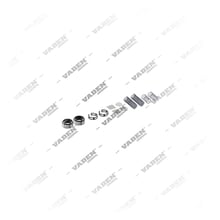
A Compressor Parts Discharge Valve Kit bundles the discharge valves in an air brake compressor's cylinder head with the springs, washers and sealing elements that need renewing alongside them. It sits in the Compressor Parts branch of the Air Brake Compressors group and restores delivery-side sealing without a full unit swap. Catalogs also list it as a discharge valve set or outlet valve kit. On truck, tractor, bus and trailer air brake circuits, this group carries compressed air one-way from the compressor into the air dryer and reservoirs.
How Does a Compressor Unloader Kit Work?
The discharge valve is a one-way component that opens and closes purely from the pressure difference during the compression stroke, with no separate actuation. The instant cylinder pressure exceeds line pressure, the valve lifts off its seat and air flows to the delivery side. When the piston moves back down, spring force plus return pressure seat the valve again.
- Compression: The piston compresses the intake air, raising cylinder pressure.
- Opening: Once cylinder pressure overcomes spring force, the valve lifts and the flow path opens.
- Discharge: Compressed air travels through the outlet passage to the air dryer and reservoirs.
- Closing: At the end of the stroke the valve reseats, acting as a check valve to block backflow.
- Impact loading: The valve and spring face high discharge temperatures and thousands of impacts per minute.
Compressor Unloader Kit Technical Specifications
Valve plates are made from heat-treated spring steel or a high-alloy stainless strip, with seating surfaces of hardened steel or cast iron. Sealing elements use gasket materials that withstand discharge temperature and oil vapor, and flatness and thickness tolerances are held tight throughout.
Sizing is built around plate diameter and thickness, spring free length and wire diameter, and valve lift distance. A larger lift distance raises flow capacity but also increases impact loading and fatigue risk. Compatibility hinges on compressor brand, housing type, cylinder count, head casting number and OE reference; for exact torque and tolerance values, follow the vehicle manufacturer's current service manual.
Compressor Unloader Kit Types and Subgroups
- Single discharge valve kit: One valve assembly and gasket for single-cylinder compressor heads.
- Twin discharge valve kit: A symmetrical valve assembly for two-cylinder housings; preferred on tractor units and buses needing higher flow.
- Reed / plate-type valve kit: A thin spring-steel reed sits against the seating surface; low inertia gives a fast response at high speed.
- Combined intake and discharge kits: Supplies the intake valve, discharge valve and gasket set together for a full head overhaul.
- Full service kits with gaskets: Add the head gasket, o-rings and lock washers on top of the valve assembly for a leak-tight rebuild in one job.
How to Choose the Right Compressor Unloader Kit
The starting point is the OE reference number stamped on the compressor housing; since the same model can run different compressors by engine option, brand and model alone are not enough. The safest check is laying the old valve assembly next to the new one to compare plate diameter, thickness and spring length.
Compressor Parts Discharge Valve Kit selection and compatibility checklist| Criterion | How to verify | What to watch for |
|---|
| OE reference number | Read the number stamped on the housing | If illegible, confirm against the chassis number |
| Compressor type | Identify whether it is single- or twin-cylinder | A twin-cylinder housing may need two valve assemblies |
| Head casting number | Check the casting code on the head against the catalog | Head design can change between production years |
| Plate dimensions | Measure diameter and thickness on the old part | A thickness mismatch throws off lift distance |
| Spring characteristics | Compare free length and wire diameter | A stiff spring opens late, a soft spring lets air leak back |
| Vehicle application | Mercedes-Benz, MAN, Scania, Volvo, DAF, Iveco, Renault Trucks, BMC, Ford list | Within the same series, parts vary by engine variant |
Compressor Unloader Kit Maintenance and Points to Consider
- Inspect the seating surface: Before installation, check the seat for scoring, carbon buildup and pitting.
- Follow the tightening sequence: Head bolts must be tightened gradually in a crosswise pattern; for exact torque figures, follow the vehicle manufacturer's current service manual.
- Never reuse gaskets: Gaskets, o-rings and washers should be renewed at every strip-down; do not apply liquid sealant to an old gasket.
- Check the intake filter: Contaminated air wears new valve surfaces down quickly, so inspect the filter at every service.
- Check the dryer and outlet line: A blocked outlet pipe or a saturated dryer raises back-pressure and shortens the kit's service life.
Common Faults and Solutions
- Slow air pressure build-up: When the reservoir fills slowly, the usual cause is backflow through a valve no longer seating fully; renew the kit and inspect the seating surface.
- Compressor staying under load continuously: If pressure keeps dropping even though the governor has cut in, air is flowing back into the cylinder; replace the valve and spring assembly.
- Metallic knocking or rattling: A cracked plate or broken spring produces an impact noise inside the cylinder; stop the compressor and open the head to search for loose fragments.
- Excessive outlet temperature: Recompressing air that has leaked back raises discharge temperature and cokes the oil; renew the kit and clear any restriction in the line.
- Leak noise after installation: Usually traced to incorrect torque, a faulty gasket, or a surface that was not cleaned properly; clean the surfaces and reassemble with a new gasket.
Why VADEN ORIGINAL?
- Manufactured to OE dimensions: Plate thickness, lift distance and spring characteristics match the original part's tolerances.
- Broad OEM matching: Cross-referenced options cover compressors built on Wabco and Knorr-Bremse architectures, for Mercedes-Benz, MAN, Scania, Volvo, DAF, Iveco, Renault Trucks and BMC applications.
- Material control: Spring steel and gasket materials are selected to withstand high temperature and continuous impact loading.
- Complete kit contents: Valve, spring, washer and gasket ship in the same package, so nothing is missing at the workshop and downtime is shorter.
- Proven in the field: VADEN ORIGINAL products are exported to more than 100 countries, with field feedback feeding straight back into product development.
Conclusion
The Compressor Parts Discharge Valve Kit is a small but decisive group that keeps compressed air moving one-way and efficiently into the reservoirs. A slow-filling reservoir, a compressor stuck under continuous load, or excessive heat at the outlet usually calls for renewing this kit rather than the complete unit. Choosing the right part by OE reference and head dimensions directly extends service life.
Frequently Asked Questions (FAQ)
What does a compressor discharge valve kit do?
It lets air compressed inside the air brake compressor cylinder pass out to the air dryer and the reservoirs. It also acts as a one-way device, stopping compressed air already in the reservoir from flowing back into the cylinder. This keeps the air the compressor produces in the system without loss.
What are the symptoms of a failing discharge valve?
The most typical sign is that air pressure builds up slowly even though the compressor has been running for a while. This can come with the compressor staying under load continuously, excessive heat at the outlet line, metallic knocking, and oil collecting in the air lines. With these symptoms the cylinder head should be removed and the valve assembly checked.
Should I replace just the discharge valve, or the whole compressor?
If the housing, crankshaft and cylinder liner are sound, renewing just the discharge valve kit is usually enough and far more economical. But if there is noticeable wear on the rings and liner, a cracked housing, or excessive crankshaft play, a complete unit replacement is the better call. The decision should be made after measurement and inspection once the unit is stripped down.
How do I identify the correct discharge valve kit?
The most reliable approach is to work from the OE reference number stamped on the compressor housing. It also helps to confirm whether the compressor is single- or twin-cylinder, check the head casting number, and compare the diameter and thickness of the old valve plate. The same vehicle model can require a different kit depending on engine variant.
What should I watch for when replacing a discharge valve kit?
The seating surface should be cleared of carbon and scoring, gaskets must always be renewed, and the cylinder head bolts should be tightened gradually in a crosswise sequence. For exact torque values, the vehicle manufacturer's current service manual is the governing reference. At the same time, check the condition of the air intake filter and the dryer cartridge.
Related technical guide: Compressor Valve & Unloader: Fault, Replacement & Care Guide