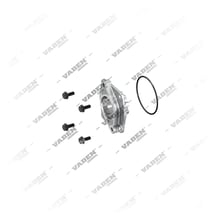
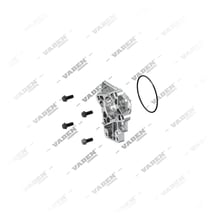
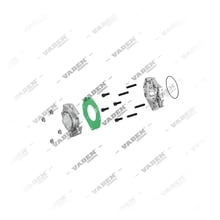
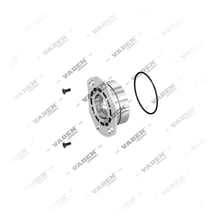
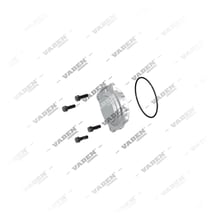
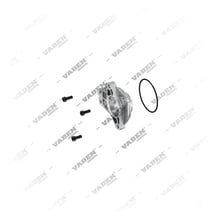
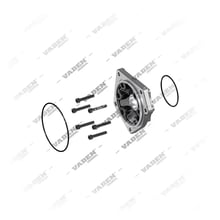
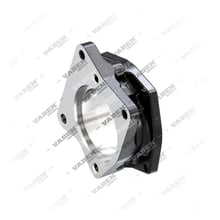
What is a compressor crankshaft flange?
The compressor is driven via gear, belt-pulley, or coupling. The intermediate element that ensures this drive reaches the crankshaft centered is the crankshaft flange. The flange is generally cast iron or steel bodied; it includes a centering (pilot) diameter, bolt hole circle, seal seat, and in most types a front bearing seat.
Although it is not a pressure-producing part, it determines the compressor's life. A flange with disrupted centering or a worn seating surface results in axis misalignment, bearing loading, seal leakage, and complete compressor damage. Our product group includes options specific to compressor type such as 26 15 12, 11 23 13, 21 02 13, 16 08 13, and 11 22 13.
What are the functions of the compressor crankshaft flange?
The flange carries out several interconnected functions together; in diagnosis it is necessary to separate which one has failed.
- Torque transmission: Transmits the moment coming from the engine drive to the crankshaft via gear, pulley, or coupling; provides resistance against impact loads.
- Centering: The pilot diameter keeps the crankshaft on-axis relative to the housing and the drive element. Loss of centering produces vibration and uneven bearing wear.
- Bearing seat carrying: In most types, the drive-side bearing or bushing seats in the flange seat; the seat dimension determines the interference fit value.
- Sealing: The surface on which the seal seats and the gasket surface facing the housing are on the flange; this is the first point of oil leakage.
- Axial positioning: Limits the axial play of the crankshaft; excessive play disrupts piston-cylinder alignment.
What are the symptoms of a compressor crankshaft flange failure?
Flange failure usually appears as oil leakage, vibration, or drive noise:
- Oil leakage on the drive side: Muddy buildup mixed with dust around the flange. Recurrence of the leak even after the seal is renewed indicates seat ovality.
- Metallic ticking at idle: Movement of the flange due to bolt loosening or pilot diameter wear; sound increasing and decreasing with speed change.
- Compressor vibration: Vibration in the housing due to axis misalignment, cracking in feet and brackets.
- Drive element wear: Belt leaning to one side; abnormal gear noise in gear drives.
- Pressure filling late: Efficiency drop due to increased friction, lengthened tank fill time.
- Bolt breakage: Fatigue-related breakage, hole enlargement, color change due to heating.
How is the compressor crankshaft flange checked?
The check is in two stages: preliminary inspection on the vehicle, and measured inspection on the removed part. Before beginning, the engine must be stopped and the air tank drained.
On the vehicle: Clean the flange area, run the engine briefly and observe where the seepage starts. Confirm that all bolts are present and tight. Force the drive element by hand radially and axially; noticeable play indicates flange or bearing failure.
On the removed part: Wash the flange; look for scratches and pitting on the gasket surface, a step mark on the seal seat, and shine on the pilot diameter. Measure the seal and bearing seat diameter in two axes with a bore comparator to determine ovality. Check flatness with a straightedge and feeler gauge, and inspect hole surroundings for cracks. Wear limits vary by type; general figures should not be used, and the values in the current OE service manual should be authoritative.
What should be watched for during replacement?
Flange replacement means reestablishing the sealing and centering arrangement; if the following points are skipped, the new part will also be damaged quickly.
- Gasket and seal renewed: The removed gasket and the crankshaft seal must not be reused; replacement is done with the appropriate gasket kit.
- Surface cleanliness: Seating surfaces should be cleared of old gasket residue and not scratched during scraping.
- Seal installation: The seal lip should face the oil side and be driven in axially with a suitable mandrel, without hammer blows.
- Tightening pattern: Bolts are tightened in cross order and in stages. Torque varies by type; the current OE service manual is authoritative for the exact value.
- Play and rotation: Axial play should be measured with a comparator, and the compressor should turn by hand without sticking.
- Alignment and lines: Pulley alignment should be checked; the oil supply line should be clean, and the air discharge line unobstructed.
How is the compressor crankshaft flange selected?
The crankshaft flange is manufactured according to the internal dimensions of the compressor; dimensions differ even within different types of the same brand. Therefore selection should be based on the compressor type number and OE number, not brand. The housing label or casting number is the most reliable reference; in Wabco, Knorr-Bremse, Bendix, Mercedes-Benz, MAN, Volvo, DAF, and Iveco applications, matching is done via the OE number.
Criteria to verify: pilot diameter, bolt circle and hole count, seal seat, bearing seat, flange thickness, and drive type. If any of these is mismatched, the part may appear installable but will produce leakage or vibration quickly.
Compressor crankshaft flange selection and inspection points| Inspection point | Why it matters | Assessment |
|---|
| Compressor type / OE number | Dimensions are type-specific | Must exactly match the label and casting number |
| Pilot (centering) diameter | Determines crankshaft axis | Must fit without play, without forcing |
| Bolt circle and hole count | Load distribution and installation fit | Circle diameter and hole count must be the same |
| Seal seat size | Oil sealing | Seal must seat fully, no step mark |
| Bearing / bushing seat | Bearing interference fit | Ovality limit per OE manual |
| Gasket surface flatness | Prevents oil and air leaks | Straightedge-feeler deviation must be within limit |
| Drive type | Gear, pulley, or coupling difference | Must be compared with the removed part |
| Tightening torque | Loosening and fatigue crack risk | By type; OE service manual is authoritative |
Maintenance and service life
The crankshaft flange has no separate replacement interval; under normal conditions it lasts until the compressor's overhaul period. The factors determining its life are lubrication quality, drive alignment, and installation torque accuracy. In vehicles with delayed oil changes and operating under heavy dust, the seal and bearing in the flange area fatigue faster.
In periodic maintenance, leak check around the flange, bolt tightness, and play in the drive element should be checked. During overhaul, the flange should be removed and measured, and seal and gasket should be renewed. Flanges with worn bearing seats or ovalized holes should not be attempted to be repaired. Oil leakage is not always flange-related; a blocked air discharge line, worn rings, or a saturated dryer cartridge can produce the same symptom.
VADEN compressor crankshaft flange
As an air brake compressor manufacturer, VADEN develops compressor parts with its own design and manufacturing experience. Our crankshaft flange group includes options suitable for single- and twin-cylinder compressor types for heavy commercial vehicle, bus, and construction machinery applications. You can select the compatible flange from our catalog by searching with the compressor type number or OE number.
Frequently Asked Questions (FAQ)
What does the compressor crankshaft flange do?
It connects the air brake compressor's crankshaft to the engine drive; while transmitting torque from the drive to the crankshaft, it centers the crankshaft relative to the housing, carries the bearing and seal seat on the drive side, and limits the crankshaft's axial play. Since it simultaneously undertakes centering, sealing, and load transfer duties, it directly affects compressor life.
How do I know if the crankshaft flange has failed?
The most typical symptom is recurring oil leakage on the drive side of the compressor; if the leak continues even after the seal is renewed, the seat may have become oval. In addition, a metallic ticking that changes with speed at idle, vibration in the compressor housing, cracking in brackets, the belt leaning to one side, abnormal noise in gear drives, and the air tank filling late indicate a flange-related failure.
What is the torque value for crankshaft flange replacement?
Tightening torque varies by compressor type and bolt size; a single general value cannot be given. Bolts should always be tightened in cross order and in stages, and the exact torque value should be taken from the vehicle's and compressor's current OE service manual. After installation, the crankshaft's axial play should be confirmed with a comparator.
How do I choose the correct crankshaft flange?
Selection should be based on the compressor type number and OE number, not brand; the housing label or casting number is the most reliable reference. Pilot diameter, bolt hole circle and hole count, seal seat size, bearing seat size, flange thickness, and drive type (gear, pulley, coupling) should be confirmed. If any of these criteria is mismatched, the part will produce leakage or vibration quickly even if it can be installed.
Can a worn crankshaft flange be repaired?
Repairing flanges with worn bearing seats, a step formed in the seal seat, a pitted gasket surface, or ovalized bolt holes via welding-machining is not recommended; dimensional and centering precision cannot be recovered. Such a flange should be replaced with a new one, and the gasket and crankshaft seal must also always be renewed during replacement.
Related technical guide: Compressor Crankshaft & Drive Assembly: Failure & Replacement Guide