
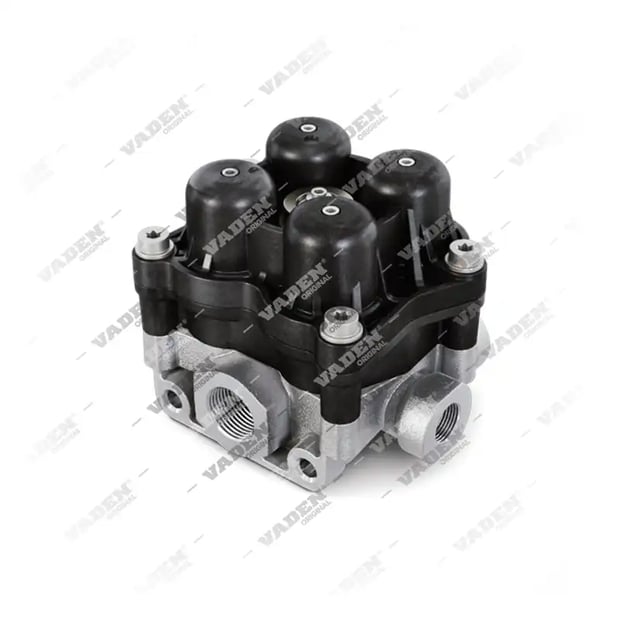
303.02.0041 Compatible 4-Circuit Protection Valve
303.02.0041
Summary
This 4-circuit protection valve is designed for heavy commercial vehicle brake systems. It features M22x1.5 and M16x1.5 port configurations and operates at a maximum pressure of 20 BAR, ensuring reliable pneumatic circuit division for DAF and Knorr-Bremse systems. Equivalent to OE DAF 1367504 and Knorr-Bremse AE4610.
| EAN Code | 8683457005204 |
|---|
Ready to Order
Compatible OEM Codes
-
KNORR-BREMSE
- II37462N52
- II37462
- AE 4610
-
DAF
- 1521155
- 1367504
Description
What does a 4-circuit protection valve do?
This 4-circuit protection valve plays a critical role in the pneumatic brake system of heavy commercial vehicles by dividing the air supply into multiple independent circuits. By managing air distribution, it ensures that a leak in one circuit does not compromise the entire braking performance of the vehicle. Built with high-strength components, this valve provides stable pressure regulation under demanding operating conditions.Vehicle and system compatibility
This component is specifically engineered to be compatible with DAF vehicles and is suitable for use in systems requiring high reliability. It functions effectively within complex pneumatic architectures, maintaining essential air pressure across all designated circuits to ensure safe braking operations.Installation and technical specifications
For optimal performance, technicians should verify the port sizes, including the M22x1.5 and M16x1.5 connections, during installation. The valve operates with specific opening pressures ranging from 6.5 BAR to 7.3 BAR, depending on the circuit, and a maximum pressure rating of 20 BAR. Regular inspection of the pneumatic lines and connection points is recommended to prevent leaks.Maintenance and troubleshooting
Consult your authorized distributor.OE cross-reference
303.02.0041 (4-circuit protection valve) is the equivalent of the DAF and Knorr-Bremse OE numbers. This part directly replaces DAF OE numbers 1367504, 1521155. It also replaces Knorr-Bremse OE numbers AE4610, II37462, II37462N52.Technical Specifications
| Port 1 | M22x1,5 |
|---|---|
| Port 21 | M16x1,5 |
| Port 22 | M16x1,5 |
| Port 23 | M16x1,5 |
| Port 24 | M16x1,5 |
| Operating Pressure | 12 BAR |
| Opening Pressure 21 | 6,5 BAR |
| Opening Pressure 22 | 6,5 BAR |
| Opening Pressure 23 | 7,3 BAR |
| Opening Pressure 24 | 6,5 BAR |
| Closing Pressure 21 | 4,5 BAR |
| Closing Pressure 22 | 4,5 BAR |
| Closing Pressure 23 | 4,5 BAR |
| Closing Pressure 24 | 4,5 BAR |
| Pressure | MAX 20 BAR |
Other OEMs
DAF
- 1521155
- 1367504
KNORR-BREMSE
- AE4610
- II37462N52
- II37462
- AE 4610
Related Products
Repair Kits
Compatible Vehicles
| Brand | Model | Model Type | Engine |
|---|---|---|---|
| DAF | |||
| KNORR-BREMSE |
FAQ
What is the function of a 4-circuit protection valve?
It divides the pneumatic brake system into four independent circuits to ensure that if one circuit fails due to a leak, the others remain functional for safe braking.
What are the port specifications for this valve?
The valve features one M22x1.5 port and four M16x1.5 ports (Port 21, 22, 23, and 24) to accommodate standard pneumatic connections.
What is the maximum operating pressure?
This protection valve is designed to operate safely at a maximum pressure of 20 BAR within the vehicle's braking system.
Which vehicle brands is this part compatible with?
This component is compatible with DAF vehicles and is suitable for use in Knorr-Bremse systems.
What are the OE reference numbers of this part?
303.02.0041 directly replaces DAF OE numbers 1367504, 1521155. It also replaces Knorr-Bremse OE numbers AE4610, II37462, II37462N52.