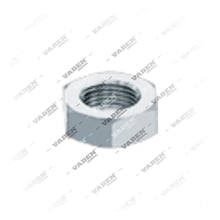
What Is a Compressor Nut?
Compressor Parts Nut is a specialized nut group used at the internal and external connection points of heavy commercial vehicle air brake compressors, designed to secure components such as the crankshaft, pulley, cylinder head, connecting rod, and flange. On the shop floor it is sometimes called a "compressor pulley nut," "crankshaft nut," or "head retaining nut." While an air brake compressor is running, it is under constant vibration, temperature swings, and high rotational speed — which makes keeping every part clamped tightly and securely just as critical as the compressor's ability to build the correct pressure. The Compressor Parts Nut range completes repair kits for overhauling Wabco- and Knorr-Bremse-type compressors fitted to Mercedes-Benz, MAN, Scania, Volvo, DAF, Iveco, Renault, and BMC heavy vehicles — an easy-to-overlook component that is nonetheless essential to overall system integrity. VADEN ORIGINAL nuts are manufactured to OE dimensions, helping the compressor run reliably over a long service life.
How Does a Compressor Nut Work?
Inside an air brake compressor, dozens of moving and stationary parts are held together at a specified tightening torque. The Compressor Parts Nut secures the pulley or coupling on the crankshaft end, fastens the cylinder head to the housing, locks the connecting rod cap onto the crankshaft, and holds the mounting flanges to the engine block. The vibration and torque fluctuations generated while the compressor runs can cause a loose or incorrectly torqued nut to work its way free over time, or even come apart entirely. That is why these nuts are engineered with self-locking thread profiles, an appropriate hardness class, and correctly designed contact-surface geometry. Once the applied tightening torque reaches the value specified by the manufacturer, the fastener achieves the preload force needed to safely carry both axial and radial loads.
- Connection and Fastening: Firmly secures parts such as the crankshaft, pulley, and cylinder head to the housing or shaft.
- Delivering Preload Force: When tightened to the correct torque, it lets the fastener safely carry axial and radial loads.
- Vibration Resistance: A self-locking thread design delays loosening under the compressor's constant vibration.
- Contributing to Sealing: Even tightening at joints such as the cylinder head helps the gasket surface stay leak-tight under pressure.
Compressor Nut Technical Specifications
Compressor Parts Nut - Key Technical Information| Feature | Description |
|---|
| Product Group | Air brake compressor connection and fastening nuts |
| Material | High-strength steel alloy, heat-treated surface |
| Application Points | Crankshaft, pulley, cylinder head, connecting rod, mounting flange |
| Thread Design | Standard metric or self-locking thread profile |
| Tightening Torque | Varies by vehicle and compressor model; manufacturer's service manual is authoritative |
| Vehicle Compatibility | Mercedes-Benz, MAN, Scania, Volvo, DAF, Iveco, Renault, BMC |
| Quality Standard | OEM-equivalent VADEN ORIGINAL manufacturing |
Compressor Nut Types and Subcategories
- Crankshaft Nut: Secures the pulley or coupling to the crankshaft, ensuring rotational motion is transmitted safely.
- Pulley Nut: Locks the drive pulley onto the shaft end; if it loosens, it causes belt or coupling vibration.
- Cylinder Head Nut: Fastens the cylinder head to the housing, preserving the pressure seal of the compression chamber.
- Connecting Rod Cap Nut: A critical, load-bearing nut that joins the connecting rod to the crankshaft.
- Flange and Mounting Nuts: Secure the compressor to the engine block or its support bracket.
- Self-Locking Nuts: Feature a special thread design that provides extra resistance to loosening in high-vibration areas.
How to Choose the Right Compressor Nut
When selecting a Compressor Parts Nut, first identify the compressor's make and model, then pin down exactly which connection point the nut will be used on — a crankshaft nut and a pulley nut typically differ in size and thread pitch. The nut's material hardness class must match the original part exactly; a nut of lower hardness can stretch over time even at the specified torque, gradually losing its preload force. Self-locking nuts can partially lose their locking capability once removed and refitted, so manufacturer guidance should be checked before reusing them on critical connections. Cross-checking the VADEN ORIGINAL catalog number or OEM reference number before ordering prevents sizing mistakes. The torque values and assembly sequence given in the vehicle's current service manual should always be the primary reference for installation.
Compressor Nut Maintenance and Care
- Follow the Specified Torque: Tighten nuts to the manufacturer's specified torque using a calibrated torque wrench.
- Keep Thread Surfaces Clean: Remove oil, dirt, and old sealant residue from thread surfaces before assembly.
- Don't Reuse Self-Locking Nuts: Replace self-locking nuts with new ones at every overhaul once their locking feature has weakened.
- Follow the Correct Tightening Sequence: On multi-point joints, tighten nuts gradually in a crisscross pattern.
- Perform Periodic Inspections: Visually and manually check connection points exposed to vibration during routine maintenance.
- Use Genuine-Size Parts: For long-term safety, always choose VADEN ORIGINAL nuts and repair kits.
Common Faults and Solutions
- Abnormal Noise from the Compressor: A loose pulley or crankshaft nut; retighten to the specified torque, or replace if worn.
- Air Leak from the Cylinder Head: Under-tightened or loosened head nuts; retighten in a crisscross sequence to the correct torque.
- Vibration and Unstable Running: Loosened flange or mounting nuts; check the bracket connections and replace with new nuts if needed.
- Play in the Pulley or Coupling: Worn thread profile or a fatigued self-locking nut; replace the nut and verify torque.
- Recurring Nut Loosening: Use of a nut in the wrong hardness class; replace with an OEM-equivalent VADEN ORIGINAL nut.
Why VADEN ORIGINAL?
- OE Size and Material Class: Nuts are manufactured to the same dimensions and hardness class as the original part, delivering reliable preload force at the specified torque.
- Broad OEM Coverage: Makes it easy to find the correct application for Mercedes-Benz, MAN, Scania, Volvo, DAF, Iveco, Renault, and BMC compressors.
- Consistent Quality Control: Every production batch is quality-checked for hardness and thread tolerance.
- Exports to More Than 100 Countries: A wide manufacturing base ensures a steady supply of the nuts and repair kits service networks need.
Conclusion
Despite its small size, the Compressor Parts Nut plays a direct role in keeping an air brake compressor running safely and leak-free. A nut fitted in the correct size, hardness class, and specified torque determines how long a compressor overhaul will last. With VADEN ORIGINAL-quality nuts, you can complete your compressor repair kit fully and reliably.
Frequently Asked Questions (FAQ)
What is a Compressor Parts Nut used for?
It is used to securely hold together components of the air brake compressor such as the crankshaft, pulley, cylinder head, and mounting flange. A nut tightened to the correct torque keeps the compressor running vibration-resistant and leak-free.
Why do compressor nuts loosen over time?
The compressor's constant vibration, temperature swings, and assembly at the wrong torque value can cause nuts to loosen over time. Self-locking nuts losing their locking capability when reused is also a common cause.
Should self-locking nuts be replaced at every overhaul?
Yes, self-locking nuts can lose locking performance once removed and refitted. To maintain safety on critical connections, it is recommended to replace these nuts with new ones at every overhaul.
Where can I find the correct tightening torque?
Tightening torque varies by vehicle and compressor model; for the exact figure, consult the vehicle's current service manual or the compressor manufacturer's technical documentation. Model-specific torque data should be used rather than a generic value.
Which vehicles are VADEN ORIGINAL nuts compatible with?
VADEN ORIGINAL Compressor Parts Nut products are compatible with Wabco and Knorr-Bremse compressors on Mercedes-Benz, MAN, Scania, Volvo, DAF, Iveco, Renault, and BMC heavy vehicles. It is recommended to verify against the catalog or OEM number before ordering.
Related technical guide: Clutched Air Brake Compressor: Faults, Replacement, Care