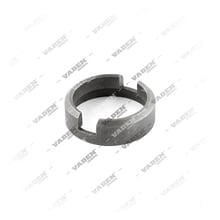
What are the functions of a Brake Caliper Mechanism Spring Case?
- Rotational support: Allows the mechanism shaft to rotate inside the caliper body with low friction and precision.
- Load carrying: Absorbs the axial and radial forces generated during brake application, preventing shaft deflection.
- Precision maintenance: Keeps shaft play to a minimum so the pad wear compensation mechanism works accurately and consistently.
- Heat and vibration resistance: Maintains performance under the brake system's high-temperature, constant-vibration conditions.
What are the symptoms of a failed Brake Caliper Mechanism Spring Case?
- Stiff or spongy brake pedal: Bearing wear disturbs the mechanism's precision, causing inconsistent pedal feel.
- Uneven pad wear: A mechanism that no longer operates smoothly can cause one side of the pad to wear faster than the other.
- Brake noise: As bearing play increases, a metallic squeal or knocking sound can be heard during brake application.
- Longer stopping distance: An inefficient mechanism can prevent pads from making full, even contact with the disc, lengthening stopping distance.
- Stiffness in the mechanism: Abnormal resistance felt when turning the adjustment mechanism by hand or with a service tool.
How is a Brake Caliper Mechanism Spring Case checked?
Inspection is carried out once the caliper is removed and the mechanism opened. The shaft is turned by hand on the bearing to check for stiffness, catching, or excessive play; a healthy bearing should let the shaft rotate smoothly and without resistance. The bearing surface is examined for pitting, wear marks, or discolouration (a sign of overheating). Radial clearance between shaft and bearing is compared against the manufacturer's specified tolerance; excessive clearance causes the pad wear compensation system to malfunction. While the caliper is bench-tested as a complete unit, whether the adjustment mechanism advances smoothly during brake application should also be observed.
What should be considered during replacement?
- Correct bearing type: A bearing with the material and dimensions specific to the caliper model must be used; a different type disturbs the mechanism's precision.
- Clean installation: The bearing bore must be cleared of dirt and old grease residue, and lubricated with the appropriate high-temperature grease before assembly.
- Correct seating: The bearing must seat fully into its bore without forcing or tilting; a suitable press tool should be used if needed.
- Mechanism calibration: After bearing replacement, the pad wear compensation mechanism should be reset or calibrated according to the manufacturer's procedure.
- Function test: After assembly, the caliper should be bench-tested as a complete unit to confirm the mechanism operates smoothly with no abnormal noise or resistance.
How should a Brake Caliper Mechanism Spring Case be selected?
Selection should be based on the caliper model, shaft diameter, and bearing type (bronze, sintered metal, needle roller). Confirming against the OEM part number guarantees the correct dimensional tolerance and load capacity.
Caliper mechanism bearing selection criteria| Criterion | Description |
|---|
| Bearing type | Bronze alloy, sintered metal, or needle roller |
| Dimensional tolerance | Matches shaft diameter and bore size exactly |
| Load capacity | Suited to the caliper's brake application force |
| Temperature resistance | No performance loss across the brake system's operating temperature range |
| Lubrication compatibility | Compatible with the grease type specified in the vehicle's current OE service manual |
Maintenance and service life
A caliper mechanism bearing lasts a long time on vehicles with regular brake maintenance and correct lubrication. Lack of lubrication, overheating, or moisture ingress leads to premature bearing wear. Opening the caliper during routine brake maintenance to check the mechanism, monitor the bearing's condition, and re-lubricate when needed preserves both brake performance and pad life.
VADEN Brake Caliper Mechanism Spring Case
VADEN manufactures OEM-matching mechanism bearings for heavy-duty commercial vehicle disc brake calipers, built to the correct material and dimensional tolerance, with the goal of preserving the vehicle's original brake precision and safety performance.
Frequently Asked Questions (FAQ)
Does a failed caliper mechanism bearing affect brake safety
Yes, if the mechanism's precision is disturbed, pads can wear unevenly and stopping distance can increase, which directly concerns safety.
Is mechanism calibration needed after replacing the bearing
In most calipers, yes; the pad wear compensation mechanism should be reset or calibrated according to the manufacturer's procedure.
How often should the caliper mechanism bearing be checked
Checking the mechanism and bearing is recommended during routine brake maintenance, especially whenever the caliper is opened for pad replacement.
Does brake noise always come from the pads
No, excessive play or wear in the mechanism bearing can also produce metallic noise during brake application, so the noise source should be correctly diagnosed.
What grease should be used when installing the bearing
A high-temperature grease recommended by the manufacturer, suited to the brake system's high-temperature conditions, must be used; general-purpose grease does not provide adequate protection.
Related technical guide: Brake Caliper Mechanism: Camshaft, Bearings, and Return Spring