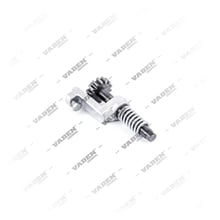
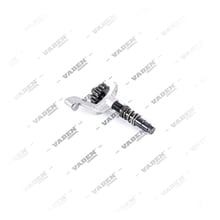
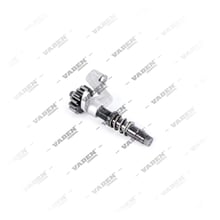
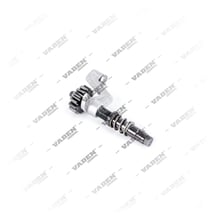
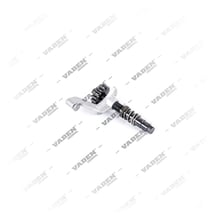
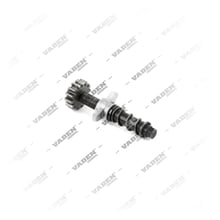
What Is a Brake Caliper Mechanism Sleeve?
The caliper actuation lever is the component inside a heavy commercial vehicle's disc brake caliper that transmits motion through the actuation mechanism. In pneumatic disc brake calipers, this is the lever that converts the linear push force coming from the brake chamber into a rotary motion applied to the adjuster spindle inside the caliper. In the field it is also known as the "caliper lever," "actuator lever," or "brake lever." The caliper actuation lever is mounted to the caliper housing on a shaft and bushing; when the brake pedal is pressed, it takes the motion delivered by the brake chamber push-rod and transfers it to the bridge mechanism, pressing the pads against the disc. Without this component, air pressure could never be converted into mechanical clamping force.
How Does a Brake Caliper Mechanism Sleeve Work?
When the brake pedal is pressed, the brake chamber push-rod moves forward and this motion is transferred to the caliper actuation lever. The lever converts the linear force it receives into rotation around its own shaft axis, and this rotation is passed on to the bridge or adjuster spindle inside the caliper. As the adjuster spindle rotates, it drives the pad-carrying pistons or the wedge mechanism, bringing the pads into contact with the disc and generating braking force.
When the pedal is released, return springs bring the lever and the connected mechanism back to their starting position and the pads move away from the disc. The caliper actuation lever is also mechanically linked to the automatic slack adjuster; on every brake cycle it compensates for pad wear so that pedal travel remains constant. Play or wear in the lever's shaft bearing introduces slack and delay throughout the entire actuation chain.
Brake Caliper Mechanism Sleeve Technical Specifications
The caliper actuation lever is typically manufactured from forged or cast steel and heat-treated for high fatigue strength, engineered to withstand repeated load-unload cycles and road vibration. The lever arm length and spline profile vary by caliper model and directly determine the force-multiplication ratio inside the caliper, which is why levers from different caliper families are not interchangeable.
- Shaft-Bushing Bearing: A needle bearing or bronze bushing allows the lever to rotate smoothly and with minimal friction.
- Sealing: A seal or bellows boot at the shaft end keeps out dust and moisture.
- Tolerances: For shaft-bushing clearance, lever angle, and spring preload, the caliper manufacturer's current service manual is the authoritative reference.
Types and Subgroups of Brake Caliper Mechanism Sleeves
- Manually Adjusted Actuator Lever: A simpler lever design used in older-generation calipers where pad clearance is adjusted by hand.
- Automatic Slack Adjuster Lever: The lever type standard in today's calipers, working together with an integrated or adjacent automatic slack adjuster mechanism.
- Shaft and Bushing Kit: The separately sold wear-item assembly that forms the rotational axis where the lever mounts to the caliper housing.
- Return Spring: The auxiliary component that pulls the lever back to its starting position when the brakes are released.
- Seal and Gasket Kit: The sealing parts that protect the lever shaft from dust, water, and road salt.
How to Choose the Right Brake Caliper Mechanism Sleeve?
The most critical criterion when selecting a caliper actuation lever is the caliper's make and model; levers that look identical can have different lever arm lengths or spline profiles and are not interchangeable. Confirming the caliper model from the vehicle's chassis number or the type label on the caliper itself prevents the wrong part from being installed. The table below summarizes the key criteria in the selection process.
Caliper Actuation Lever Selection Criteria| Criterion | Why It Matters |
|---|
| Caliper make and model | Lever arm length and spline profile are specific to each caliper family |
| Adjuster type (manual/automatic) | The lever must be mechanically compatible with the adjuster, otherwise pad clearance becomes uneven |
| Shaft-bushing clearance tolerance | Excessive play causes the lever to wobble and delays brake response |
| Seal and gasket fit | An incorrect seal size allows dust and moisture ingress and leads to premature corrosion |
| Material and heat-treatment quality | Low-grade steel carries a higher risk of early fatigue cracking under repeated loading |
Brake Caliper Mechanism Sleeve Maintenance and Points to Watch
- Periodic Visual Inspection: During brake service, visually check the lever shaft for play, corrosion, and seal damage.
- Lubrication: On bushing-type levers, lubricate with the grease specified by the manufacturer at the recommended intervals, and avoid over-greasing.
- Correct Tightening Torque: Tighten the lever mounting nuts to the manufacturer's specified torque; under- or over-tightening leads to premature wear.
- Adjuster Compatibility: When replacing the lever, also inspect the adjuster mechanism, since the two must operate in sync.
- Seal Integrity: Replace torn or hardened seals without delay.
Common Failures and Their Solutions
- Delayed Brake Response: Caused by increased shaft-bushing clearance or an adjuster fault; inspect the lever and adjuster assembly together and replace worn parts.
- Irregular Increase in Pad Clearance: Caused by the mechanical link between the adjuster and lever slipping; renew the lever-adjuster kit.
- Vibration or a Wobbling Feel in the Brakes: Caused by excessive play in the lever shaft or a broken return spring; replace the shaft-bushing kit and the spring.
- Squeaking or Stiffness in the Lever: Caused by insufficient lubrication or corrosion; clean and re-lubricate, and replace the lever if necessary.
- Grease Leaking from the Lever Shaft: Caused by a torn seal or gasket; replace the sealing kit.
Why VADEN ORIGINAL?
- Manufactured to OE Dimensions: Lever arm length and spline profile match the original assembly geometry precisely.
- Broad Caliper Compatibility: Offers compatible alternatives for the Knorr-Bremse and Wabco caliper families used on Mercedes-Benz, MAN, Scania, Volvo, DAF, Iveco, and Renault Trucks vehicles.
- Fatigue Resistance: Controlled material and heat-treatment processes preserve the lever's durability over a long service life.
- Global Reach: VADEN ORIGINAL products are exported to more than 100 countries, delivering a consistent quality standard.
Conclusion
The caliper actuation lever is one of the fundamental components that converts air pressure into mechanical clamping force inside a disc brake caliper, and braking safety depends directly on this part functioning correctly. Choosing the right caliper model match, performing regular maintenance, and replacing the part on time are essential for consistent brake response and safe driving. VADEN ORIGINAL caliper actuation levers deliver a reliable solution to this need, built to OE quality.
Frequently Asked Questions (FAQ)
What does a caliper actuation lever do?
The caliper actuation lever converts the linear push force coming from the brake chamber into a rotary motion applied to the adjuster spindle inside the caliper. This presses the pads against the disc, and when the pedal is released, the return spring pulls the pads back away from the disc.
What symptoms appear when a caliper actuation lever fails?
The most common symptoms are delayed brake response, uneven growth in pad clearance, a vibration or wobbling feel in the brakes, and squeaking from the lever. In these cases, check the shaft-bushing bearing, the return spring, and seal integrity.
Does a caliper actuation lever fit every caliper model?
No. Lever arm length and spline profile are specific to each caliper family, so levers from different caliper models are not interchangeable. Confirming the caliper's make and model is essential before selecting the correct part.
How is the caliper actuation lever related to the automatic slack adjuster?
The lever is mechanically linked to the automatic slack adjuster and compensates for pad wear on every brake cycle. If either the lever or the adjuster fails, constant pedal travel can no longer be maintained and brake response becomes inconsistent.
Which vehicles are VADEN ORIGINAL caliper actuation levers compatible with?
VADEN ORIGINAL levers offer compatible alternatives for the Knorr-Bremse and Wabco caliper families used on heavy-duty Mercedes-Benz, MAN, Scania, Volvo, DAF, Iveco, and Renault Trucks vehicles. Verifying the caliper model before ordering is recommended.
Related technical guide: Brake Caliper Mechanism: Camshaft, Bearings, and Return Spring