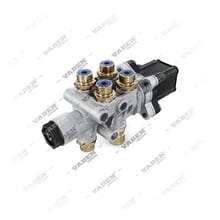
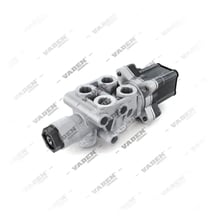
What Is an Axle Lift Valve?
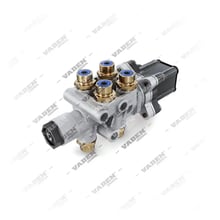
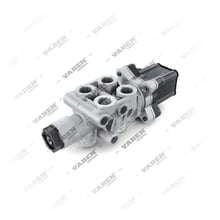
The Axle Lift Valve is the complete, ready-to-install unit of the pneumatic control valve that raises and lowers a carrier axle independently of load on multi-axle trucks, tractor units, and trailers. The products listed in this category are not individual seals or pistons, but complete assemblies supplied with the full valve body, ready for installation. In the field it is also known as the "lift axle valve," "axle lift switch," or "lift control valve." It connects to the bellows line to raise or lower the rear or mid axle pneumatically, depending on the vehicle's load condition, in order to reduce tire wear, fuel consumption, and toll costs. This category is built for workshops that want to replace a faulty or worn-out valve outright rather than repair it piece by piece.
How Does an Axle Lift Valve Work?
When the control switch inside the cab is pressed, the axle lift valve directs pressure from the air tank to the lift bellows; the bellows inflate and lift the axle off the ground. When the axle is lowered, the valve vents the air from the bellows to atmosphere and the carrier axle makes contact with the road again. Some complete units also include an electro-pneumatic solenoid group with automatic raise/lower logic based on vehicle speed or axle load. The pendulum or piston mechanism inside the valve body manages airflow in both directions while also preventing backflow within the system. The purpose of a complete unit replacement is to restore this entire mechanism to factory tolerances; piece-by-piece repair rarely lasts, since the precision surfaces inside the body wear out.
Axle Lift Valve Technical Specifications
Complete axle lift valve units vary by model in port count, operating pressure range, and body material. Valves are generally designed to run within a 6-10 bar range, and their bodies are made of corrosion-resistant zinc-plated steel or aluminum alloy. Connections are mostly 8 mm or 10 mm push-in quick-connect air fittings; some models use an M16x1.5 or M22x1.5 threaded inlet. There are three main control types: manual, cable/bowden-operated, and electro-pneumatic solenoid. When choosing the right unit, it is essential that port count, connection diameter, and control type match the original part exactly; for exact pressure and torque values, the vehicle's current service manual should be the reference.
- Body Material: Zinc-plated steel or aluminum alloy, giving resistance to corrosion.
- Connection Type: 8/10 mm quick-connect fitting or M16x1.5 / M22x1.5 threaded inlet.
- Control Input: Mechanical lever, bowden cable, or electro-pneumatic solenoid socket.
Axle Lift Valve Types and Subgroups
- Manually Controlled Valve: A simple type operated directly by a mechanical switch in the cab, with no electronic dependency.
- Automatic/Load-Dependent Valve: An electro-pneumatic unit that automatically raises and lowers the axle based on signals from axle-load or vehicle-speed sensors.
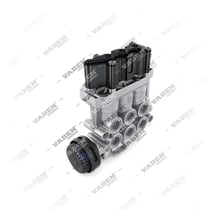
- Solenoid-Equipped Complete Valve: A valve block with an electromagnetic solenoid that converts an ECU command into pneumatic action; typically integrated with EBS systems.
- Trailer-Type Lift Valve: A complete unit that works independently of the tractor's valve, dedicated to the lift axle on the trailer.
- Time-Delay Valve: A special variant that lowers the axle with a set delay to prevent sudden load application.
How to Choose the Right Axle Lift Valve
The most critical step when buying a complete unit is verifying the OEM reference number of the existing valve and the port layout on the body. The table below summarizes the key selection criteria.
Axle Lift Valve Selection Criteria| Criterion | Check Point |
|---|
| Control Type | Compatibility with manual, cable, or electro-pneumatic/solenoid operation |
| Connection Port | Port count and fitting diameter (8 mm, 10 mm, M16x1.5, M22x1.5) |
| Operating Pressure | Pressure range compatible with the vehicle's air circuit |
| Mounting Position | Fixing hole and bracket dimensions on the chassis |
| OE Reference Match | Exact match with Wabco, Knorr-Bremse, or Haldex OEM number |
| Vehicle/Axle Configuration | Single or dual lift axle, tractor or trailer application |
A replacement made without meeting these criteria can cause air leaks, or leave the axle lifting only partially or not at all. When an OE-equivalent complete valve is chosen, the original installation geometry and airflow rate are preserved, so no extra adaptation is needed.
Axle Lift Valve Installation and Points to Consider
- Drain the Air Circuit Before Installation: Fully release tank pressure to prevent a sudden air blast during replacement.
- Check the Bracket and Fixing Points: Make sure the new valve's hole and bracket dimensions on the chassis match the original exactly.
- Tighten Fittings and Hose Connections Leak-Free: Loose or cross-threaded hoses are the most common cause of leaks after installation.
- Verify the Cable Socket on Electro-Pneumatic Models: On solenoid-equipped valves, compare the connector pin layout with the vehicle's wiring harness.
- Run a Function Test After Installation: Raise and lower the axle several times to confirm response time and full travel.
Common Faults and Solutions
- Axle Doesn't Lift at All: There may be a blockage in the valve body or a solenoid fault; inspect the complete valve and replace it if needed.
- Axle Lifts or Lowers Slowly: This can result from wear in the pendulum mechanism inside the valve or a partial blockage in the line; replacing the complete unit is usually the most lasting fix.
- Continuous Air Leak Sound: Internal sealing failure in the valve body; installing an OE-equivalent complete unit is recommended rather than a seal repair.
- Control Switch Not Responding: Wiring disconnection or solenoid coil failure; test the electrical circuit first, then the valve unit.
- Axle Lowers on Its Own While Driving: Weakening of the backflow control inside the valve; since this poses a safety risk, the valve must be replaced immediately.
Why VADEN ORIGINAL?
- Manufactured to OE Dimensions: Body geometry, port layout, and tolerance values match the original part exactly, needing no extra adaptation.
- Broad OEM Cross-Reference: Coding comparable to Wabco, Knorr-Bremse, and Haldex references makes it quick to find the correct unit.
- Strict Quality Control: Body sealing and solenoid durability go through detailed testing before series production.
- Long Service Life: Corrosion-resistant body material limits performance loss over frequent raise-lower cycles.
- International Reach: VADEN ORIGINAL products are exported to more than 100 countries and trusted across heavy commercial vehicle fleets.
Conclusion
When correctly selected and properly installed, the Axle Lift Valve directly affects tire life, fuel efficiency, and load-carrying flexibility. Replacing the complete unit offers a more reliable, longer-lasting solution than repairing a worn valve piece by piece. A replacement that respects OE-equivalent installation dimensions and the correct control type restores the vehicle to its original performance.
Frequently Asked Questions (FAQ)
What does an axle lift valve do?
The axle lift valve is the pneumatic control unit that raises and lowers a carrier axle with air, independently of load, on multi-axle heavy commercial vehicles. By lifting the axle during empty or lightly loaded runs, it reduces tire wear, fuel consumption, and, on some roads, toll costs.
When an axle lift valve fails, should it be repaired or replaced completely?
When the pendulum mechanism or solenoid inside the valve body wears out, replacing individual parts rarely delivers a lasting fix. That's why a complete unit replacement is preferred - it shortens labor time and restores sealing to factory-level performance.
What should I check when choosing a new axle lift valve?
Be sure to verify the control type (manual, cable, or electro-pneumatic), the number and diameter of connection ports, the operating pressure range, and the OEM reference number. The bracket and mounting dimensions on the chassis must also match the original.
Which vehicles are VADEN ORIGINAL axle lift valves compatible with?
VADEN ORIGINAL products are manufactured for OE-equivalent compatibility with heavy trucks, tractor units, and trailers built on Wabco, Knorr-Bremse, and Haldex reference systems. For exact compatibility, it's best to verify using the vehicle's chassis number and the reference code of the existing valve.
What should I do if the axle lowers on its own while driving?
This points to a failure in the valve's backflow control and can create a safety risk by disrupting load distribution. Before continuing to operate the vehicle, have the valve unit inspected at an authorized service center and replaced completely if necessary.
Related technical guide: Lift Axle Valve: Faults, Replacement and Maintenance Guide